
Boland Law Group, PLLCPassionately Preserving Wealth™
Estate planning, Scottsdale, Arizona
Scottsdale estate planning attorneys for substantial estates.
Personalized service. Customized estate planning.
Boland Law Group designs and drafts complete estate plans for families whose net worth, business interests or family structure make a template dangerous: trusts, wealth transfer tax strategy, charitable planning and the directives that protect you while you are living. Two generations of LL.M. attorneys, one trained in taxation and one in estate planning, design and draft every plan, and both are admitted to defend it in the U.S. Tax Court.
Our clients come to us from Scottsdale, Paradise Valley, North Scottsdale and Phoenix: Gainey Ranch and McCormick Ranch, DC Ranch, Silverleaf, Troon and Desert Mountain, the Camelback and Mummy Mountain estates, Arcadia and the Biltmore. The office is in the Scottsdale Airpark, and each community we serve most has its own page: estate planning in Scottsdale, North Scottsdale, Paradise Valley and Carefree, with the rest listed on our locations page.
Four Arizona facts that shape every plan we draw
Arizona's property law, its probate limits and the absence of a state death tax change the design of a Scottsdale plan before the first document is drafted.
-

Community property
Arizona is a community property state. At the first death, both halves of community property receive a step-up in income tax basis under Internal Revenue Code section 1014(b)(6), not only the half that belonged to the spouse who died. Retirement accounts and annuities are the exception: they receive no step-up. That changes how marital shares are drawn and which assets a plan holds where. Templates from common law states miss this.
-

No state death tax
Arizona levies no estate, inheritance or gift tax of its own, so planning turns on the federal exemption, income tax basis and family design. In 2026 the federal exemption is $15 million per person, and up to $30 million for a married couple when the first spouse's unused amount is preserved by a portability election or a credit shelter trust. Transfers above the exemption are taxed at 40 percent.
-

Probate and the small estate limits
A will does not avoid probate in Arizona; it only directs the court. Under A.R.S. 14-3971, as amended by HB 2116 effective September 26, 2025, small estate affidavits reach $200,000 of personal property and $300,000 of real property, each net of liens. Above those limits, a funded trust is what keeps the estate out of court.
-

Beneficiary deeds and titling
Arizona recognizes the beneficiary deed, its form of transfer-on-death deed for real property, under A.R.S. 33-405, and retirement accounts and insurance pass by designation. Useful in the right place, no substitute for a funded trust in the wrong one. Most plans we repair failed in the titling, not the drafting.
Arizona and federal estate planning figures for 2026
| Figure | 2026 amount or rule | Source |
|---|---|---|
| Federal estate, gift and GST exemption | $15,000,000 per person | Internal Revenue Code section 2010, as amended in 2025; indexed for inflation beginning in 2027. IRS: estate and gift tax |
| Married couple | Up to $30,000,000 | Requires a timely portability election on Form 706 or a credit shelter trust. The GST exemption is not portable. |
| Top federal transfer tax rate | 40 percent | Internal Revenue Code section 2001 |
| Annual gift exclusion | $19,000 per recipient | Internal Revenue Code section 2503(b). Electing to split gifts requires Form 709. A community property gift is treated as made half by each spouse, so no election is needed. |
| Annual exclusion, spouse who is not a U.S. citizen | $194,000 | Internal Revenue Code section 2523(i) |
| Arizona estate, inheritance and gift tax | None | Arizona imposes no state transfer tax. |
| Small estate affidavit, personal property | $200,000, net of liens | Available 30 days after death. A.R.S. 14-3971, as amended by HB 2116, effective September 26, 2025 |
| Small estate affidavit, Arizona real property | $300,000, net of liens | Available six months after death, filed with the Superior Court, valued at the assessor's full cash value. A.R.S. 14-3971 |
| Creditor claim period in probate | Four months | From first publication of notice, or 60 days after mailed notice to a known creditor if later. A.R.S. 14-3801 |
| Beneficiary deed | Recorded before death | Void if no named beneficiary survives and no successor is named. A.R.S. 33-405 |
| Statutory perpetuities period | 500 years | A.R.S. 14-2901; questioned under the Arizona Constitution in Attorney General Opinion I18-006 |
| Inherited IRA or 401(k), most non-spouse beneficiaries | 10-year payout | SECURE Act; annual withdrawals in years one through nine when the owner died on or after the required beginning date |
Reviewed by Grant M. Boland, J.D., LL.M. Last reviewed . Figures are for calendar year 2026.
The four hallmarks of a complete plan
A hallmark is struck into precious metal to certify its standard. These four are ours, and every plan carries all four.
-

Wills & Trusts
Clear, enforceable instruments that keep families out of probate court and maintain privacy.
- Revocable living trusts and pour-over wills
- Irrevocable trusts (SLATs, dynasty, third-party asset protection)
- Special-needs and supplemental-needs trusts
- Written funding instructions, one Arizona deed and successor-trustee counseling
-

Advance Healthcare Directives
Ensure trusted decision-makers can act if you become incapacitated.
- Durable healthcare powers of attorney
- Living wills and end-of-life directives
- HIPAA authorizations and mental healthcare powers of attorney
- Coordination with physicians and care facilities
-

Wealth-Transfer Tax Planning
Sophisticated strategies designed to reduce estate, gift and generation-skipping transfer (GST) taxes.
- Grantor Retained Annuity Trusts (GRATs)
- Intentionally Defective Grantor Trusts (IDGTs)
- Family limited partnerships and LLCs built for management, succession and creditor protection, with valuation by qualified appraisal
- Intra-family loans, sales, and lifetime-gifting programs
-

Charitable Planning
Align philanthropy with tax efficiency.
- Donor-advised funds (DAFs)
- Charitable remainder and lead trusts (CRTs / CLTs)
- Private foundations and supporting organizations
- Qualified charitable distributions from IRAs
Trusts we design
A trust is not a form; it is an instrument tuned to one family's assets, tax position and history. These are the five we draft most often for Scottsdale families, in-house, by the same LL.M. counsel who will defend the design if the IRS disagrees.
-

Revocable living trusts
A revocable living trust is a trust you create and control during life, which holds your assets so they pass at incapacity or death without a court. It is the chassis of nearly every Arizona plan. You remain trustee and can amend or revoke it while you have capacity; at incapacity or death your successor trustee steps in without a court. A funded revocable trust keeps a Scottsdale estate out of probate, preserves privacy and, for a married couple, carries the community property basis step-up at the first death. Funding is where most trusts fail, so every core plan includes the deed for one Arizona property, an assignment of personal property and written funding instructions, and a full funding service is available when you want us to carry out the retitling and beneficiary designations for you.
Revocable trusts in detailFurther reading: revocable trusts, the 2025 law and the Arizona basis step-up.
-

Irrevocable trusts
An irrevocable trust is a trust the settlor cannot revoke or freely amend, used to move assets outside the taxable estate and out of reach of a beneficiary's creditors or divorce. You give up direct control by design, and the instrument earns that sacrifice through grantor trust status, independent trustee provisions, decanting authority and a trust protector who can adapt it to later law. One Arizona limit matters: the state has no self-settled asset protection trust, so under A.R.S. 14-10505 a trust you fund for your own benefit stays within reach of your own creditors. Protection comes from trusts funded for others, from entities, or from another jurisdiction where that is warranted. We draft gifting, generation-skipping and asset protection structures for Scottsdale and Paradise Valley estates at or above the exemption line.
Irrevocable trusts in detailFurther reading: BDITs, BDOTs and beneficiary-controlled design.
-

Spousal lifetime access trusts (SLATs)
A spousal lifetime access trust (SLAT) is an irrevocable trust that one spouse funds by gift for the benefit of the other spouse and, usually, their descendants. It lets the donor spouse use up to $15 million of lifetime exemption now while the other spouse remains a discretionary beneficiary, so the family keeps indirect access. Drawn correctly, the gift and all later growth sit outside both estates. The design turns on Arizona community property (the gift has to come from the donor's separate property, so community assets are partitioned first), the reciprocal trust doctrine, divorce and death contingencies, and basis planning, because SLAT assets receive no step-up at death. For Scottsdale couples between roughly $20 million and $60 million it is often the first advanced move we recommend.
SLATs in detailFurther reading: SLATs, estate tax and the step-up in basis.
-

Dynasty trusts
A dynasty trust is an irrevocable, generation-skipping trust designed to hold wealth outside the taxable estates of your children, grandchildren and their descendants for as long as the law allows. Arizona's perpetuities statute, A.R.S. 14-2901, permits up to 500 years. A 2018 Arizona Attorney General opinion questioned whether that period is consistent with the perpetuities clause of the Arizona Constitution, and the question remains open, so we draft with a perpetuities savings clause and the flexibility to change situs and governing law. Generation-skipping transfer tax exemption is allocated when the trust is funded, and a fully exempt trust stays exempt as it grows, so the assets are designed to pass free of estate tax at each generation. Discretionary, spendthrift design protects beneficiaries from most creditors and from divorce, subject to the narrow exceptions in A.R.S. 14-10503, such as child support. We pair the instrument with family governance and a trust protector so it outlasts the people who made it.
Dynasty trusts in detailFurther reading: dynasty trusts and generational wealth after the 2025 changes.
-

Irrevocable life insurance trusts (ILITs)
An irrevocable life insurance trust (ILIT) is an irrevocable trust that owns a life insurance policy so the death benefit is not part of the insured's gross estate. If you own the policy, the proceeds are counted in your estate under Internal Revenue Code section 2042; in Arizona, when the policy is community property, half is counted in the insured spouse's estate and the other half belongs to the surviving spouse. For a family already near the exemption, a large policy is often what carries the estate over the line. An ILIT owns the policy instead, keeping the proceeds outside both estates and protecting the benefit from a beneficiary's creditors and divorce. The trustee can lend to the estate or buy assets from it, which supplies cash for estate tax without pulling the proceeds back in. Premium gifts come from the insured spouse's separate property when the other spouse is a beneficiary. We draft the Crummey withdrawal powers, advise the trustee, plan around the three-year rule for existing policies transferred after issue, and offer annual Crummey administration as a continuing service.
ILITs in detailFurther reading: children’s trusts, income tax basis and advanced structures.
Estate planning for high net worth families
Above the federal exemption, estate planning stops being about documents and becomes a tax and family design problem. In 2026 the line sits at $15 million per person and up to $30 million per married couple, indexed for inflation beginning in 2027, and the taxable estate above it is taxed at 40 percent. For a family with a closely held business, appreciated real estate in Scottsdale or Paradise Valley, concentrated stock and life insurance, that line arrives sooner than the balance sheet suggests. The gross estate counts the full death benefit of insurance you own rather than its cash value, and it values the business at appraised fair market value rather than book value, with the tax due in cash nine months after death.
The work at this level combines the instruments above: a revocable trust as the chassis, a SLAT or dynasty trust to use the exemption while it is available, an ILIT to move the insurance out, and a family LLC, GRAT or installment sale to a grantor trust to shift future growth at little or no gift tax cost. Portability and generation-skipping exemption are captured deliberately: a surviving spouse keeps the first spouse's unused exemption only if a timely estate tax return elects portability, and the GST exemption cannot be ported at all. Every piece is drafted in-house, coordinated with your CPA and investment advisor, and built by attorneys who have defended these structures in the U.S. Tax Court.
Estate planning for high net worth familiesIf a sale is coming, read planning a business exit or liquidity event and QSBS trust stacking under Treasury scrutiny.

Eight situations, planned differently
The instruments are the same; the sequence is not. Each of these has its own page, written for the way that life is actually structured. See everyone we serve.
- Multi-generational familiesWealth meant to outlast the people who made it, held in trust across three generations.
- Business ownersThe company and the estate drawn as one file: entity, buy-sell, valuation, succession.
- Business exits and liquidity eventsPlanned in quarters, not weeks. The structure has to exist before the letter of intent.
- Senior executivesConcentrated stock, deferred compensation and equity that vests on somebody else’s calendar.
- Planning in retirementIncapacity, the order accounts are drawn down, and the plan your family will actually run.
- Family officesCounsel that fits alongside the CIO, the CPA and the governance already in place.
- Athletes and public figuresShort earning windows, long plans, and privacy built into the structure from the start.
- Outside general counselA standing seat for companies that need judgment more often than they need a filing.
Scottsdale, North Scottsdale and Paradise Valley
Three communities, three kinds of estate, one office that serves all of them by appointment. We also plan for Carefree, Cave Creek and the rest of the valley from the same desk; the full list is on our locations page.
-
Scottsdale
The office is in the Scottsdale Airpark, beside the Scottsdale Airport runway, minutes from Gainey Ranch, McCormick Ranch and Old Town. Plans here are drawn around Arizona community property and the homes, businesses and retirement accounts most of the estate sits in.
Estate planning attorneys in Scottsdale -
North Scottsdale
DC Ranch, Silverleaf, Troon and Desert Mountain hold some of the largest estates in Arizona, often with a primary home in another state. We plan for the Arizona property, the domicile question, the home state's own estate or inheritance tax where one applies, and the family that gathers here in winter.
Estate planning attorneys in North Scottsdale -
Paradise Valley
Paradise Valley estates tend to be large, illiquid and personal: a home on Camelback or Mummy Mountain, a family business, art and collections. The plan has to provide liquidity for tax, keep the residence in the family if that is the intent, and treat heirs fairly.
Estate planning attorneys in Paradise Valley
How a plan comes to be

- 01
A conversation
Call the office. We listen first: the family, the holdings, the intent.
- 02
The invitation
If we are the right counsel, the consultation is scheduled and priced in writing, and our planning questionnaire follows by private invitation.
- 03
The design
Your attorneys draft a plan built for one family: yours.
- 04
The review
Drafts in hand, we walk the plan together, line by line, until it says exactly what you intend.
- 05
The execution meeting
Signatures witnessed and notarized, your Arizona deed recorded, written funding instructions in hand, and your advisors aligned around one strategy.
Two partners. No hand-offs.
Every plan is designed, drafted and reviewed with you by the two partners named below, from the first meeting to the execution of documents. Both hold an LL.M. and both are admitted to the U.S. Tax Court. Our staff supports scheduling, intake, notarization and recording under attorney supervision and the same duty of confidentiality; they do not draft. Meet the people who will actually draft it.
Robert W. Boland, Jr., J.D., LL.M.
Founding and Managing Partner, Tax
Founder of BLG. Federal tax litigation in the U.S. Tax Court, with particular emphasis on TEFRA and CPAR family limited partnership matters, business and succession planning, and estate planning for high net worth families across the greater Scottsdale area. Licensed since 1974. LL.M. in Taxation, University of Missouri-Kansas City.
- Who’s Who in American Law
- Martindale-Hubbell AV Preeminent
- U.S. Tax Court
Grant M. Boland, J.D., LL.M.
Tax and Estate Planning Partner
Design, implementation and defense of strategies for transferring family businesses and legacy properties to succeeding generations or to charity, with the business plan and the personal estate plan drawn as one. LL.M. in Estate Planning and Elder Law, Western New England University.
- Lawyer of the Year, Trusts and Estates, Scottsdale, 2027
- Best Lawyers in America, 2024 to 2027
- U.S. Tax Court
Trusted by families and individuals to protect their legacy
Families and individuals trust BLG to safeguard their legacy, ensuring their wealth, values and vision are preserved and carried forward with integrity.
BLG is a father and son practice: two generations of Boland attorneys advising multi-generational families on wealth that is meant to outlast them both. Our story explains how the firm came to be built that way.
Our attorneys are respected leaders, actively involved in local bar associations, charitable organizations and community initiatives. The quiet credentials page lists the full record, and about the firm covers the rest.
Professional memberships and volunteer service. Marks belong to their organizations and do not imply endorsement of the firm.


A cross-disciplinary bench
Estate planning here draws on four disciplines under one roof: tax planning, tax controversy, business law and partnership law. The attorney who designs a structure has also defended structures like it before the IRS and in the U.S. Tax Court, and that changes how it is drawn.
-
Fixed fee engagements
Most estate planning is done on a published fixed fee, set in writing before work begins. Open-ended, contested or high-volume matters are billed hourly against a retainer. Both schedules are published on the rates page.
-
Tax savings
Advanced wealth transfer strategies designed to reduce estate, gift and generation-skipping tax, so more of the legacy reaches the next generation.
-
Sophisticated expertise, simplified
We are equally comfortable with a deep technical dive or a clear, simplified plan. Every service the firm offers is listed in one place.
Ten differences, and the question behind each
Choosing counsel for a substantial estate is a diligence exercise. Each difference below comes with the question we would put to any estate planning attorney, ourselves included.
-
01
Advanced expertise and credentials
BLG
Every attorney holds an LL.M., an advanced law degree earned after the Juris Doctor, some in taxation and some in estate planning. That training is what allows a plan to be aligned with your personal, financial and business goals at the same time.
Ask any firm
What advanced training in tax or estate planning does the attorney who will draft my plan hold, and how much of the practice is devoted to it?
-
02
Fully customized solutions
BLG
We do not hand a family a generic form or an outdated template. Every document is drafted for your family’s circumstances, so the objectives you actually have are the ones the instrument carries out.
Ask any firm
Which provisions of my documents will be written for my family, and which arrive unchanged from a form?
-
03
Consistently updated intellectual property
BLG
Our drafting reflects current strategy, incorporating the latest tax law developments and court rulings, and is reviewed and refined continually. See the insights archive for the changes we are tracking now.
Ask any firm
When were your trust provisions last revised for a change in tax law, and what changed?
-
04
Direct attorney involvement
BLG
From the initial meeting through the execution of documents, the design, the drafting and the advice are handled personally by the attorneys who will sign the work. Staff support the logistics; they do not draft.
Ask any firm
Who drafts the documents, and will I meet that person before I sign?
-
05
Premium, proactive service
BLG
We intentionally limit client volume to make room for personal attention, in-depth discussion and proactive follow-up, and we invest substantial attorney time in each plan.
Ask any firm
How many plans does each attorney complete in a month, and how much attorney time is budgeted for mine?
-
06
Integrated business and financial insight
BLG
With attorneys who hold business degrees and business backgrounds, succession and asset management are built into the estate plan itself, which matters most at a liquidity event.
Ask any firm
Who on the team has owned, run or advised a business, and how will my company’s succession be written into the estate plan?
-
07
Comprehensive, long-term relationship
BLG
The goal is not document creation but ongoing management and adaptation, including amendment and decanting as your life, your family and the law evolve.
Ask any firm
After signing, who reviews the plan when the law or my family changes, and what does that cost?
-
08
Confidentiality and trust
BLG
Discretion, personal attention and confidentiality at every stage. Advice and drafting stay with the attorneys on your matter, and everyone in the office who supports it works under attorney supervision and the same duty of confidentiality.
Ask any firm
Who inside and outside the firm will see my financial information, and is any drafting sent to an outside document service?
-
09
Advanced protection from divorce, lawsuits and creditors
BLG
Our plans use structures designed specifically to protect inherited wealth from divorce settlements, judgments and creditor claims, which is most of the reason a trust is irrevocable at all.
Ask any firm
How will my children’s inheritances be protected from their creditors and from a divorce, and where does Arizona law limit that protection?
-
10
Preservation of wealth without governing from the grave
BLG
Plans are structured to protect assets without over-restricting the people who inherit them, so heirs keep their autonomy and the wealth stays insulated from outside risk.
Ask any firm
How do you balance protecting an inheritance with leaving my heirs real control over it?
What clients say
Mr. Boland protected our family’s wealth and gave us peace of mind for generations to come.
Working with BLG transformed our family’s approach to wealth preservation and estate planning. Their attorneys took the time to understand our unique goals and concerns, crafting a personalized plan that safeguarded our assets for future generations. We feel confident knowing our children and grandchildren are protected from unnecessary taxes, creditors, and legal disputes. BLG’s thoughtful guidance gave our family lasting peace of mind and clarity, ensuring our legacy will continue exactly as we intended.
They were the missing piece of the puzzle.
Our financial advisors and tax accountants were outstanding, but partnering with BLG was truly the missing piece of the puzzle. Their collaboration with our existing advisory team provided the clarity and integration we had been seeking. Now, all our advisors are aligned, working seamlessly together, and the comprehensive strategy BLG developed perfectly complements our financial and tax planning. BLG’s involvement brought cohesion and confidence to our overall wealth management and estate planning goals.
Client statements reflect the experience of those individuals and are not a promise or guarantee about the outcome of any other matter.
Scottsdale estate planning questions we hear first
Twenty-two answers on Arizona law, the 2026 federal numbers and what the work costs here. If yours is not below, the office will answer it on the phone.
Does Arizona have an estate tax?
No. Arizona levies no estate tax, no inheritance tax and no gift tax, and it has none scheduled. For an Arizona resident, planning turns on the federal system: in 2026 the estate, gift and generation-skipping transfer exemption is $15 million per person, and up to $30 million for a married couple, with transfers above it taxed at 40 percent. If you are domiciled in another state and only winter here, your home state's estate or inheritance tax may still apply. Families near the line plan differently from families well below it.
What does an estate plan cost in Scottsdale?
Our fees are published, not quoted from a meter. A complete core plan for an estate under $5 million starts at a fixed $5,000 for one client and $5,500 for a married couple, and at $6,000 and $6,500 for estates of $5 million to $15 million. One Arizona deed is included; each additional deed is $350. Third-party costs such as recording and notary fees are passed through at cost. The initial consultation is billed at the published hourly rate, currently $460 with a one-hour minimum, and is credited toward a fixed fee when you engage within thirty days. The rates page carries the full schedule, and our 2026 Arizona fee guide explains what drives the number.
Do you bill hourly or by fixed fee?
Most estate planning is done on a published fixed fee, set in writing before work begins. Open-ended, contested or high-volume matters are billed hourly against a retainer, and the 2026 attorney rates run from $460 to $1,050 an hour depending on the attorney and the matter, with paralegal and administrative time from $75. Every rate is published in advance, and no engagement is formed until a written engagement letter is executed.
Do I need a trust or a will in Arizona?
Both. For most Scottsdale families with a home and retirement accounts, the answer is a funded revocable living trust with a pour-over will behind it. In Arizona a will does not avoid probate; it only tells the court how to distribute. A funded trust keeps the estate private, out of court and available to your successor trustee the week it is needed rather than months later.
What is the difference between a revocable and an irrevocable trust?
Control and tax treatment. A revocable trust can be amended or revoked while you have capacity, you remain trustee, and the assets stay inside your taxable estate, which is what preserves the basis step-up at death. An irrevocable trust gives up that control. When it is funded for others and drawn correctly, the assets leave your estate and sit beyond the reach of a beneficiary's creditors and a beneficiary's divorce. Arizona does not shield a trust you settle for your own benefit from your own creditors (A.R.S. 14-10505). Most plans of any size use both.
Can my family avoid probate in Arizona without a trust?
Sometimes, but rarely for everything. Beneficiary deeds, payable-on-death and transfer-on-death designations, and survivorship titling pass the assets they cover without probate at any size. For whatever is left, A.R.S. 14-3971, as amended by HB 2116 effective September 26, 2025, lets a successor collect up to $200,000 of personal property by affidavit thirty days after death, and up to $300,000 of Arizona real property by an affidavit filed with the Superior Court six months after death, each net of liens, with real property measured by the county assessor's full cash value. Each of those tools covers one asset and none of them plans for incapacity, so above those limits, or with a business or several properties, a funded trust is the answer.
How long does probate take in Maricopa County?
An uncontested informal probate in Maricopa County Superior Court usually runs six to twelve months. The personal representative must publish notice to creditors, and under A.R.S. 14-3801 claims are barred four months after the first publication, or sixty days after a known creditor is mailed notice if that is later, so the estate cannot close sooner even when the family agrees on everything. A contested matter, an unclear will or Arizona real estate owned by an out-of-state decedent all extend it.
Is a beneficiary deed enough for my Scottsdale house?
It helps, and it is not a plan. An Arizona beneficiary deed under A.R.S. 33-405 passes the house at death without probate, but only if it is recorded before death. If the named beneficiary dies first and the deed names no successor, the deed is void, the antilapse statute does not rescue it, and the house goes through probate. It does nothing for incapacity, for a minor, or for a beneficiary in the middle of a divorce or a lawsuit. We use one where a property has to stay in your own name, naming your trust as the beneficiary, rather than as a substitute for a trust.
What does community property change for a Scottsdale couple?
At the first death, both halves of community property receive a step-up in income tax basis under Internal Revenue Code section 1014(b)(6), not just the deceased spouse's half. For a couple holding long-held stock or a home bought decades ago, that single feature is often worth more than every other provision in the plan. It does not apply to IRAs, 401(k)s or annuities, and it can be put at risk when community property is retitled as joint tenancy or as separate property. It also changes how marital and family shares are drawn and which trust holds what. Out-of-state templates routinely get it wrong.
What is the federal estate tax exemption in 2026?
$15 million per person in 2026, and up to $30 million for a married couple, with the rate above it at 40 percent. The couple's figure is not automatic: the survivor keeps the first spouse's unused exemption only if a timely estate tax return elects portability or the plan captures it in a credit shelter trust, and the generation-skipping exemption cannot be ported at all. The 2025 act made the amount permanent and indexes it for inflation beginning in 2027, but permanence in tax law means only that no expiry is written down today. Estates that grow at 6 percent double in twelve years, which is why families well under the line still plan as if they will cross it.
How much can we give away in 2026 without a gift tax return?
$19,000 per recipient from each giver in 2026, to as many people as you like. An Arizona couple giving community property can give $38,000 to one person with no return, because each spouse is treated as giving half. If the gift comes from one spouse's separate property, treating it as split between you requires a Form 709 even though no tax is due. Tuition and medical bills paid directly to the school or provider are unlimited and do not count. Gifts in trust often need a return at any amount, because a gift of a future interest does not qualify for the annual exclusion unless the beneficiary holds a present withdrawal right. Larger gifts require a Form 709 and reduce the $15 million lifetime exemption, but no tax is due until that exemption is exhausted.
Is my life insurance part of my estate?
Usually, yes. If you own a policy on your own life, the death benefit, not the cash value, is counted in your gross estate under Internal Revenue Code section 2042. In Arizona, when the policy is community property, half is counted in the insured spouse's estate and the other half belongs to the surviving spouse, where it is counted later. Either way the household total includes all of it: a couple who believe they are worth $24 million and own an $8 million policy have a $32 million estate, above the $30 million a married couple can shelter in 2026. An irrevocable life insurance trust owns the policy instead, which keeps the proceeds outside both estates. Its trustee can lend to the estate or buy assets from it, which provides cash for estate tax without bringing the proceeds back in.
What is a SLAT, and when does it make sense for a Scottsdale couple?
A spousal lifetime access trust is an irrevocable trust one spouse funds by gift for the other spouse and, usually, the children. It lets the donor spouse use up to $15 million of lifetime exemption now, moving the gift and all later growth outside both estates while the other spouse remains a discretionary beneficiary, so the family keeps indirect access. It is the instrument we use most for couples between $20 million and $60 million. The design turns on Arizona community property (the gift has to come from the donor's separate property), the reciprocal trust doctrine when both spouses create trusts, and what happens on divorce or an early death.
How long can an Arizona trust last?
Up to five hundred years under the statute. A.R.S. 14-2901 validates an interest that vests or terminates within 500 years of its creation, far longer than the common law's lives in being plus twenty-one years, and it separately validates interests in certain trusts whose trustee has the power to sell trust assets. A 2018 Arizona Attorney General opinion concluded that both provisions are likely inconsistent with the perpetuities clause in Article 2, Section 29 of the Arizona Constitution. That opinion is advisory and the question remains open, so we draft dynasty trusts with a perpetuities savings clause and the flexibility to change situs and governing law. Generation-skipping transfer tax exemption is allocated when the trust is funded, and a fully exempt trust stays exempt as it grows.
We winter in Scottsdale but live in another state. Do we need an Arizona plan?
You need a plan that addresses the Arizona property. Your domicile governs most of the estate, but Arizona real estate held in your own name faces a second, ancillary probate here, in a court your family does not live near. Deeding the Scottsdale or Paradise Valley home into your revocable trust avoids that proceeding; where title has to stay in your own name, a recorded beneficiary deed naming the trust does the same job for that one property. Arizona adds no estate or inheritance tax, but your home state may impose its own, so we coordinate with your home-state counsel.
Who should be trustee of my Arizona trust?
You, while you can. The harder question is who follows. A child who lives here is convenient and can be exactly the wrong choice in a family where the siblings disagree; a corporate trustee is neutral, permanent and charges for it. For an irrevocable trust, an independent trustee is often required for the tax result to hold. We design the succession and the removal power together, not separately.
What happens to my IRA and 401(k) when I die?
They pass by beneficiary designation, outside the will and, unless the trust is the named beneficiary, outside the trust, which is why a stale designation quietly overrides a beautifully drafted plan. Under the SECURE Act most adult children must empty an inherited account within ten years, and annual withdrawals are required in years one through nine when the owner died on or after their required beginning date. Inherited retirement accounts receive no step-up in basis. The tax consequence of the order in which accounts are drained is part of the design.
I own a business in Scottsdale. What changes?
Everything above the balance sheet. For estate tax, a closely held company is valued at fair market value, the price a willing buyer and a willing seller would agree on, as established by a qualified appraisal, not at book value and not at the owner's own number. It is usually illiquid at exactly the moment the tax is due, nine months after death. We plan the entity, the buy-sell, the appraisal and the estate as one file. Start with estate planning for business owners and, if a sale is near, business exits and liquidity events.
When should a Scottsdale family update an existing trust?
When the law moves or the family does. A marriage, a divorce, a sale, a move across state lines, a death or new grandchildren all change the right answer, and the 2025 act reset the exemption underneath every plan drawn before it. A revocable trust is updated by amendment for minor changes and by restatement for anything structural. An irrevocable trust can often still be changed, by decanting, a nonjudicial settlement agreement or court modification. Arizona authorizes decanting in A.R.S. 14-10819 and nonjudicial settlement agreements in A.R.S. 14-10111, so long as no material purpose of the trust is violated.
Who will draft my plan?
A partner holding an LL.M. From the first meeting through the execution of documents, the attorney who designed the structure drafts it, and both partners are admitted to the United States Tax Court, so the person who drew the design is the person who would defend it. No document service, no paralegal drafting and no hand-off to an associate you have never met. Our staff handles scheduling, intake, notarization and recording under attorney supervision. Meet them here.
Will you work with our existing advisors?
Yes, by design. Most of the families we serve already have a CPA, a wealth advisor and an insurance agent, and the plan only works when all of them are pointed at the same structure. If you are the advisor rather than the client, our page for financial advisors sets out how the referral works and what the client gets back. A family office gets the same treatment.
Where is your Scottsdale office, and which communities do you serve?
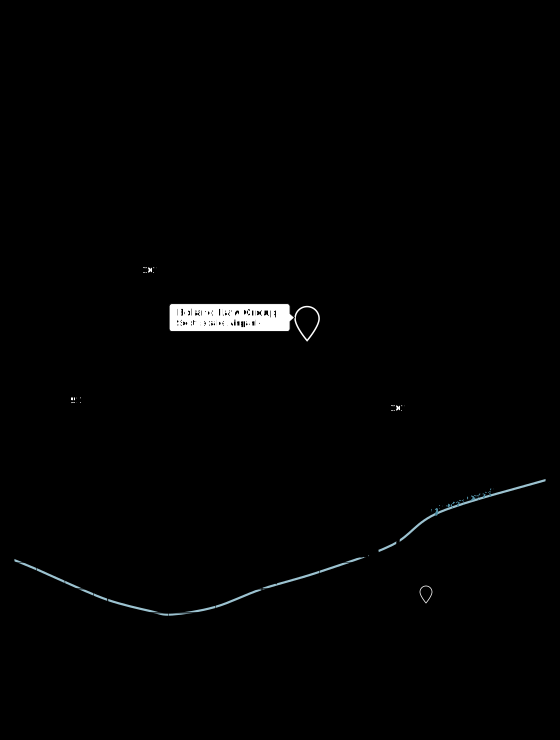
The office is at 15100 N. 78th Way, Suite 203, in the Scottsdale Airpark, open Monday through Thursday, 9am to 5pm, with Saturdays by appointment; work requested outside regular business hours is subject to the after-hours terms on our rates page. We serve Scottsdale, North Scottsdale, Paradise Valley, Carefree, Cave Creek and Phoenix from it, and travel for in-home appointments across the East Valley, Prescott and Sedona.
From the insights archive
Written by the attorneys, updated as the law moves. The full archive is at insights.
- Estate planning costs in Arizona, 2026What Phoenix and Scottsdale attorney fees actually buy, itemized.
- The exemption after the 2025 actWhat the $15 million exemption means for a plan drawn earlier, and why planning still matters.
- Revocable trusts and the Arizona step-upProbate avoidance, estate tax and community property basis, worked through.
- QSBS trust stacking under scrutinyWhere Treasury is looking, and how a stacking plan should be documented in 2026.
- Section 1202 after the OBBBAThe 2025 and 2026 planning differences for founders holding qualified small business stock.
- Beneficial ownership reporting toolkitWhat entity owners were asked to file, and where the reporting obligation stands.
Passionately Preserving Wealth™
Get a personal consultationCall the office to begin. The first call is unhurried, our fees are published before you make it, the consultation is scheduled and priced in writing, and our planning questionnaire follows by private invitation once it is on the calendar.
Office
Boland Law Group, PLLC
15100 N. 78th Way, Suite 203
Scottsdale, Arizona 85260
Open hours
Monday through Thursday, 9am to 5pm
Saturday by appointment
Office visits by appointment only
The rest of the practice
This page is provided for general information and does not constitute legal or tax advice, nor does it create an attorney-client relationship. Descriptions of our practice areas are general in nature, and prior results do not guarantee a similar outcome. Client statements reflect the experience of those individuals and are not a promise or guarantee about the outcome of any other matter. Tax figures are federal amounts for 2026; the exemption is indexed for inflation beginning in 2027. Professional recognitions are conferred by the organizations named, are listed with the year where one applies, and are not a promise or guarantee about the outcome of any matter. No engagement is formed unless and until a written engagement letter is executed and any required fees are paid and cleared.