The short answer
What does estate planning cost in Arizona in 2026?
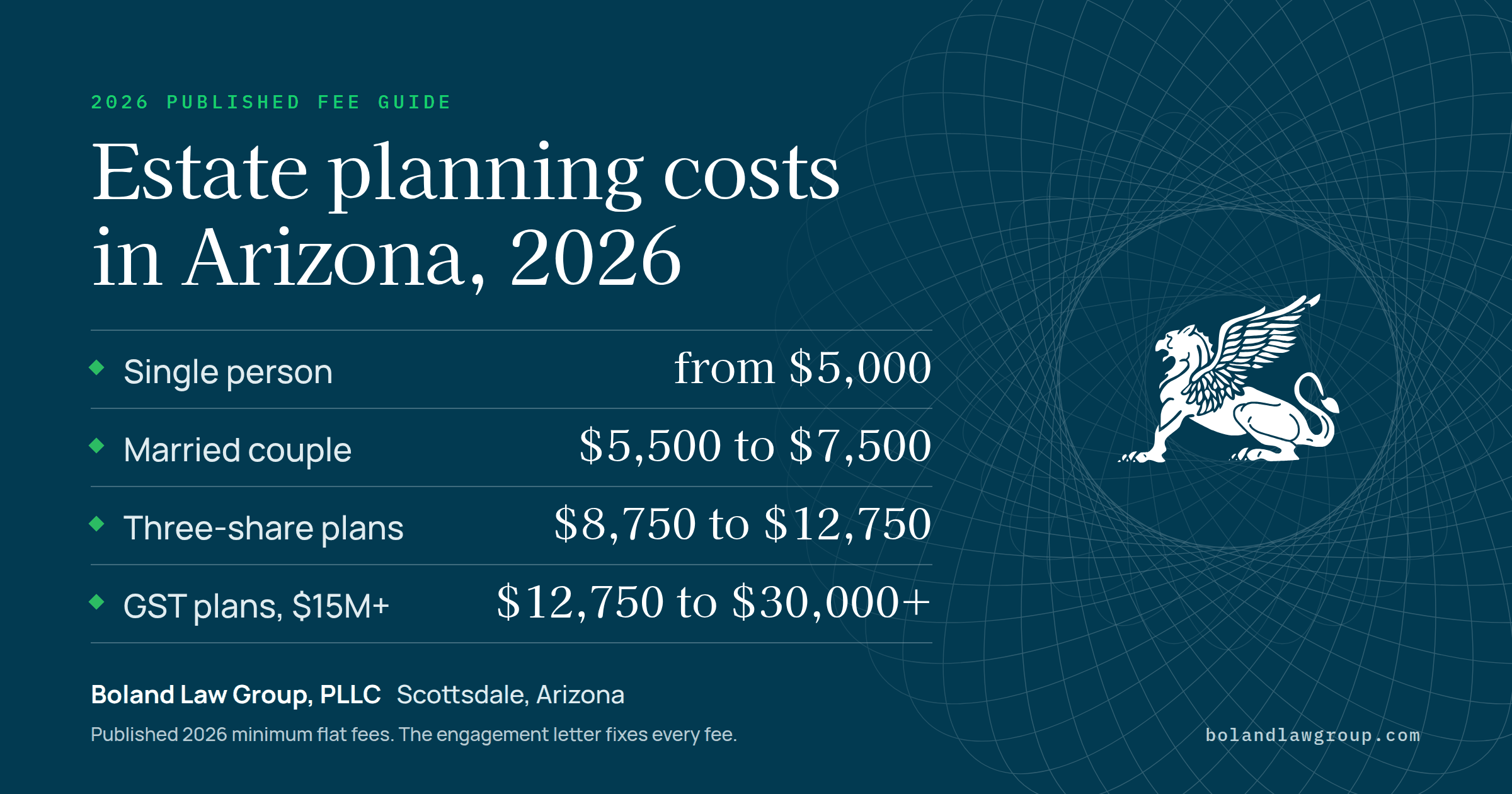
On Boland Law Group's published 2026 schedule, a complete trust-based estate plan starts at $5,000 for a single person and runs $5,500 to $7,500 for most married couples. Three-share and Clayton plans for $5 million to $15 million estates run $8,750 to $12,750, and GST architectures for estates above $15 million run $12,750 to $30,000 or more. Every figure is a minimum flat fee set by gross estate and design, and the engagement letter fixes the final number.
- Every core plan includes the trust, pour-over will, powers of attorney, living will, HIPAA authorization, one deed and written funding instructions.[1]
- Opening an informal probate in Maricopa County costs $306 in filing fees alone;[2] in our experience an uncontested probate commonly totals $15,000 or more.
- The 2026 federal estate, gift and GST exemption is $15 million per person, with a top rate of 40 percent above it.[3, 4]
- Arizona imposes no estate, inheritance or gift tax.[5]
What an estate plan costs in Arizona depends on three things: the size of your gross estate, the shape of your family, and the number of trust shares the design requires. This guide puts real 2026 numbers on each of them. It is written for families in Phoenix, Scottsdale, the East Valley, Prescott and Tucson, including our neighbors in Scottsdale, North Scottsdale, Paradise Valley and Carefree, and for the financial advisors who work alongside them.
Quick answers for 2026
- What does an estate plan cost in Arizona in 2026? On Boland Law Group's published 2026 schedule, a complete core plan for a single person starts at $5,000; married couples run $5,500 to $7,500 for most architectures, $8,750+ for a three-share A/B/C plan, and $9,750 to $12,750 for a Clayton plan. GST architectures for estates above $15 million run $12,750+ to $30,000+ by estate size.[1]
- What does probate cost in Arizona? Court initiation in Maricopa County is $306,[2] attorney fees for uncontested probates commonly run $7,000 to $15,000, total costs commonly reach $15,000+, and contested matters run $25,000 to $50,000+. Informal probates typically take 6 to 12 months and proceed on a public court file.[6]
- What changed in the 2026 tax law? The federal estate, gift, and GST exemption is now $15,000,000 per person and $30,000,000 for a married couple, set permanently by the One Big Beautiful Bill Act, with inflation indexing beginning in 2027.[3, 7] The top transfer tax rate is 40%.[4] There is no exemption sunset; that pre-2026 planning pressure is gone.
- Does Arizona have an estate tax? No. Arizona has no state estate tax, inheritance tax, or gift tax.[5]
| Service (2026) | Fee | Source and notes |
|---|---|---|
| Core estate plan, single person | From $5,000 (from $6,000 above a $5M gross estate) | Published minimum. Includes revocable living trust, pour-over will, all powers of attorney, living will, HIPAA, deed, and funding instructions |
| Core plan, married couple (most architectures) | $5,500 to $7,500 | Published minimums. Survivor's Trust $5,500; blended family and A/B designs $5,750 to $7,500 by architecture and estate size |
| A/B/C three-share plans | $8,750+ (Non-Clayton); $9,750 to $12,750 (Clayton) | Published minimums, $5M to $15M gross estates |
| GST architectures ($15M+ gross estates) | $12,750+ to $30,000+ | Published minimums by estate tier; Reverse Clayton with GST sub-trusts is the flagship instrument |
| Advanced lifetime instruments (ILIT, SLAT, GRAT, sale, dynasty, charitable, entity) | $5,000+ to $60,000+ each | Published minimums per irrevocable trust or other instrument, first $7.5M of funding included; the largest engagements exceed $350,000 |
| Trust amendment / restatement | Amendment $1,500+; restatement at core plan minimums | Published policy: one minor amendment only; restatements are the standard of care. See trust planning and modification |
| Probate (no funded trust) | Commonly $15,000+ uncontested; $25,000 to $50,000+ contested | Arizona market context. Maricopa County initiation $306;[2] informal probates typically 6 to 12 months, on a public court file |
Published figures above are Boland Law Group's 2026 minimum flat fees; the engagement letter fixes every fee. Probate and third-party figures are general Arizona market context, not quotes.
Why you can't get an honest estate planning quote without details
Estate planning isn't priced like a haircut; it's priced like building a custom home. Until an attorney knows your family, your assets, and your goals, any flat number you see online is a marketing hook, not a quote. If you want a written range before you meet anyone, our fee estimator builds one from the published schedules.
What an attorney must know before quoting
- Family structure: single, married, blended, children from prior marriages, special needs dependents
- Assets: homes, rentals, businesses, investment and retirement accounts, and life insurance death benefits
- Community vs. separate property: Arizona's community property rules can change the document count and the design
- Goals: equal or unequal distributions, protecting children from prior marriages, charitable giving, multigenerational wealth
- Complexity and timing: how many trust shares the design needs, how much funding work is involved, and how fast it must execute
How those answers move the fee (published 2026 minimums)
- Single person, any straightforward estate: from $5,000
- Married couple, first marriage, aligned beneficiaries: from $5,500
- Blended family protections: $5,750 to $7,500 by architecture
- Three-share A/B/C and Clayton designs: $8,750 to $12,750
- GST architecture above $15M: $12,750 to $30,000+ by tier
- Advanced lifetime wealth transfer: $5,000+ to $60,000+ per instrument; combined programs routinely price into six figures
The more moving parts, the more drafting, strategy, and partner time the plan requires. That is why fees rise.
Gross estate vs. net worth: the measure that sets your tier
Families ask, "Do I need advanced planning?" thinking in terms of net worth. The Internal Revenue Code doesn't use net worth; it uses your gross estate: the total fair market value of everything you own or control at death, before debts and deductions.[8]
What counts toward your gross estate
- Real property: homes, rentals, land, vacation homes
- Bank and brokerage accounts: checking, savings, investments
- Retirement accounts: 401(k), IRA, pensions
- Business interests: LLCs, partnerships, S-corps, family businesses
- Life insurance you own: the death benefit, not the cash value[9]
- Tangible property: vehicles, jewelry, art, collectibles
- Certain transfers: for example, life insurance transferred within three years of death,[10] and assets you still control[11]
Because the death benefit counts in full, your gross estate is usually much larger than your net worth. An irrevocable life insurance trust is the instrument that moves the policy outside it.
Example: net worth vs. gross estate
- A couple thinks they are "worth" $2.5M: a $1.5M home, $500k in retirement, $500k in savings
- They also own a $3M life insurance policy
- Gross estate for planning purposes: $5.5M, which moves them into the next fee tier and a different set of design questions
The 2026 tiers (published schedule)
| Gross estate | Tier | What the planning is about | Published 2026 core minimums |
|---|---|---|---|
| Under $5M | Foundations | Probate avoidance, incapacity protection, beneficiary structure | Single $5,000; married $5,500 to $6,500 |
| $5M to $15M | Foundations for Sizable Wealth | Control, creditor and remarriage protection, the community-property basis step-up, and optionality against a future smaller exemption | Single $6,000; married $6,500 to $7,500; A/B/C $8,750+; Clayton $9,750 to $12,750 |
| $15M to $30M | Exemption & GST Architecture | Transfers above the exemption face the 40% rate; the GST exemption cannot be ported between spouses and must be captured at the first death | Single $6,000; Clayton w/ GST Subs $12,750+; Reverse Clayton w/ GST Subs $15,000+ |
| $30M to $45M | Beyond the Combined Exemption | Both exemptions used; lifetime transfer strategies do the heavy lifting | Clayton w/ GST Subs $18,750+; Reverse Clayton $22,500+; single $10,000+ |
| Above $45M | Family Office Scale | Multi-entity, multigenerational, and charitable structures | Clayton w/ GST Subs $25,000+; Reverse Clayton $30,000+; single $15,000+ |
Tiers and minimums are from the published core schedule.[1] Families in the $5 million to $15 million band and above will also want our page on high net worth estate planning.
The 2026 numbers everyone plans around
- Federal estate, gift & GST exemption: $15,000,000 per person; $30,000,000 for a married couple. The One Big Beautiful Bill Act set these amounts permanently, with inflation indexing beginning in 2027.[3, 7] The old "2026 sunset" that we wrote about in mid-2025 is repealed and no longer a planning deadline; our estate tax update explains why planning still matters.
- Top transfer tax rate: 40% on transfers above the exemption[4]
- Annual gift exclusion: $19,000 per recipient;[12] $38,000 with gift-splitting;[13] $194,000 to a non-citizen spouse[14]
- GST exemption portability: none. Unlike the estate exemption,[15] the GST exemption cannot be transferred to a surviving spouse.[16] It is allocated in life, captured at the first death, or lost, which is why GST sub-trust architecture matters for $15M+ estates and for multi-generational families.
Quick takeaway
You may think you have a $2.5M estate, but once life insurance death benefits and retirement accounts are counted, you may actually have a $5.5M gross estate. Your tier, your architecture, and your fee all follow the gross estate.
Blended families: the highest-risk plans in Arizona
Blended families are a significant source of probate disputes in Arizona. In a fully revocable one-trust plan, the surviving spouse can amend the plan after the first death and redirect assets away from, or fully disinherit, the first spouse's children. Blended-family planning balances care for the survivor with locked-in protection for each spouse's children, and that requires structures that become irrevocable at the first death. Our guide to children's trusts for lifetime planning covers how those protected shares are built.
The instruments and what they do
- A Trust Only (Survivor's Trust): one continuing trust the survivor controls. Simplest, and the weakest protection for stepchildren.
- A Trust Only (Blended Family): the same chassis hardened with protective provisions for each spouse's children.
- A/B (Non-Tax / Blended Family): the B share becomes irrevocable at the first death, locking the agreed disposition, and can sprinkle income among the survivor and the children. The core blended-family protection.
- A/C (Disclaimer): everything passes to the survivor, who holds a nine-month window to disclaim assets into a protected credit shelter trust.[17, 18] Flexible, but the survivor must act, and the deadline does not extend.
- A/B (QTIP / CS): the survivor receives all income for life; the document, not the survivor, controls where the remainder goes.[19]
The three-share Clayton designs in the table rest on a settled rule: a marital trust still qualifies even though the share the fiduciary does not elect passes to a bypass trust.[20, 21] The election is made on the Form 706, which is due nine months after death[22] with an automatic six-month filing extension.[23] After the first death, our trust administration practice guides the survivor and the trustee through sub-trust funding and those elections.
| Architecture | Who decides after the first death | Under $5M | $5M to $15M |
|---|---|---|---|
| A Trust Only (Survivor's Trust) | The survivor; fully amendable | $5,500 | $6,500 |
| A Trust Only (Blended Family) | The survivor, within protective provisions | $5,850 | $6,850 |
| A/C (Disclaimer) | The survivor, by nine-month disclaimer | $5,750 | $6,750 |
| A/B (Non-Tax / Blended Family) | The document; B share irrevocable at first death | $6,000 | $7,000 |
| A/B (QTIP / CS) | The document, via the Form 706 election | $6,500 | $7,500 |
| A/B/C (Non-Clayton) | The document; three shares fixed by formula | Not offered | $8,750 |
| A/B/C (Clayton, w/ or w/o GST Subs) | An independent fiduciary, on the Form 706 | Not offered | $9,750 to $12,750 |
Published 2026 minimum flat fees from Boland Law Group's core schedule. The consultation decides the final architecture; the engagement letter fixes the fee.
Example: a Scottsdale couple
- John and Maria each have children from prior marriages
- With a plain Survivor's Trust ($5,500), Maria could amend the plan after John's death and disinherit John's kids
- With an A/B (Non-Tax / Blended Family) plan ($6,000), the B share locks at John's death: Maria is provided for, and both sets of children are protected
The protection gap costs a few hundred dollars at signing. The litigation it prevents routinely costs tens of thousands later.
Quick takeaway
In Arizona, blended families need more than a basic trust. If nothing becomes irrevocable at the first death, stepchildren can be cut out completely.
High-net-worth and advanced planning (2026)
Above the core plan, high net worth planning shifts from probate avoidance to taxes, asset protection, and multigenerational transfer. Every advanced instrument is a one-way door: an irrevocable movement of real wealth. On the published 2026 schedule, each minimum includes the first $7.5 million funded; each additional $1 million or part adds a stated per-million figure; fundings above $50 million are individually quoted.[24]
| Instrument | 2026 minimum | Each additional $1M funded |
|---|---|---|
| ILIT, single life | $7,500+ | + $750 |
| ILIT, survivorship (second-to-die) | $10,000+ | + $750 |
| SLAT, one spouse | $35,000+ | + $1,500 |
| SLANT (non-grantor SLAT) | $40,000+ | + $1,500 |
| SLATs, both spouses (non-reciprocal pair) | $60,000+ | + $2,000 |
| GRAT, first vintage | $35,000+ | + $1,000 |
| IDGT (intentionally defective grantor trust) | $35,000+ | + $1,500 |
| Installment sale to grantor trust | $60,000+ | + $2,000 |
| QPRT, per residence | $30,000+ | + $1,000 |
| Standalone GST / dynasty trust | $40,000+ | + $1,500 |
| Family LLC / FLP formation | $45,000+ | + $1,000 |
| Business succession architecture | $35,000+ | + $1,000 |
| Charitable remainder trust (CRAT / CRUT / Flip-CRUT) | $35,000+ | + $1,000 |
| Charitable lead trust | $50,000+ | + $1,500 |
| Private foundation formation | $10,000+ | + $1,000 |
| BDIT / BDOT (beneficiary defective trust) | $15,000+ | + $2,000 |
| Decanting | $10,000+ | + $1,000 |
| Nonjudicial settlement agreement or modification | $5,000+ | + $500 |
| Asset-protection structuring, out-of-jurisdiction | $35,000+ | + $1,500 |
Published 2026 minimums per instrument, before timing and asset-risk loadings. Computed fees round up to the nearest $500. A Form 706 for a taxable or GST-allocating estate is billed hourly at gross-estate-tiered rates.
A few of those lines rest on rules worth knowing. GRATs and QPRTs are priced off the special valuation rules for retained interests[25] and the monthly section 7520 rate.[26] Charitable remainder trusts are creatures of statute.[27] SLATs for both spouses are drafted as a non-reciprocal pair because courts uncross reciprocal trusts,[28] a risk our SLAT planning guide covers in depth. Arizona lets a trust interest run for up to 500 years,[29] which is what makes an Arizona dynasty trust practical. And because Arizona has no domestic asset protection trust statute, a settlor's creditors can reach what the trust could distribute to the settlor,[30] which is why self-settled protection is structured through entities or another jurisdiction. For athletes and public figures, that structure is often the point.
How the loadings work
- Standard runway is 90 days at the scheduled fee. Execution inside 45 days is ×1.25, inside 30 days ×1.5, inside 15 days ×2.
- Year-end: work accepted after October 15 for a December 31 deadline is ×1.5; after December 1, ×2 at the firm's discretion. The greater trigger governs; triggers never stack with each other.
- Health deadline: engagements against a health deadline are accepted at the firm's discretion at the ×2 class or hourly.
- Hard-to-value or pre-liquidity assets (closely held interests, carried interest, pre-IPO stock) are ×1.25, and this compounds with timing. Owners approaching a sale should read planning before a business exit or liquidity event; senior executives with concentrated equity face the same valuation questions, and founders holding qualified small business stock should see our note on QSBS trust stacking under Treasury scrutiny.
Worked examples from the published schedule
- ILIT, single life, funded at $20 million: $17,500+
- SLAT, one spouse, funded at $20 million: $54,500+
- The same SLAT at the included funding, executed inside 15 days: $70,000+
- Charitable lead trust at $20 million, accepted after October 15: $104,500+
- Installment sale funded at $60 million: Quoted, $166,000+ indication
Instruments combine. A trust plus an installment sale commonly begins around $95,000 combined before loadings and appraisal costs, and the largest engagements exceed $350,000. The engagement letter, not any web page, fixes the number.
Families operating at family office scale usually run several of these instruments at once, and owners who need continuing corporate counsel after the structure is built can retain us as outside general counsel.
Companion services (published 2026 fees)
- Structured annual-exclusion gifting program, design: $15,000; administration quoted
- Each additional GRAT vintage: $15,000; GRAT annual administration $1,500 per year
- Crummey administration: $1,500 per year, up to four powerholders, $150 each additional. The Crummey notices are what keep the annual exclusion;[31] skipping them is how ILITs fail on audit, which is where a tax controversy practice earns its keep.
- Donor-advised fund coordination: $3,500
- Special needs trust: $6,000 third-party; $9,500+ first-party (payback)[32]
- Form 706, portability-only (DSUE election): $5,000 + $500 per $1M of gross estate above $7.5M; preserves the deceased spouse's unused exclusion of up to $15,000,000.[15] IRS relief allows a simplified late election up to the fifth anniversary of death for estates not otherwise required to file.[33]
Why more shares cost more: the architecture approach to pricing
Estate planning fees rise with the number of trust shares, sometimes called buckets, that the design requires. Each share answers a different risk, and each share the plan adds means more drafting, more analysis, and more partner time. Think of shares like rooms in a home: a one-share plan is a starter house, a three-share plan is a family home, and a GST sub-trust plan is built for generations.
- One share (Survivor's Trust): simplest; from $5,500 for a couple
- Two shares (A/B or A/C): locks protection or preserves flexibility at the first death; $5,750 to $7,500
- Three shares (A/B/C): marital, bypass, and QTIP shares fixed by formula or fiduciary election; $8,750 to $12,750
- GST sub-trust architecture: exempt and non-exempt sub-trusts running for grandchildren and beyond; $12,750+ to $30,000+ by estate size. The Reverse Clayton design pairs the Clayton architecture with the reverse QTIP election.[34]
- Advanced lifetime program layered on top: $5,000+ to $60,000+ per instrument; the largest programs exceed $350,000
Each additional share adds protection, drafting, and cost, just as each additional room adds to the build.
When a flat fee does not fit: 2026 hourly rates and pass-through costs
Flat fees fit work with a defined scope. Open-ended, contested, or high-volume matters are billed hourly against a retainer, as are supporting organizations and other exempt structures, standalone buy-sell documents, and a Form 706 for a taxable or GST-allocating estate.[24] Attorney rates tier on the gross estate and are rounded up to the nearest $5; staff time is never tiered.
| Timekeeper | To $15M | Above $15M | Above $50M |
|---|---|---|---|
| Robert W. Boland, Jr., J.D., LL.M. | $700 / hr | $875 / hr | $1,050 / hr |
| Steven A. Bloom, J.D., M.B.A., LL.M. | $650 / hr | $815 / hr | $975 / hr |
| Grant M. Boland, J.D., LL.M. | $460 / hr | $575 / hr | $690 / hr |
| Staff | $75 to $150 / hr | Never tiered | Never tiered |
Published 2026 hourly rates. Where a signed engagement letter states a rate, that rate controls.
The current hourly schedule, billing increments and cost policies are maintained on our rates page. Third-party costs are passed through at cost rather than folded into the fee, even on a flat-fee matter: Arizona recording at about $30 per instrument, a mobile notary at $100, an outside witness at $50, shipping at $25 to $45, and an extra plan binder at $45. Work requested outside regular business hours carries a published surcharge equal to 50% of the hourly rate.[35] Existing clients can make a payment online.
The step most plans miss: trust funding
Creating a trust is only half the job. A revocable living trust must be funded: your assets must be retitled or assigned to it. Without funding, your trust is an empty binder and your estate can still land in probate. Our guide to revocable trusts after the 2025 law covers the mechanics.
What funding involves
- Real estate: deeds retitled into the trust, with county recording
- Bank and brokerage accounts: new ownership paperwork at each institution
- Retirement accounts: beneficiary designations aligned with the plan (these are not retitled into the trust), a recurring issue for clients planning in retirement
- Businesses and LLCs: membership interests formally assigned
- Life insurance: ownership and beneficiaries coordinated with the design
What the published 2026 schedule includes
- Every core plan includes one special warranty deed into the trust and written funding instructions
- Each additional Arizona deed into the trust: $350 per property
- Full funding service beyond the included deed (account retitling, entity interests, beneficiary designations): quoted, because banks, brokerages, and title companies each have their own forms and timelines
Arizona example (hypothetical): the Mesa family
A Mesa couple purchased a $995 "bargain trust" online. The documents were valid, but no deeds or accounts were ever transferred into the trust. When the first spouse passed, the family still went through probate at a cost of about $18,000. The trust existed; it was an empty binder.
Quick takeaway
A trust isn't complete when it's signed. It's complete when it's funded. Without funding, your estate still goes through probate.
Updating and maintenance
Estate planning is not a one-time project. A plan that is never updated is almost as dangerous as no plan at all. Our guide to the purpose of estate planning in Arizona explains what each part of the plan is for, which is the best test of whether yours still does its job.
When to update
- Family changes: marriage, divorce, births, deaths, adoptions, blended-family restructuring
- Financial changes: new businesses, property purchases, inheritances, major sales
- Relocation: moving between community property and separate property states
- Law changes: the 2026 federal overhaul is exactly why pre-2026 documents built around the old sunset should be reviewed; see our explainer on the gift and estate tax exemption changes
- Fiduciary changes: a trustee, executor, or guardian who is no longer the right choice
What updates cost (published 2026 policy)
- Trust amendment: $1,500+, one amendment only, minor changes only (a fiduciary substitution or specific-gift adjustment), and only to the firm's own instruments
- Restatement: priced at the corresponding core plan minimums. A restatement replaces the trust's terms entirely while preserving its original date and title, so funding stays intact and nothing is retitled. It is the standard of care for structural changes and for every plan drafted by another firm.
- Codicils: not offered; a will is changed by executing a new will
Review your plan every 3 to 5 years, and immediately after any major life event. Irrevocable trusts can often be modernized too, through trust planning and modification.
Arizona-specific rules that change the plan (2026)
Community property vs. separate property
- Arizona is a community property state: most assets acquired during marriage are jointly owned,[36] while assets acquired before marriage, by gift, or by inheritance are separate.[37]
- Community property earns a full, double basis step-up at the first spouse's death,[38] a major income tax advantage that proper titling protects.
- Misclassifying property is one of the most common causes of probate litigation. A home acquired during marriage but titled in one spouse's name may still be community property.
- Where the design needs them, a Separate Property Spousal Trust runs $2,900 each and a Community Property Pour-Over Trust $1,500 on the published 2026 schedule.
Snowbirds and out-of-state property
- Many Arizona residents winter in Scottsdale and summer elsewhere. Without planning, each out-of-state property can trigger ancillary probate in its own court. Many of our Paradise Valley clients, for example, also own California property.
- One properly funded trust covers property in every state.
Beneficiary deeds: useful but limited
- Arizona recognizes beneficiary (transfer-on-death) deeds,[39] typically $300 to $500 in the market.
- They transfer one property but provide no incapacity protection, no remarriage or stepchild protection, and no tax architecture. Best for simple, single-property situations only.
Small estates: the limits rose in late 2025
- Under HB 2116, effective September 26, 2025,[40] Arizona's small estate affidavit limits under A.R.S. § 14-3971 are now $200,000 of personal property and $300,000 of Arizona real property, both measured net of liens.[41]
- The personal property affidavit is available 30 days after death; the real property affidavit six months after death.
- More modest estates now avoid probate by affidavit, but the limits apply to equity, and estates above them still need a funded trust to stay out of court.
Incapacity documents are Arizona documents too
- The powers of attorney and directives in every core plan are creatures of Arizona statute: the durable power of attorney,[42] the health care power of attorney,[43] the living will[44] and the mental health care power of attorney.[45] Out-of-state forms often omit the last one.
Other Arizona advantages
- No state estate tax, inheritance tax, or gift tax
- The Arizona Trust Code permits nonjudicial settlement agreements,[46] decanting,[47] and modification,[48] so a funded irrevocable trust with the wrong terms can often be repaired
- Arizona has no domestic asset protection trust statute, so self-settled creditor protection is structured through entities or another jurisdiction
Quick takeaway
Arizona's mix of community property law, snowbird real estate, and blended families means cookie-cutter documents from national form mills routinely fail here. The plan has to be built for Arizona.
Case studies: Arizona families (hypothetical examples)
The following are hypothetical illustrations built on the published 2026 schedule to show how strategies and fees map to common situations. Every family's facts are unique, and actual fees are fixed only in an engagement letter.
Scottsdale couple, $2.5M gross estate, blended family (hypothetical illustration)
- Situation: remarried couple, children from prior marriages, a Scottsdale home, retirement accounts, life insurance
- Problem: a plain Survivor's Trust would let the survivor amend the plan and disinherit stepchildren
- Design: A/B (Non-Tax / Blended Family), locking the B share at the first death
- Published 2026 minimum: $6,000, versus $5,500 for the unprotected version
- Outcome: probate avoided and both sets of children protected, for a few hundred dollars more
Phoenix couple, $6M gross estate (hypothetical illustration)
- Situation: the couple believed they were "worth" $3.5M, but a $2.5M life insurance death benefit brought the gross estate to $6M
- Design: A/C (Disclaimer), giving the survivor a nine-month window to move assets into a protected credit shelter trust if the picture at the first death calls for it
- Published 2026 minimum: $6,750
- Outcome: flexibility against future law changes, protection available without locking anything prematurely
Mesa family, the $995 "cheap trust" (hypothetical illustration)
- Situation: a $995 trust package bought through a financial planner
- Problem: never funded; no deeds, no retitling, beneficiaries unchanged
- Result: probate anyway, at about $18,000
- Lesson: an unfunded trust is an empty binder
Paradise Valley family, gross estate just above $15M (hypothetical illustration)
- Situation: about $16M gross, including a $6M closely held business and $4M of survivorship life insurance, with grandchildren in the picture
- Design: A/B/C (Reverse Clayton w/ GST Subs) as the core plan, a survivorship ILIT to move the death benefit outside both estates, and a family LLC for the business
- Published 2026 minimums: core plan $15,000+, survivorship ILIT $10,000+, family LLC $45,000+; the program begins around $70,000+ before loadings and third-party appraisal costs
- Outcome: GST exemption captured at the first death, insurance outside the taxable estate, and the business made governable and transferable, the outcome our work with Arizona business owners is built around
Common estate planning mistakes in Arizona
- Thinking a will avoids probate. It doesn't. In Arizona a will generally must be admitted to probate before it can transfer property.[49] A will only directs how assets move through the court process, which still commonly costs $15,000+.
- Relying on a cheap $995 trust. Bargain packages from advisors and document preparers use recycled templates, miss Arizona's community property rules, and are almost never funded.
- Failing to fund the trust. Homes, accounts, and businesses must be retitled or assigned, or probate happens anyway.
- Not updating after life or law changes. Pre-2026 documents drafted around the now-repealed exemption sunset are a prime example.
- Overlooking Arizona-specific issues. Community vs. separate property, the double step-up, snowbird ancillary probate, and blended-family protections.
- Hiring the wrong provider. Document preparers cannot give legal advice; financial advisors are not licensed to draft trusts; generalist lawyers miss tax and community property design. Only attorneys who practice exclusively in this field, ideally with the LL.M., build plans designed to last.
Probate in Arizona (2026)
Probate is the court-supervised process of administering an estate when property is held in the decedent's own name. Even with a will, those assets typically pass through probate unless structured otherwise.
The paths
- Informal probate: the common route when no one contests the will and heirs agree. Typically 6 to 12 months.
- Formal probate: required for disputes, contests, or complex assets; a judge is involved, and contested matters can run years.
- Small estate affidavits: since September 26, 2025, available for up to $200,000 of personal property (30 days after death) and $300,000 of Arizona real property (six months after death), net of liens.
- A probate application may not be granted until 120 hours (5 days) after death.[50, 51]
Costs and timeline
- Court initiation: $306 in Maricopa County, plus certification ($35 for each certified copy of the letters of appointment), publication ($100 to $300+), and recording costs
- Attorney fees: commonly $7,000 to $15,000 for uncontested probates; contested matters $25,000 to $50,000+
- Appraisals: real property typically $300 to $600 each; inventory due within 90 days unless extended[52]
- Creditors: claims may be presented for four months after the first published notice,[53] which is one reason even a simple probate rarely closes quickly
- All-in: uncontested probates commonly total $15,000+, and complex or contested estates can consume 3 to 8% of the gross estate. Arizona sets no statutory percentage; personal representatives are entitled to reasonable compensation,[54] so the total follows the time the estate takes.
- Public record: Arizona court records are presumed open to the public, so the case file, including the will, the application and the appointment, can generally be inspected by anyone. Accountings are confidential under the probate rules,[55] and the inventory may be delivered to the heirs instead of being filed, but the existence of the estate, the people involved and the disputes are not private.
| Feature | Funded revocable living trust | Probate (Arizona court process) |
|---|---|---|
| Cost | $5,000 to $12,750 published core minimums for most families | Commonly $15,000+ uncontested; $25,000 to $50,000+ contested |
| Timeline | Private administration; assets transfer in weeks | 6 to 12 months informal; years if contested |
| Privacy | Private; no court file in an ordinary administration | A presumptively public court file |
| Control | Family-selected trustee, flexible distribution | Court-appointed personal representative |
| Multi-state property | One trust covers all states | Ancillary probate in each state |
| Family conflict | Reduced by clear, irrevocable instructions | Elevated; probate invites litigation |
Quick takeaway
Probate in Arizona commonly costs thousands to tens of thousands, takes 6 to 12 months or more, and is public. A will does not change that; only a funded trust, or an estate small enough for the new affidavit limits, keeps your family out of court.
Estate planning providers compared (Arizona, 2026)
| Provider | What they do | Risks and limits |
|---|---|---|
| Document preparers | Boilerplate forms and templates | Certified legal document preparers may give general legal information but cannot give legal advice or customize strategy;[56] cheapest upfront, often ends in probate |
| Financial advisors | Bundle $995 "trusts" with asset management | Not licensed to practice law;[57] outsource to low-cost template attorneys; funding rarely happens. Compare how advisors partner with estate counsel instead |
| General practice attorneys | Wills, POAs, basic trusts alongside other practice areas | Shallow on Arizona community property and tax design; fine for very simple estates only |
| Certified specialists | State-certified focus on estate and trust law[58] | Stronger than generalists, but certification does not guarantee advanced tax training |
| Estate planning experts (LL.M.) | Advanced law degree, 100% estate and tax focus, custom multi-share and lifetime strategies. See our credentials | Higher starting fees; full funding beyond the included deed quoted separately. The safest long-term outcome for blended families, multi-state property, and $5M+ estates |
Red flag checklist: spotting a generalist
- Advertises "$995 living trust packages"
- Also handles divorces, DUIs, or personal injury
- Documents are assembled by staff, not the attorney
- Cannot explain gross estate vs. net worth
- Never raises blended-family risk, disclaimer windows, or Arizona community property rules
Four questions that sort experts from generalists
- Do you hold an LL.M. in estate or tax law?
- Is estate planning 100% of your practice?
- Have your plans been tested in Arizona probate or litigation?
- Do you draft custom strategies or fill templates?
You can put those questions to us. Read about our attorneys, the people who will actually draft your plan, and see the full range of Scottsdale estate planning services.
Where we meet clients
Our office is in the Scottsdale Airpark at 15100 N. 78th Way, Suite 203, Scottsdale, Arizona 85260, and every visit is by appointment. See all locations and appointment options.
- Scottsdale
Within about 25 minutes of most of the city.
- North Scottsdale
About 12 minutes to DC Ranch and Silverleaf, about 32 minutes to Desert Mountain.
- Paradise Valley
About 17 minutes, off-peak, from the center of town.
- Carefree
About 29 minutes from the Carefree Sundial, and serving Cave Creek.
- In your home
Across the East Valley, and in Prescott, Prescott Valley, Sedona, Clarkdale and Jerome.
- Anywhere in Arizona
Secure video and telephone consultations, including Phoenix and Tucson.
Frequently asked questions (Arizona estate planning costs, 2026)
How much does estate planning cost in Arizona in 2026?
On Boland Law Group's published 2026 schedule, a single person's complete plan starts at $5,000 and married couples run $5,500 to $7,500 for most architectures. Three-share A/B/C plans start at $8,750, Clayton plans run $9,750 to $12,750, and GST architectures for estates above $15 million run $12,750+ to $30,000+ by tier. Advanced lifetime instruments run $5,000+ to $60,000+ each, and the largest programs exceed $350,000. Every figure is a minimum flat fee, and the engagement letter fixes the final fee.
What is the average cost of a living trust in Scottsdale or Phoenix?
Most married couples land between $5,500 and $12,750 depending on architecture and gross estate, with blended-family protections adding a few hundred dollars rather than thousands. A single person's plan starts at $5,000. Those are our published minimums for a complete revocable living trust plan, not a bare trust document: they include the pour-over will, powers of attorney, living will, HIPAA authorization, one deed into the trust and written funding instructions.
What is included in a core estate plan at the published fee?
Every core plan on the published 2026 schedule includes a revocable living trust, a pour-over will, a general durable power of attorney, a health care power of attorney, a mental health care power of attorney, a living will, a HIPAA authorization, a certificate of trust, age-gated shares for children and grandchildren held in trust to the ages you choose, an assignment of personal property, one special warranty deed into the trust, and written funding instructions.
Do I really need a trust if I have a will?
Yes, for most families. In Arizona a will does not avoid probate; it only directs how assets move through the court. A properly funded trust keeps the estate private and avoids a process that commonly costs $15,000 or more.
How much does probate cost in Maricopa County?
The Clerk's filing fee to open an informal probate is $306, and each certified copy of the letters of appointment is $35. Attorney fees commonly run $7,000 to $15,000 for uncontested probates, totals commonly reach $15,000+, and contested matters run $25,000 to $50,000+ over 6 to 12 months or longer, on a public court file. The attorney and total figures are general Arizona market context, not quotes.
Is probate really public in Arizona?
Largely, yes. Arizona court records are presumed open to the public, so the probate case file, including the will once it is filed, the application, and the appointment of the personal representative, can generally be inspected by anyone. There are limits: accountings are confidential documents under the probate rules, and a personal representative may deliver the inventory to the heirs instead of filing it. A funded revocable trust avoids the question, because no court file is opened in an ordinary administration.
What changed in the 2026 federal tax law?
The One Big Beautiful Bill Act permanently set the estate, gift, and GST exemption at $15,000,000 per person ($30,000,000 per married couple), with indexing from 2027 and a 40% top rate. The 2026 annual gift exclusion is $19,000 per recipient, $38,000 with gift-splitting, and $194,000 to a non-citizen spouse. The old sunset deadline is gone, but the GST exemption still cannot be ported between spouses, which keeps GST architecture essential for larger estates.
Does Arizona have a state estate tax or inheritance tax?
No. Arizona has no state estate tax, inheritance tax, or gift tax; the Arizona estate tax ended for decedents dying after 2004. Arizona residents plan around the federal system: a $15,000,000 exemption per person in 2026 and a 40% top rate above it. Real estate you own in another state may still be subject to that state's estate or inheritance tax.
What are Arizona's new small estate limits?
Effective September 26, 2025, under HB 2116, affidavits can transfer up to $200,000 of personal property (30 days after death) and $300,000 of Arizona real property (six months after death), each net of liens, without probate. Estates above those limits still need a funded trust to stay out of court.
What happens if I don't fund my trust?
An unfunded trust is an empty binder. If homes, accounts, and business interests are never retitled or assigned, probate is still required even though the documents exist.
How much does it cost to add another property to my trust?
Every core plan includes one special warranty deed into the trust. Each additional Arizona deed is $350 per property on the published 2026 schedule, and county recording is passed through at cost, about $30 per instrument. Property in another state is handled within quoted funding work, because each state has its own deed forms and recording rules.
Are there costs on top of the flat fee?
Yes. Third-party costs are passed through at cost rather than folded into the fee. Common examples on our published 2026 rate notice: Arizona recording at about $30 per instrument, a mobile notary at $100, an outside witness at $50, shipping at $25 to $45, and an extra plan binder at $45. Advanced engagements add third-party appraisals and valuations at cost, and work requested outside regular business hours carries a published surcharge equal to 50% of the hourly rate.
Is the fee flat or hourly, and what are the hourly rates?
Estate planning is priced as a flat fee that is fixed in the engagement letter. Open-ended, contested, or high-volume matters are billed hourly against a retainer. For gross estates up to $15 million the published 2026 rates are $700 per hour for Robert W. Boland, Jr., $650 for Steven A. Bloom and $460 for Grant M. Boland, with staff at $75 to $150. Attorney rates tier upward for gross estates above $15 million and above $50 million.
How much more does a blended family plan cost?
On the published 2026 schedule a blended-family design costs $350 to $1,000 more than the plain Survivor's Trust. For estates under $5 million the Survivor's Trust is $5,500, the hardened A Trust Only (Blended Family) is $5,850, the A/B (Non-Tax / Blended Family) plan that locks the B share at the first death is $6,000, and the A/B (QTIP / CS) plan is $6,500. Each figure is $1,000 higher for $5 million to $15 million estates.
What is the difference between a disclaimer plan and a Clayton plan, and why does Clayton cost more?
Both defer the tax decision until the first death; they differ in who decides and how long they have. In an A/C (Disclaimer) plan ($5,750, or $6,750 for $5 million to $15 million estates) the surviving spouse must disclaim within nine months, without having accepted the benefits, and the deadline does not extend. In an A/B/C (Clayton) plan ($9,750 to $12,750) an independent fiduciary makes the QTIP election on the Form 706, which is due nine months after death with an automatic six-month filing extension. Clayton costs more because it is a three-share instrument with more drafting and more post-death flexibility.
What does an estate plan cost for an estate above $15 million?
Only GST architectures are offered for married couples at that level. From $15 million to $30 million, Clayton with GST sub-trusts starts at $12,750 and Reverse Clayton with GST sub-trusts at $15,000 (single $6,000). From $30 million to $45 million the minimums are $18,750 and $22,500 (single $10,000), and above $45 million they are $25,000 and $30,000 (single $15,000). Engagements at this level usually add lifetime instruments priced on the advanced schedule; see high net worth estate planning.
Why does life insurance raise my fee tier?
Because fee tiers follow the gross estate, and the gross estate includes the full death benefit of life insurance you own, not its cash value. A couple with $2.5 million of assets and a $3 million policy has a $5.5 million gross estate. An irrevocable life insurance trust (from $7,500 for a single-life policy, $10,000 for survivorship) can own the policy so the proceeds land outside the taxable estate. An existing policy transferred within three years of death is still counted.
How much does an ILIT cost in Arizona?
On the published 2026 schedule a single-life ILIT starts at $7,500 and a survivorship (second-to-die) ILIT at $10,000. Each minimum includes the first $7.5 million of funding and adds $750 for each additional $1 million or part. Annual Crummey administration is $1,500 per year for up to four powerholders and $150 for each additional one. The Crummey notices are what keep each premium gift inside the $19,000 annual exclusion.
How much does a SLAT cost?
A spousal lifetime access trust for one spouse starts at $35,000, a non-grantor SLANT at $40,000, and SLATs for both spouses, drafted as a non-reciprocal pair, at $60,000. Funding above $7.5 million adds $1,500 per $1 million ($2,000 for the pair). A one-spouse SLAT funded at $20 million computes to $54,500+ before timing and asset-risk loadings.
How much does a dynasty trust cost in Arizona?
A standalone GST or dynasty trust starts at $40,000 on the published 2026 schedule, plus $1,500 for each $1 million funded above the first $7.5 million. It allocates GST exemption now, at a zero inclusion ratio, so the trust can run for grandchildren and beyond free of GST tax. Arizona law allows a trust interest to last up to 500 years, which makes Arizona a workable home for multigenerational trusts.
What does it cost to change an irrevocable trust in Arizona?
Decanting starts at $10,000 and a nonjudicial settlement agreement or modification at $5,000, with $1,000 and $500 respectively for each $1 million above the first $7.5 million. The Arizona Trust Code authorizes all three tools, so a funded irrevocable trust with outdated terms can often be repaired without starting over. See trust planning and modification.
What does business succession planning cost?
On the published 2026 schedule, family LLC or FLP formation with valuation coordination starts at $45,000 and business succession and recapitalization architecture at $35,000, each adding $1,000 per $1 million above the first $7.5 million. The third-party valuation is passed through at cost, and standalone buy-sell documents are quoted separately or handled hourly. See planning for Arizona business owners.
What does charitable planning cost?
A charitable remainder trust (CRAT, CRUT or Flip-CRUT) starts at $35,000, a charitable lead trust at $50,000, and private foundation formation at $10,000 on the published 2026 schedule. Donor-advised fund coordination is $3,500. Supporting organizations and other exempt structures are handled hourly, and the IRS user fee on an exemption application is passed through at cost.
How much does a special needs trust cost?
On the published 2026 schedule a third-party special needs trust is $6,000 and a first-party (payback) special needs trust starts at $9,500. A first-party trust holds the beneficiary's own assets and must repay the state Medicaid program at the beneficiary's death. A third-party trust funded by parents or grandparents carries no payback requirement.
What does a portability (DSUE) return cost, and when is it worth it?
A portability-only Form 706 is $5,000 plus $500 per $1 million of gross estate above $7.5 million, and it is not charged when the taxable or GST-allocating Form 706 is engaged. The filing preserves the deceased spouse's unused exclusion, up to $15,000,000, for the survivor. The election belongs on a timely Form 706, and IRS relief allows a simplified late election up to the fifth anniversary of death for estates not otherwise required to file. Our trust administration practice handles the filing.
What are timing loadings, and how do I avoid them?
Advanced instruments are priced at a standard 90-day runway. Execution inside 45 days is ×1.25, inside 30 days ×1.5, and inside 15 days ×2. For a December 31 deadline, work accepted after October 15 is ×1.5 and after December 1 ×2 at the firm's discretion. The greater trigger governs and timing triggers never stack with each other, although hard-to-value assets add ×1.25 on top. The way to avoid a loading is to start year-end planning before mid-October.
How much does it cost to amend or restate a trust, including one drafted by another firm?
On the published 2026 schedule a minor amendment is $1,500+: one amendment only, minor changes only, and only to our own instruments. A restatement is priced at the corresponding core plan minimums. It replaces the trust's terms entirely while preserving the original date and title, so funding stays intact and nothing is retitled. It is the standard of care for structural changes and for every plan drafted by another firm. Codicils are not offered.
How often should I update my plan?
Review every 3 to 5 years, and immediately after marriage, divorce, a birth or death, a major financial change, a move into or out of Arizona, or a tax law change. On the published 2026 schedule a minor amendment is $1,500+, and a restatement, the standard of care for structural changes and for plans drafted elsewhere, is priced at the core plan minimums with no retitling required.
Is a beneficiary deed cheaper than a trust?
Yes, up front. Arizona recognizes beneficiary (transfer-on-death) deeds, which typically cost $300 to $500 in the market and pass one property at death without probate. A beneficiary deed provides no incapacity protection, no remarriage or stepchild protection, and no tax architecture, and it does nothing for accounts or business interests. It suits simple, single-property situations only.
Is a $995 living trust package worth it?
Rarely. Bargain packages from advisors and document preparers use recycled templates, miss Arizona's community property rules, and are almost never funded. In our hypothetical Mesa example, a valid $995 trust with no deeds or accounts transferred into it still ended in a probate costing about $18,000. The trust existed; it was an empty binder.
Can my financial advisor or a document preparer set up my trust?
A financial advisor who is not a lawyer cannot: in Arizona, preparing a document intended to affect a specific person's legal rights is the practice of law. A certified legal document preparer may prepare documents and give general legal information but may not give legal advice, so no one is responsible for the design. Advisor-bundled packages are typically outsourced templates, and the funding step that makes a trust work is usually skipped. Many advisors instead work alongside estate counsel.
How do I know if I'm talking to an expert or a generalist?
Ask the four questions above: the LL.M., the 100% practice focus, the litigation-tested documents, and custom drafting. A "no" on any of them means you are likely talking to a generalist.
Who will actually draft my plan?
An LL.M. partner. Under the published schedule, every matter is handled directly by LL.M. partners from the first consultation through funding and post-signing maintenance, with no associate hand-off and no support-staff drafting. Meet our attorneys.
Can I get a written estimate before I meet with you?
Yes. Both 2026 fee schedules are published, and our online fee estimator builds an illustrative range from them after a few questions. An estimate is not a quote or an offer of representation. The fee is fixed only in a signed engagement letter after a consultation.
I'm a snowbird with a home in another state. Does that change the plan or the cost?
It changes the funding work more than the fee tier. Fees follow the gross estate and the architecture, not the number of states. Without a trust, each out-of-state property can require its own ancillary probate; one properly funded revocable trust holds property in every state. The out-of-state deed is handled within quoted funding work.
Do you serve clients outside Scottsdale?
Yes. Our office is in the Scottsdale Airpark, within easy reach of North Scottsdale, Paradise Valley and Carefree. We hold in-home appointments across the East Valley and in Prescott, Prescott Valley, Sedona, Clarkdale and Jerome, and we offer secure video and telephone consultations anywhere in Arizona, including Phoenix and Tucson.
Bottom line for 2026
Estate planning in Arizona is not one-size-fits-all. Fees follow the gross estate, the family structure, and the number of shares the design needs. One truth is constant: you either plan now, or your family pays later.
- Core plans: $5,000 to $12,750 published minimums for most families
- GST architectures: $12,750 to $30,000+ by estate size
- Advanced lifetime programs: $5,000+ to $60,000+ per instrument, with the largest engagements above $350,000
- Probate avoided, blended families protected, the GST exemption captured, and the family's finances kept off the public record
A funded trust is insurance against probate: a fixed fee now instead of an open-ended, public, court-supervised process later. 2026 is the year to get the plan right, with experts, not templates.
This schedule is provided for general information and does not constitute legal or tax advice, nor does it create an attorney-client relationship. All fees, figures, and terms set forth herein are estimates only, are subject to the firm's sole discretion, and may be modified, adjusted, or withdrawn at any time without notice. No fee is binding unless and until set forth in a signed engagement letter.
Boland Law Group, PLLC
15100 N. 78th Way, Suite 203, Scottsdale, Arizona 85260
(480) 420-8268
Related reading
- Purpose of estate planning in Arizona: nine goals (2026)
- Revocable trusts after the 2025 law: estate tax, basis step-up and wealth transfer
- Spousal lifetime access trusts: estate tax and basis planning
- Dynasty trusts: step-up in basis, estate tax changes and generational wealth
- Children's trusts for lifetime planning after the federal changes
- BDITs and BDOTs in estate planning
- Estate tax update: the $15 million exemption, and why planning still matters
- The One Big Beautiful Bill Act: key takeaways at a glance
- QSBS under IRC 1202: 2025 vs. 2026 planning after the OBBBA
- QSBS stacking with trusts: IRC 1202 planning strategies
- Tax controversy and litigation: the counsel who drafts a plan should be able to defend it.
Browse all estate planning articles, our estate tax and gift tax coverage, every insight or all six practice areas.
Sources
Numbered citations in the article link to the entries below. Fee figures are drawn from the firm's own published 2026 schedules. Statutes are linked to the Arizona Legislature and to the Legal Information Institute at Cornell Law School for convenience, and other sources link to their publishers; the official text controls.
- Boland Law Group, PLLC, Estate Planning & Private Client Services: Schedule of Services and Fees (effective 2026), the firm's published core estate planning fee schedule. bolandlawgroup.com. Back to text
- Clerk of the Superior Court, Maricopa County, Filing Fees, Probate, Conservatorship, Guardianship and Fiduciary Fees (Probate, Informal / Affidavits, $306.00; Certified Letters of Appointment, $35.00), as published Sept. 17, 2026. clerkofcourt.maricopa.gov. Back to text
- Internal Revenue Service, Rev. Proc. 2025-32 (released Oct. 9, 2025), § 2.14 (basic exclusion amount and GST exemption of $15,000,000 for 2026, adjusted for inflation for 2027 and later years) and § 4.42 (annual exclusion of $19,000; $194,000 for gifts to a spouse who is not a U.S. citizen). irs.gov. Back to text
- 26 U.S.C. § 2001, Imposition and rate of tax; § 2001(c) sets the top rate at 40 percent. Cornell LII. Back to text
- Arizona Department of Revenue, Publication 900, Estate Tax (rev. Sept. 2006), stating that Arizona imposes no estate tax for decedents dying after 2004 and does not impose an inheritance or gift tax. azdor.gov. Back to text
- Ariz. R. Sup. Ct. 123(c)(1), Access to Judicial Records (court records are presumed open to any member of the public). Court Rules Network. Back to text
- Pub. L. No. 119-21, § 70106, 139 Stat. 72 (July 4, 2025) (H.R. 1, 119th Cong.), amending 26 U.S.C. § 2010(c)(3) to set the basic exclusion amount at $15,000,000 and striking former subparagraph (C), the scheduled sunset. govinfo.gov. Back to text
- 26 U.S.C. § 2031, Definition of gross estate; see also § 2033, Property in which the decedent had an interest. Cornell LII. Back to text
- 26 U.S.C. § 2042, Proceeds of life insurance (proceeds are included where the decedent held incidents of ownership). Cornell LII. Back to text
- 26 U.S.C. § 2035, Adjustments for certain gifts made within 3 years of decedent's death (reaching life insurance transferred within the three-year period). Cornell LII. Back to text
- 26 U.S.C. § 2036, Transfers with retained life estate. Cornell LII. Back to text
- 26 U.S.C. § 2503, Taxable gifts; § 2503(b) is the annual exclusion. Cornell LII. Back to text
- 26 U.S.C. § 2513, Gift by husband or wife to third party (gift-splitting). Cornell LII. Back to text
- 26 U.S.C. § 2523, Gift to spouse; § 2523(i) governs gifts to a spouse who is not a U.S. citizen. Cornell LII. Back to text
- 26 U.S.C. § 2010, Unified credit against estate tax; § 2010(c)(2) through (5) define the applicable exclusion amount, the basic exclusion amount, the deceased spousal unused exclusion amount and the portability election. Cornell LII. Back to text
- 26 U.S.C. § 2631, GST exemption; § 2631(c) sets the exemption equal to the basic exclusion amount under § 2010(c), which does not include a deceased spouse's unused exclusion. Cornell LII. Back to text
- 26 U.S.C. § 2518, Disclaimers; § 2518(b) requires a written disclaimer within 9 months, before any acceptance of the interest or its benefits. Cornell LII. Back to text
- A.R.S. § 14-10001 and following, the Arizona Uniform Disclaimer of Property Interests Act. azleg.gov. Back to text
- 26 U.S.C. § 2056, Bequests, etc., to surviving spouse; § 2056(b)(7) is the election for qualified terminable interest property (QTIP). Cornell LII. Back to text
- Treas. Reg. § 20.2056(b)-7(d)(3)(i) (an income interest contingent on the executor's QTIP election still qualifies, even though the portion not elected passes to others). Cornell LII. Back to text
- Estate of Clayton v. Commissioner, 976 F.2d 1486 (5th Cir. 1992) (marital deduction allowed where the unelected portion passed to a bypass trust). OpenJurist. Back to text
- 26 U.S.C. § 6075(a) (estate tax return due within 9 months after death). Cornell LII. Back to text
- Treas. Reg. § 20.6081-1(b) (automatic 6-month extension of time to file Form 706 on a timely Form 4768). Cornell LII. Back to text
- Boland Law Group, PLLC, Advanced Planning & Lifetime Wealth Transfer: Schedule of Services and Fees (effective 2026), the firm's published advanced planning fee schedule, including loadings, worked examples and gross-estate-tiered hourly rates. bolandlawgroup.com. Back to text
- 26 U.S.C. § 2702, Special valuation rules in case of transfers of interests in trusts (the framework for GRATs and QPRTs). Cornell LII. Back to text
- 26 U.S.C. § 7520, Valuation tables (the monthly rate that prices annuity, term and remainder interests). Cornell LII. Back to text
- 26 U.S.C. § 664, Charitable remainder trusts. Cornell LII. Back to text
- United States v. Estate of Grace, 395 U.S. 316 (1969) (the reciprocal trust doctrine). Cornell LII. Back to text
- A.R.S. § 14-2901, Nonvested property interest; general power of appointment; validity; exception (the 500-year period is in subsection A, paragraph 2). azleg.gov. Back to text
- A.R.S. § 14-10505, Creditor's claim against settlor (a settlor's creditors may reach the maximum amount distributable to the settlor from an irrevocable trust). azleg.gov. Back to text
- Crummey v. Commissioner, 397 F.2d 82 (9th Cir. 1968) (withdrawal powers make gifts in trust present interests that qualify for the annual exclusion). OpenJurist. Back to text
- 42 U.S.C. § 1396p(d)(4)(A) (trust for a disabled individual under age 65, with repayment to the state Medicaid program at death). Cornell LII. Back to text
- Internal Revenue Service, Rev. Proc. 2022-32 (July 8, 2022), simplified method for a late portability election up to the fifth anniversary of death for estates not otherwise required to file. irs.gov. Back to text
- 26 U.S.C. § 2652, Other definitions; § 2652(a)(3) is the special election for qualified terminable interest property (the reverse QTIP election). Cornell LII. Back to text
- Boland Law Group, PLLC, Notice of 2026 Billable Rates (effective Jan. 1, 2026), including costs passed through at cost, the after-hours surcharge and billing increments. bolandlawgroup.com/rates. Back to text
- A.R.S. § 25-211, Property acquired during marriage as community property; exceptions; effect of service of a petition. azleg.gov. Back to text
- A.R.S. § 25-213, Separate property. azleg.gov. Back to text
- 26 U.S.C. § 1014, Basis of property acquired from a decedent; see § 1014(b)(6) for the surviving spouse's half of community property. Cornell LII. Back to text
- A.R.S. § 33-405, Beneficiary deeds; recording; definitions. azleg.gov. Back to text
- Ariz. H.B. 2116, 57th Leg., 1st Reg. Sess. (2025), small estate; affidavit; limits (Laws 2025, ch. 24), amending A.R.S. § 14-3971; general effective date Sept. 26, 2025. azleg.gov. Back to text
- A.R.S. § 14-3971, Collection of personal property by affidavit; ownership of vehicles; affidavit of succession to real property. azleg.gov. Back to text
- A.R.S. § 14-5501, Durable power of attorney; creation; validity. azleg.gov. Back to text
- A.R.S. § 36-3221, Health care power of attorney; scope; requirements; limitations; fiduciaries. azleg.gov. Back to text
- A.R.S. § 36-3261, Living will; verification; liability. azleg.gov. Back to text
- A.R.S. § 36-3281, Mental health care power of attorney; scope; definition. azleg.gov. Back to text
- A.R.S. § 14-10111, Nonjudicial settlement agreements; definition. azleg.gov. Back to text
- A.R.S. § 14-10819, Trustee's special power to appoint to other trust (decanting). azleg.gov. Back to text
- A.R.S. § 14-10411, Modification or termination of noncharitable irrevocable trust by consent; see also §§ 14-10412 and 14-10416. azleg.gov. Back to text
- A.R.S. § 14-3102, Necessity of statement or order of probate for will; exception. azleg.gov. Back to text
- A.R.S. § 14-3302, Informal probate; duty of registrar; effect of informal probate (statement issues only if at least 120 hours have elapsed since death). azleg.gov. Back to text
- A.R.S. § 14-3307, Informal appointment proceedings; delay in order; duty of registrar; effect of appointment. azleg.gov. Back to text
- A.R.S. § 14-3706, Duty of personal representative; inventory and appraisement (inventory within ninety days; it may be filed with the court or delivered to heirs or devisees instead). azleg.gov. Back to text
- A.R.S. § 14-3801, Notice to creditors (claims due within four months after first publication). azleg.gov. Back to text
- A.R.S. § 14-3719, Compensation of personal representative (reasonable compensation; Arizona sets no statutory percentage). azleg.gov. Back to text
- Ariz. R. Prob. P. 8, Confidential Documents and Information (accountings filed under A.R.S. Title 14 are confidential documents and are not part of the public record of a probate case). Court Rules Network. Back to text
- Arizona Supreme Court, Certification and Licensing Division, Legal Document Preparer Program (certified preparers may give general legal information but may not give legal advice); see Arizona Code of Judicial Administration § 7-208. azcourts.gov. Back to text
- Ariz. R. Sup. Ct. 31(b) (the practice of law includes preparing a document intended to affect or secure a specific person's legal rights). Court Rules Network. Back to text
- State Bar of Arizona, Board of Legal Specialization, Estate & Trust Legal Specialization (certification standards; the Board operates under Ariz. R. Sup. Ct. 44). azbar.org. Back to text
Important legal notice
Please read this notice before relying on anything in this article. By reading this article you acknowledge the following.
Information only, not advice
This article is general educational information about federal and Arizona law, estate planning and legal fees. It is not legal, tax, accounting, investment, or financial advice, and it is not a substitute for advice from a qualified professional who knows your facts. Do not act, or refrain from acting, based on anything in it.
Fees are minimums and estimates, not quotes
Figures identified as Boland Law Group's published 2026 schedule figures are minimum flat fees. All fees, figures, and terms are estimates only, are subject to the firm's sole discretion, and may be modified, adjusted, or withdrawn at any time without notice. No fee is binding unless and until set forth in a signed engagement letter. General Arizona figures, including probate costs, court fees and third-party ranges, are market context, not quotes, offers, or guarantees.
No attorney-client relationship
Reading this article, using this website or its fee estimator, calling, emailing, or submitting a form does not create an attorney-client relationship with Boland Law Group, PLLC or any of its attorneys. A relationship is formed only after a conflict check, a written engagement letter signed by the client and the firm, and payment of any required fees, as described in our Terms of Engagement. Until then, please do not send confidential information; anything you send may not be treated as privileged or confidential.
Not a tax opinion; not for penalty protection
This article is not a tax opinion or written tax advice on which any person may rely. It was not written to be used, and cannot be used, by any person to avoid penalties that may be imposed under the Internal Revenue Code or any state or local tax law. It is not an offer, solicitation, promotion, or recommendation of any transaction, investment, trust structure, or tax strategy.
No guarantee of any outcome
No result is promised or guaranteed. Courts, the Internal Revenue Service and state agencies may disagree with any view expressed here. Whether any plan achieves its purpose depends on specific facts, drafting, funding, timing, and administration.
The law and the fees change; no duty to update
This article reflects statutes, regulations, court fee schedules, and published sources known to us as of September 17, 2026. Tax law, estate law, court fees and our own schedules change. We have no obligation to update this article, and information that was accurate when written may later become inaccurate.
Third-party sources and links
Court fees and other third-party information are summarized from the public sources listed above. We do not control, endorse, or guarantee the accuracy, completeness, or availability of any third-party content or link.
Examples are hypothetical and simplified
The case studies, worked examples, tables, and figures are hypothetical, simplified illustrations only. They do not describe actual clients, and they are not projections or promises of any fee, tax savings or result. Your circumstances will differ.
Jurisdiction
Our attorneys are admitted to practice before the Supreme Court of Arizona, the United States Tax Court, and the United States District Court for the District of Arizona. Discussion of other states' laws is general in nature; consult counsel licensed in that state. This article is not intended to solicit clients in any jurisdiction where doing so would not comply with applicable rules.
Limitation of liability
To the fullest extent permitted by law, Boland Law Group, PLLC and its attorneys and staff disclaim all liability for any loss, damage, tax, interest, penalty, or expense arising from any use of, or reliance on, this article or any linked content. Your use of this website is also subject to our Privacy Policy.
Attorney advertising
This article may be considered attorney advertising under applicable rules of professional conduct. Responsible attorney: Grant M. Boland, J.D., LL.M., Boland Law Group, PLLC, 15100 N. 78th Way, Suite 203, Scottsdale, Arizona 85260, (480) 420-8268.
Passionately Preserving Wealth™
Two generations of LL.M. counsel. Founder licensed in 1974.