Beneficiary Defective Inheritor's Trusts (BDITs) and Beneficiary Deemed Owner Trusts (BDOTs) are advanced estate planning tools that use the grantor trust rules in an unusual way. In a typical intentionally defective grantor trust, the person who creates the trust is treated as its owner for income tax purposes. In a BDIT or a BDOT, the beneficiary is treated as the owner under Section 678 of the Internal Revenue Code.[1, 11] The result can be a trust that a family member creates for you, that you help manage and may benefit from, that sits outside your taxable estate and beyond most creditors, and whose income is taxed to you. These are among the most technical instruments in high net worth estate planning, and they sit at the far end of the Scottsdale estate planning work we do for business owners and families with taxable estates.
This guide analyzes the legal structure, purpose, and operation of BDITs and BDOTs, compares them with each other and with SLATs, GRATs, IDGTs and dynasty trusts, and examines how H.R. 1 of the 119th Congress, the One Big Beautiful Bill Act of 2025, affects them. It was first published in October 2025 and was fully updated in September 2026 with 2026 figures, the current IRS no-ruling position, and a new section on Arizona law. If irrevocable planning is new to you, start with our overview of irrevocable trusts in Scottsdale and come back.
What are BDITs and BDOTs? The short answer
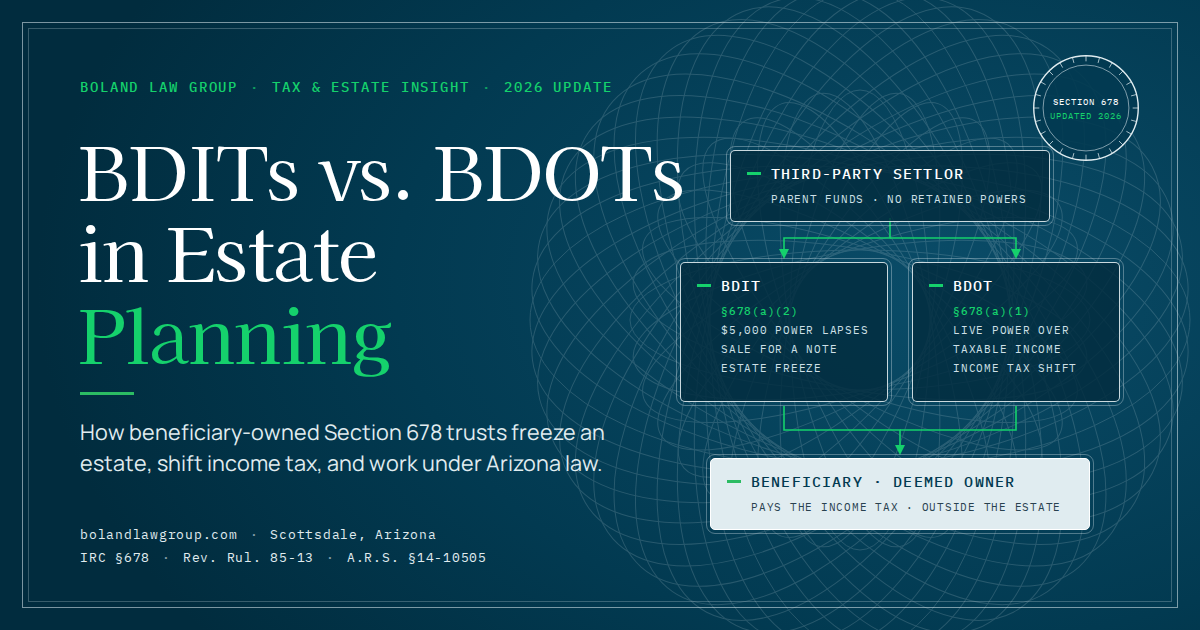
A beneficiary defective inheritor's trust (BDIT) is an irrevocable trust created and funded by a third party, usually a parent, with a small gift, commonly $5,000. The beneficiary receives a temporary right to withdraw that gift, lets the right lapse, and is then treated as the owner of the entire trust for income tax purposes. Because a person cannot sell to himself for income tax purposes, the beneficiary can sell appreciating assets to the trust for a promissory note without recognizing gain, and the later growth occurs outside the beneficiary's estate.[2, 3]
A beneficiary deemed owner trust (BDOT) is an irrevocable trust in which the beneficiary holds a continuing power to withdraw the trust's taxable income each year. That power alone makes the beneficiary the deemed owner under Section 678(a)(1), so the trust's income is reported on the beneficiary's return whether or not anything is withdrawn.[4, 12]
The difference in one sentence: a BDIT is an estate freeze built on a lapsed power over a small gift, and a BDOT is an income tax shift built on a live power over income. One trust can be drafted to do both.
I. Legal Structure, Purpose, and Operation of BDITs and BDOTs
Section 678(a) treats a person other than the grantor as the owner of any portion of a trust over which that person (1) holds a power, exercisable solely by himself, to vest the corpus or the income in himself, or (2) has previously partially released or otherwise modified such a power and afterward retains the kind of control that would make a grantor the owner under Sections 671 to 677. Section 678(b) gives priority to the actual grantor: where the grantor is already treated as the owner, a beneficiary's power over income does not shift the tax.[1] The rule descends from Mallinckrodt v. Nunan, a 1945 decision that taxed a beneficiary who could take trust income on demand.[13, 14] BDITs and BDOTs are, in effect, grantor trusts with respect to the beneficiary.
A. Beneficiary Defective Inheritor's Trust (BDIT)
A BDIT is an irrevocable trust funded by a third party, often a parent or another family member, for the benefit of the client, who is the inheritor and beneficiary.[11, 15] The defining feature is that the trust is drafted so that the beneficiary, rather than the settlor, is treated as the owner for income tax purposes, hence "beneficiary defective." The beneficiary is given a Crummey withdrawal power over the initial contribution, so that under Section 678(a)(1) the beneficiary holds a power exercisable solely by himself to vest the corpus in himself.[1, 16] The seed gift is commonly kept to $5,000 so that the lapse of the power falls inside the "five or five" safe harbor of Sections 2514(e) and 2041(b)(2), which treat a lapse as a taxable release only to the extent it exceeds the greater of $5,000 or 5 percent of the trust assets.[17, 18] The beneficiary lets the power lapse after a short window, often 30 to 60 days.[19]
Because the settlor keeps no power that would make the settlor a grantor under Sections 671 to 677, Section 678(b) does not displace the beneficiary.[1] After the lapse, the planning relies on Section 678(a)(2): the beneficiary is treated as having partially released the power while retaining interests that would make a grantor taxable, most often the right to receive distributions from a nonadverse trustee under Section 677(a) and, in many designs, authority over investments or trustee succession.[20, 21] In PLR 200949012 the IRS ruled that a beneficiary would be treated as the owner of the trust "before and after the lapse" of the withdrawal power, in a design where the beneficiary kept a nonlapsing power to withdraw for health, education, maintenance and support.[22, 23] A private letter ruling binds the IRS only as to the taxpayer who received it and cannot be cited as precedent. Properly drafted, the result is that the beneficiary remains taxable on all trust income going forward, even though the withdrawal right was temporary.[11]
Purpose and benefits. The BDIT lets an individual enjoy many of the benefits of a traditional IDGT without making a taxable gift and without creating a self-settled trust. The key advantages:
- Estate tax freeze and transfer efficiency. The beneficiary can sell assets to the BDIT without recognizing capital gain, because a wholly owned grantor trust is disregarded for income tax purposes under Rev. Rul. 85-13.[3] Typically, after the $5,000 funding, the beneficiary sells a high-growth asset, such as an interest in a closely held business, to the trust for a promissory note bearing interest at the applicable federal rate.[11, 24] The note freezes the value that returns to the beneficiary's estate at its face amount plus interest, while future appreciation accrues inside the trust. If the interest sold is a minority, nonmarketable interest, a qualified appraisal will often support a valuation discount, so more value moves for the same note.[11] Interest paid on the note is not taxable income to the beneficiary, who is treated as both lender and borrower.[3, 15]
- No use of the beneficiary's own gift exemption. The beneficiary makes no gift to the trust. Apart from the third party's seed gift, the transaction is a sale for full and adequate consideration, so the beneficiary's lifetime exemption is not used.[2] Richard Oshins, who developed the technique, describes it as letting clients "put a wrapper around their assets" while continuing to control and enjoy them.[2] It is also the point on which the IRS has declined to give advance comfort, as discussed under risks below.
- Beneficiary control and access. Unlike the settlor of a standard IDGT, the beneficiary of a BDIT can be a discretionary beneficiary of the trust, together with descendants, and may serve as investment trustee.[15, 11] Distributions to the beneficiary should be controlled by an independent trustee or limited by an ascertainable standard relating to health, education, maintenance and support, so that the beneficiary's interest is not a general power of appointment under Section 2041.[18] The beneficiary may also hold a limited testamentary power of appointment to redirect the trust among descendants.
- Income tax "burn" paid by the beneficiary. Because the beneficiary is the owner for income tax purposes, the trust's income, deductions and credits are reported by the beneficiary.[1, 25] Paying that tax reduces the beneficiary's own estate while the trust grows without an income tax drag. Rev. Rul. 2004-64 holds that a grantor who pays the income tax on a grantor trust makes no gift, because the grantor is discharging his own legal obligation. Practitioners apply the same reasoning to a Section 678 owner, although the ruling itself addresses grantors.[26]
- Asset protection. A BDIT is created and funded by a third party, so it is not a self-settled trust as to the beneficiary.[2] With a spendthrift clause and discretionary distributions, the beneficiary's creditors generally cannot reach the trust assets. The beneficiary's sale to the trust is an exchange for reasonably equivalent value, which is the answer to a fraudulent transfer claim, provided the price is supported by an appraisal and the note is real.[2, 27] In effect the BDIT reaches the result a domestic asset protection trust aims for without relying on a self-settled trust statute. That matters in Arizona, which has no such statute; see the Arizona section below.
Example. A mother contributes $5,000 to a trust for her son, who holds a withdrawal power over the $5,000 and lets it lapse. The son then sells $1 million of business stock to the trust for a $1 million note. Because the son is treated as the owner of the trust, no capital gain is triggered on the sale.[11] If the stock doubles to $2 million, the $1 million of appreciation is outside the son's estate. The only gift was the $5,000 seed, which qualifies for the mother's annual exclusion as a present interest because of the withdrawal right.[16]
| Step | Amount |
|---|---|
| Seed gift from parent, subject to the beneficiary's withdrawal power | $5,000 |
| Appraised value of the business interest the beneficiary sells to the trust, paid with a note at the applicable federal rate | $5,000,000 |
| Capital gain recognized on the sale, if the trust is wholly owned by the seller for income tax purposes | $0 |
| Assumed value of the interest ten years later | $12,000,000 |
| Growth outside the seller's estate, before note interest | $7,000,000 |
| Federal estate tax on that growth at 40 percent, if the seller's estate is otherwise taxable | $2,800,000 |
Illustration only. The growth rate is assumed. Interest paid on the note returns to the seller's estate and reduces the net shift. The example assumes a respected appraisal, a note treated as genuine debt, adequate security or guarantees, and an estate above the federal exemption. The top federal estate tax rate is 40 percent.[28]
Operation and requirements. Several technical requirements must be observed:
- Independent settlor and initial funding. Every gratuitous transfer to the trust must come from someone other than the beneficiary, and the seed must be the settlor's own money. Funds supplied or reimbursed by the beneficiary invite a step transaction argument.[2] The settlor retains no power that would trigger Sections 671 to 677: no power to revoke, no beneficial interest, no role as trustee.[22] If the trust is meant to be exempt from generation-skipping transfer tax, the settlor files a gift tax return allocating GST exemption to the seed gift.[29, 30]
- Crummey power to the beneficiary. The beneficiary holds a temporary right to withdraw the entire contribution and allows it to lapse. Because the whole seed is subject to the power, the beneficiary is treated as the owner of the whole trust, which is what allows a later sale to be fully disregarded. A larger seed would exceed the safe harbor on lapse. The excess would either be a gift by the beneficiary to the trust, which could expose that portion to estate inclusion and weaken the third-party character of the trust, or would have to be left as a hanging power that is itself included in the beneficiary's estate until it lapses.[17, 4]
- Valuation and adequate funding. A trust holding $5,000 that buys a multimillion dollar asset on credit is thinly capitalized. A common rule of thumb in installment sales to grantor trusts is equity of roughly 10 percent of the purchase price, a convention from practice rather than from any statute.[15] Because a BDIT cannot simply be seeded with more money, planners usually supply the cushion with a guarantee of part of the note by another trust or a family member with independent means, for which the trust pays a fee.[2, 11] If the note is not respected as debt, the IRS can argue that the sale was part gift or that the seller retained an interest in the assets, with gift tax or estate inclusion under Section 2036 as the result.[11, 31]
- Trustee and governance. An independent trustee typically controls distributions to the beneficiary, while the beneficiary may direct investments.[22] Powers to remove and replace trustees are limited to successors who are not related or subordinate. If the trust will own insurance on the beneficiary's life, the beneficiary should hold no incidents of ownership over the policy, and the regulations count a power held as trustee. Otherwise Section 2042 can bring the proceeds into the estate.[32, 33] Our irrevocable life insurance trust page explains that rule in more detail.
Summary of the BDIT. A BDIT lets a beneficiary remove future growth from the taxable estate while continuing to manage, and potentially benefit from, the assets. Compared with the alternatives it demands more care, and it can yield more: no estate inclusion, no gift by the seller, income tax paid by the beneficiary, and creditor protection without the limits that apply to self-settled trusts.[2, 11] For an owner whose company is the estate, it belongs in the same conversation as the other tools on our page for estate planning for business owners.
B. Beneficiary Deemed Owner Trust (BDOT)
A BDOT is another Section 678 trust, with a different emphasis and mechanism. The trust instrument gives the beneficiary a continuing power to withdraw the trust's taxable income each year, typically all of it, which makes the beneficiary the owner of that portion of the trust under Section 678(a)(1).[4, 12] A typical clause provides, in substance, that the beneficiary may withdraw at any time during the year an amount equal to the trust's taxable income for the year. The beneficiary need not actually withdraw anything. The existence of the power is what shifts the tax.[1]
Structure. Unlike the BDIT, which relies on a one-time lapse and Section 678(a)(2) afterward, a BDOT relies on a power that is live every year under Section 678(a)(1), the more settled of the two prongs.[4] The power is drafted over taxable income, including capital gains and other items that trust accounting would allocate to principal, and it may be satisfied from any trust asset. Under the regulations, a power over ordinary income alone leaves income allocable to corpus, such as capital gains, outside the owned portion, while a power that reaches both ordinary income and corpus brings both kinds of income into it. In PLR 201633021 the IRS ruled that the holder of a sole power to withdraw net income, defined to include capital gains, was the owner of that portion under Section 678(a).[25, 34] On that reasoning, a power over all taxable income makes the beneficiary the deemed owner of the whole trust for income tax purposes, which is the position Edwin Morrow, who named the technique, sets out at length.[4] No published ruling or case squarely confirms it, so careful drafting tracks the regulation closely.
To keep an unexercised power from becoming a gift by the beneficiary each year, the lapse is limited. At year end the power lapses only to the extent of the greater of $5,000 or 5 percent of the trust assets from which it could have been satisfied. Any excess continues, or "hangs," and lapses in later years as the safe harbor allows.[17, 4] The amount still subject to an unlapsed power is a general power of appointment. It is included in the beneficiary's estate if the beneficiary dies holding it, and it is exposed to the beneficiary's creditors while it can be exercised.[18, 10]
The result is that all of the trust's taxable income, including capital gains when the power is drafted to reach them, is taxed to the beneficiary and not to the trust or the settlor.[12, 4] If the beneficiary withdraws only enough to pay the tax, the rest stays invested in the trust.
Purpose and use cases. The main reasons to use a BDOT:
- Income tax rate arbitrage. In 2026 a non-grantor trust reaches the 37 percent federal bracket at $16,000 of taxable income, and the 3.8 percent net investment income tax applies to undistributed investment income above the same threshold. A single individual does not reach 37 percent until $640,600 of taxable income, and a married couple filing jointly not until $768,700.[5, 35] A BDOT moves the trust's income onto the beneficiary's return. Even if the beneficiary is already in the top bracket, nothing is lost on rate, and the compounding benefit described next remains.
- Preservation of trust corpus. Because the beneficiary pays the income tax, often from personal funds, the trust's assets grow without an income tax drag, much as an IDGT benefits from the grantor's tax payments.[12, 26] Over a long horizon this matters most in a dynasty trust, where the current generation shrinks its own estate by paying tax for a trust that will benefit later generations.
- Estate tax planning. The person who funds a BDOT removes the assets and their appreciation from his or her own estate, as with any completed gift in trust.[12] The difference is who pays the income tax afterward. An older parent with limited liquidity may prefer that a financially strong child carry the tax, which keeps the parent's remaining estate intact and lets the child, in effect, add to the trust each year without making a gift.
- Simplicity and flexibility. A BDOT can be funded with a large gift, because the beneficiary's withdrawal right reaches income and not the gifted principal. No note, no sale and no guarantee are required. Morrow presents the lifetime BDOT as an alternative to an installment sale to a BDIT for exactly that reason.[4] BDOT provisions can also be added to trusts that arise at death, such as a credit shelter trust or a trust for a child.
- Asset protection. A BDOT remains a third-party trust. The exposure is limited to the amount the beneficiary can currently withdraw. Once a power lapses, the lapsed amount stays in the trust under its spendthrift and discretionary terms.[4, 10]
| Who is taxed | Income tax | NIIT | Total |
|---|---|---|---|
| Non-grantor trust that accumulates the income | about $34,900 | about $3,200 | about $38,100 |
| BDOT beneficiary, married filing jointly, in the 24 percent bracket | $24,000 | $3,800 | $27,800 |
| Approximate federal tax saved for the year | about $10,300 |
Illustration only. Assumes $100,000 of interest and nonqualified dividends, a $100 trust exemption, the 2026 brackets for estates and trusts, a joint return on which all of the added income falls within the 24 percent bracket ($211,400 to $403,550 of taxable income), and modified adjusted gross income of at least $350,000, so that the beneficiary's net investment income tax applies to the full $100,000. The trust's net investment income tax is computed on adjusted gross income above the $16,000 threshold.[5, 35] State income tax is ignored. In Arizona it is the same flat rate either way.
Example. A father establishes a trust for his daughter with $2 million. The instrument gives the daughter a power to withdraw any or all of the trust's taxable income each year, including capital gains. In 2026 the trust realizes $100,000 of income and gains. The daughter is the deemed owner under Section 678(a)(1) and reports the $100,000 on her own return. The trust pays no income tax. She withdraws enough to cover the tax and leaves the rest invested. Because $100,000 is 5 percent of a trust still worth $2 million at year end, when the lapse is measured, the unexercised balance of her power lapses at year end within the safe harbor and is not a gift by her.[17] Had the trust realized $160,000, about $100,000 of the unexercised power would lapse and the remainder would hang into the next year. Over time the trust compounds before tax, and the daughter's own estate is reduced by the tax she pays.
Special use: transactions between trusts. In PLR 202022002 the sole beneficiary of a subtrust could withdraw all of its assets except an LLC interest. The subtrust sold the LLC interest, for cash and a note that she could withdraw, to a second trust that she was already treated as owning. The IRS applied Rev. Rul. 85-13 and ruled that the sale was not recognized, because she was treated as the owner of the assets of both trusts.[36, 37] The ruling is not precedent, but it supports using Section 678 powers to let one beneficiary move assets between trusts without gain. BDOT powers are often most useful after the settlor's death: a credit shelter trust or a descendant's trust can give the surviving spouse or a child a withdrawal power over taxable income, which moves the tax to individual brackets and opens the door to swaps and sales between that trust and the individual's other grantor trusts.[4] The benefit is smaller for a marital (QTIP) trust, whose assets are included in the surviving spouse's estate in any case.
Key requirements for BDOTs.
- Section 678(b) compliance. The settlor must not be treated as the owner under Sections 671 to 677, or the settlor's status overrides the beneficiary's power over income.[1] This is why BDOT powers in a spousal lifetime access trust do not operate during the donor's life: a SLAT is a grantor trust as to the donor because the donor's spouse is a beneficiary, and the donor is treated as holding any power the spouse holds.[20, 38] BDOT provisions in a SLAT can be drafted to take effect when grantor trust status ends, usually at the donor's death.
- Withdrawal power wording. The power should reach all taxable income, including capital gains and other taxable items allocated to principal, and should be exercisable throughout the year and payable from any asset.[4, 25] A power limited to accounting income leaves capital gains taxed to the trust.
- Lapse safe harbor. Lapses are limited to the greater of $5,000 or 5 percent each year, with any excess hanging.[17] Where income is regularly high relative to principal, the design should be modeled before it is adopted.
- No adverse estate inclusion. Apart from any amount still withdrawable at death, the trust is not included in the beneficiary's estate, provided the beneficiary's other powers are limited in the usual way.[18]
BDIT vs. BDOT: key differences
Both trusts make the beneficiary the income tax owner. They differ in purpose and design, as the following table summarizes.
| Aspect | BDIT: Beneficiary Defective Inheritor's Trust | BDOT: Beneficiary Deemed Owner Trust |
|---|---|---|
| Funding and origin | Settled by a third party with a minimal seed gift, commonly $5,000. Designed for the beneficiary to sell assets to the trust later. | Settled by a third party, often with a large gift that uses the settlor's exemption. Not limited to $5,000. |
| Tax trigger under Section 678 | A Crummey power over the contribution, then Section 678(a)(2) after the lapse. The design is for the beneficiary to be treated as owner of the entire trust. | A continuing power to withdraw taxable income, under Section 678(a)(1), for as long as the power exists. |
| Primary purpose | Estate freeze. The beneficiary sells appreciating assets to the trust without gain and without a gift, and may still benefit from them. | Income tax shifting. Trust income is taxed at the beneficiary's brackets, the trust compounds before tax, and trusts with the same owner can deal with each other without gain. |
| Beneficiary access and control | Significant. The beneficiary is often investment trustee and a discretionary beneficiary, and may hold a limited power of appointment. | The guaranteed access is the annual right to withdraw income. Everything else is in the trustee's discretion unless the settlor grants more. |
| Income tax | All income and gains are taxed to the beneficiary. Sales between the beneficiary and the trust, and interest on the note, are disregarded. | All taxable income is taxed to the beneficiary when the power is drafted to reach it. Sales by the settlor to the trust are not disregarded, because the settlor is not the owner. |
| Transfer tax | The seed gift is covered by the settlor's annual exclusion. The beneficiary uses no exemption. Growth after the sale is outside the beneficiary's estate. | The settlor's gift uses exemption. The trust is outside the settlor's estate and, apart from any unlapsed withdrawal amount, outside the beneficiary's estate. |
| Asset protection | Strong. Third-party settled, spendthrift, and the beneficiary's transfer is a sale for value. | Strong. Third-party settled and spendthrift. The exposure is the amount currently withdrawable. |
| IRS posture | No-ruling area when the seed is nominal compared with the property purchased. Depends on Section 678(a)(2) after the lapse. | Relies on Section 678(a)(1), which applies by its terms. Treatment of capital gains rests on the regulations and a private ruling. |
| Complexity | High. Independent settlor, appraisal, note, guarantee, and strict administration. | Moderate. The work is in the wording of the power, the lapse mechanics, and annual administration. |
Sources for this comparison: the statute and regulations, the Oshins and Morrow papers, and the practitioner summaries cited above.[1, 2, 4, 11]
The two techniques are not mutually exclusive. A trust can begin as a BDIT and include BDOT provisions for its ongoing income. In practice, planners use "BDIT" for the full beneficiary grantor trust strategy involving a sale, and "BDOT" for trusts whose key feature is income taxed to the beneficiary.
Risks, open questions, and the IRS no-ruling position
These trusts are built from well-established parts, but the combination has never been tested in a published case. Anyone considering one should understand the following before a word is drafted.
- The IRS will not rule on a nominally funded note sale. The annual no-rule list states that the IRS will not ordinarily rule on whether a beneficiary is the owner of a trust under Section 678, whether the trust is included in the beneficiary's estate under Sections 2035 to 2038 or 2042, or whether the sale is a gift under Section 2501, when the trust buys property from the beneficiary with a note and the value of the assets with which the grantor funded the trust is nominal compared with the property purchased. The current list is Rev. Proc. 2026-3, sections 4.01(43), (51) and (54).[6] The position first appeared in 2013.[39] A no-rule position does not say the technique fails. It does mean a thinly funded note sale proceeds on counsel's analysis and not on an IRS ruling.
- Whether a lapse is a "release." Section 678(a)(2) speaks of a power that was "partially released or otherwise modified." It does not mention a lapse. Private rulings have treated a lapse as a partial release, including PLR 200022035 and PLR 200949012, but no regulation, revenue ruling or court has said so, and respected commentators question the reading.[21, 22, 7] A BDOT avoids the question, because its power never fully lapses.
- Thin capitalization and Section 2036. If the note is not genuine debt, or the price is not full and adequate consideration, the seller risks a gift on the sale and inclusion of the sold assets in the estate.[31, 11] Qualified appraisals, real security or guarantees, a commercially reasonable note, and payments made on time are the defense.
- Partial ownership. Rev. Rul. 85-13 protects a sale only when the seller is the deemed owner of the entire trust. A trust that is partly a grantor trust and partly not can produce partly taxable sales.[4, 25]
- No basis step-up. Assets outside the gross estate do not receive a new basis at the deemed owner's death. Rev. Rul. 2023-2 reaches that conclusion for an irrevocable grantor trust funded by a completed gift, and the same reading of Section 1014 is generally understood to apply to assets held in a trust owned under Section 678.[40] For an Arizona couple the comparison is sharp, because community property held until the first death generally receives a full basis adjustment on both halves.[41] For a low-basis asset the family expects to keep for decades, the trade is usually worth making. For an asset likely to be sold soon after death, or an estate below the exemption, the lost step-up can cost more than the estate tax saved. Our guide to revocable trusts, estate tax and the basis step-up in Arizona works through that comparison.
- The beneficiary's tax bill. The beneficiary owes tax on income he or she may never receive. A BDIT is ordinarily drafted with no right of reimbursement. In a BDOT the beneficiary can withdraw what is needed, at the cost of taking money out of the trust.
- Death with a note outstanding. Grantor trust status ends at the owner's death, and the income tax treatment of an unpaid note at that moment is unsettled. Notes are often paid down or refinanced during the seller's life for that reason.
- Administration. Separate accounts, documented note payments, annual notices of withdrawal rights in a BDOT, and correct reporting under the grantor trust reporting rules all matter in an audit.[42] The firm that drafts the plan should be able to defend it, which is why our estate planning and our tax controversy and litigation work sit under one roof.
BDITs and BDOTs under Arizona law
Federal tax law decides what these trusts save. Arizona trust law decides whom they protect, how long they last, and who must sign. For families in Scottsdale, Paradise Valley and the rest of the state, six points of Arizona law shape the design.
Arizona has no self-settled asset protection trust
Under A.R.S. § 14-10505(A)(2), a creditor of the settlor of an irrevocable trust may reach the maximum amount that can be distributed to or for the settlor's benefit.[10] A trust you create for yourself in Arizona protects little, as our irrevocable trust page explains. A BDIT is different because someone else is the settlor. Arizona defines a settlor as a person who creates or contributes property to a trust, and the beneficiary's later transfer to a BDIT is a sale for full value and not a contribution.[43] The statute does not mention BDITs by name, so the conclusion rests on that definition and on the sale being genuine. For an Arizona business owner, physician or developer who wants both continued involvement and creditor protection, that distinction is the heart of the technique.
A lapsed withdrawal power does not make the holder a settlor
Arizona law addresses withdrawal powers directly. While a power of withdrawal can be exercised, the holder is treated like the settlor of a revocable trust to the extent of the property subject to the power, so that amount is reachable by the holder's creditors. On the lapse, release or waiver of the power, the holder is not treated as a settlor by reason of the power.[10] The Uniform Trust Code's model provision protects a lapse only up to the greater of the five or five amount or the gift tax annual exclusion. Arizona's statute has no such ceiling. In practice, a BDIT's $5,000 power is exposed for a month or two, and a BDOT's exposure at any time is the income currently withdrawable, not the trust.
A beneficiary may serve as trustee without losing protection
A creditor of a beneficiary cannot reach the beneficiary's interest or compel a distribution when the trustee's discretion is purely discretionary or is limited by an ascertainable standard such as health, education, support or maintenance, and that is true whether or not the beneficiary is also a trustee.[44] Arizona also enforces spendthrift clauses, with narrow exceptions such as child support.[45]
Community property and spousal signatures
Arizona is a community property state, and a business interest acquired during marriage is presumptively owned by both spouses.[46] When the asset sold to a BDIT is community property, both spouses should join in the sale, the note belongs to the community, and the trust's terms for the spouse need separate thought. Joinder of both spouses is required for any transaction of guaranty, indemnity or suretyship, so a married guarantor of the BDIT's note binds the community only if both spouses sign.[47]
Trusts that can last for generations
An interest in an Arizona trust may remain unvested for up to 500 years, so a BDIT or a BDOT can be drafted as a dynasty trust for children and grandchildren with GST exemption allocated at the start.[48, 29] Our dynasty trust page describes the constitutional question about that statute and the savings clause we use to draft around it. Arizona also allows a trustee with discretion over distributions to decant to a new trust, which is one way an older irrevocable trust can sometimes acquire BDOT provisions, so long as the change does not adversely affect the trust's tax treatment.[49] See trust modification and decanting.
State taxes
Arizona imposes no estate, inheritance or gift tax.[50] It taxes resident trusts at a flat 2.5 percent, the same flat rate that applies to individuals, so a BDOT produces no Arizona rate savings. The benefit is federal.[51, 52] A trust is an Arizona resident trust if a fiduciary is an Arizona resident.[53] Where a trustee or beneficiary lives in a state with a different rule, such as California, which state taxes the income becomes a real question. Our update on QSBS trust stacking covers the California side of that problem. Finally, a transfer made to hinder a creditor, or made for less than reasonably equivalent value by someone in financial difficulty, can be undone under A.R.S. § 44-1004, so this planning comes before a claim arises and never after.[27]
II. Comparison with Other Advanced Estate Planning Strategies
BDITs and BDOTs belong to the family of irrevocable trust strategies that transfer wealth efficiently while managing tax. This part compares them with intentionally defective grantor trusts (IDGTs), spousal lifetime access trusts (SLATs), grantor retained annuity trusts (GRATs), and other irrevocable trusts. The table gives the overview, and the sections after it give the detail.
| Strategy | Who pays the income tax | Transfer tax effect | Access and control | Best suited to |
|---|---|---|---|---|
| BDIT | The beneficiary, as Section 678 owner | Seed gift only. The sale uses none of the beneficiary's exemption. Growth is outside the beneficiary's estate. | The beneficiary may direct investments and receive discretionary distributions | An heir or owner with a fast-growing asset and a willing parent or other settlor |
| BDOT | The beneficiary, through a power over taxable income | The settlor's gift uses exemption. The trust is outside both estates, apart from any unlapsed amount. | An annual right to withdraw income. The rest is in the trustee's discretion. | Long-term trusts where trust tax rates would otherwise apply, and trusts arising at death |
| IDGT | The settlor | A seed gift uses exemption. A sale for a note freezes value. Growth is outside the settlor's estate. | The settlor gives up benefit and keeps only administrative powers | A senior generation moving a business or real estate to children |
| SLAT | The donor spouse | The gift uses the donor's exemption. The assets are outside both spouses' estates if properly drafted. | The beneficiary spouse has access. The donor benefits only indirectly. | Married couples who want to use exemption and keep a safety net |
| GRAT | The settlor, during the term | A near-zero gift. Growth above the Section 7520 rate passes to the remainder if the settlor survives the term. | The settlor receives the annuity and nothing more | A single volatile asset with near-term upside |
| Dynasty trust | The settlor or the trust, depending on design | The gift uses gift and GST exemption. The assets are outside the transfer tax system for generations. | Discretionary, across generations | Families building a lasting structure |
Summary only. Each row is discussed below with sources.
Intentionally defective grantor trust (IDGT)
In an IDGT, the settlor creates an irrevocable trust that is outside the estate but is a grantor trust as to the settlor, usually funds it with a gift, and often sells assets to it for a note.[11, 3] The settlor pays the income tax, which is not a further gift.[26] The settlor generally gives up beneficial enjoyment. The BDIT reaches a similar freeze from the other direction: the person who benefits from the assets is also the one who freezes them, with a third party's help. An IDGT is the natural choice when parents want to move wealth to children. A BDIT fits when the child is the one with the growing asset. Compared with a BDOT, the difference is who pays the tax: in an IDGT the settlor, in a BDOT the beneficiary, which can make sense when the settlor cannot or does not want to carry the tax for decades.
Spousal lifetime access trust (SLAT)
In a SLAT, one spouse makes a gift in trust for the other spouse and usually the children. The assets and their growth leave the donor's estate, and the donor keeps indirect access through the beneficiary spouse.[54] A SLAT is normally a grantor trust as to the donor.[20, 38] The risks are loss of access on death or divorce and, where each spouse creates a trust for the other, the reciprocal trust doctrine.[54, 55] A SLAT's beneficiary is someone other than the settlor. A BDIT's beneficiary is the client. For that reason the two often sit side by side in one plan, and they do not compete. Our SLAT planning guide covers the design choices in depth.
Grantor retained annuity trust (GRAT)
In a GRAT, the settlor transfers assets to a trust and keeps a fixed annuity for a term of years, sized under Section 2702 so that the taxable gift is close to zero. Growth above the Section 7520 rate passes to the remainder beneficiaries free of gift tax if the settlor survives the term.[56] If the settlor dies during the term, most or all of the assets return to the estate. GST exemption cannot be allocated efficiently to a GRAT, so it is a tool for children and not for grandchildren. A GRAT is statutory and conservative. A BDIT or an IDGT sale carries no mortality risk and can be GST exempt from the first day, but it rests on more interpretation. With a $15 million exemption, many families now make a direct gift to a dynasty trust where they once would have rolled GRATs.
Other irrevocable trusts
A dynasty trust describes a term, and it is not a separate tax technique. A BDIT or a BDOT can be a dynasty trust, and our dynasty trust planning guide explains the GST mechanics. An ILIT keeps life insurance proceeds outside the estate, and a BDIT may hold insurance if the incidents of ownership are handled correctly.[32] Qualified personal residence trusts and charitable remainder and lead trusts serve narrower goals and are described on our irrevocable trust page. For trusts designed around children at each stage of life, see our guide to children's trusts after the 2025 tax law. All of these sit on top of a revocable living trust, which remains the foundation of the plan.
Observations
Each strategy has its place. An IDGT sale is powerful for a senior generation transferring a business. A GRAT suits a short, low-risk freeze. A SLAT suits a couple who want to use exemption while one spouse can still benefit. A BDIT is the choice when the heir already holds, or will hold, the appreciating asset and wants both protection and continued involvement. A BDOT provision can be added to many trusts to improve their income tax result.[4, 12]
There is a difference in philosophy. With IDGTs, SLATs and GRATs, the older generation gives up assets to benefit the next, and often pays income tax on assets it no longer owns in order to shrink its estate. With BDITs and BDOTs, the aim is to let the younger generation benefit now and still keep the assets out of its own estate. Each also has limits. GRATs carry mortality risk and GST inefficiency. SLATs risk loss of access. IDGTs depend on the grantor's ability to pay tax for many years. BDITs require a cooperative third-party settlor and strict formalities and proceed without an IRS ruling. BDOTs place a real tax cost on the beneficiary, which must be weighed against the rate savings.
III. Legislative Changes in H.R. 1 (119th Congress, the One Big Beautiful Bill Act) and Their Impact
On July 4, 2025, the One Big Beautiful Bill Act (OBBBA) became law as Public Law 119-21.[8] It changed the estate and gift tax exemption and many income tax rules, and it left others alone. This part explains what that means for BDITs, BDOTs and related strategies. For the broader picture, see our key takeaways from the One Big Beautiful Bill Act and our update on the $15 million estate tax exemption.
A. Estate and Gift Tax Exemptions and Rates
Section 70106 of the Act raised the basic exclusion amount to $15 million per person for 2026, with inflation adjustments in later years, and the GST exemption moves with it.[8, 5] The 2025 figure was $13.99 million, and under prior law the exemption was scheduled to fall by roughly half in 2026.[57] The change has no sunset date. The top rate remains 40 percent, portability between spouses is unchanged, and the GST exemption remains non-portable.[28, 9] A married couple can now shelter $30 million, and the annual exclusion for 2026 remains $19,000 per recipient.[5] Our earlier article on gift and estate tax exemption changes under the Act traces how the provision developed.
Impact. The higher exemption reduces the urgency of complex transfer strategies for many families. An estate that would have needed a freeze at a $7 million exemption may owe nothing at $15 million, and for those families the focus moves to income tax basis, asset protection and good governance. For estates above the exemption, planning remains essential, and it can now be calibrated to a stable number. A beneficiary with a $50 million estate still faces a 40 percent tax on the excess, and a BDIT remains one of the few ways to move future growth without using exemption. Families who use exemption during life are protected by the anti-clawback regulation if the exemption is ever reduced.[58] Because "permanent" lasts only until Congress acts again, most advisors still favor flexible designs.
For a client under the exemption, a BDIT may still be worth considering for asset protection, and a BDOT for income tax efficiency. The estate tax case for either one is weaker, and the lost basis step-up described above weighs more heavily.
B. Trust Income Taxation
The Act did not impose new taxes on trusts or change how they are taxed.[9] In particular:
- Trust brackets remain compressed. The 37 percent bracket for estates and trusts began at $15,650 in 2025 and begins at $16,000 in 2026, and the net investment income tax applies to undistributed investment income above the same threshold.[5, 35] The Act made the individual rate structure permanent, so the gap between trust and individual brackets, which is the reason for a BDOT, continues.[59]
- The grantor trust rules were not touched. Earlier proposals would have pulled grantor trusts into the grantor's estate and taxed sales to them. None was enacted, and the Act contains nothing like them. Grantor trusts, SLATs and GRATs remain unaffected, and Section 678 applies as it did before.[9]
- Section 199A is permanent. The 20 percent deduction for qualified business income was made permanent, with wider phase-in ranges and a $400 minimum deduction beginning in 2026.[59] When a BDOT or a BDIT holds a pass-through business, the deduction is computed on the deemed owner's return.
- The SALT cap rose temporarily. The cap on the state and local tax deduction is $40,000 for 2025 and $40,400 for 2026, rises 1 percent a year through 2029, phases down for incomes above $500,000, and returns to $10,000 in 2030.[59, 9] Because a BDIT or a BDOT is a grantor trust as to the beneficiary, its state taxes fall under the beneficiary's own cap.
- Trump accounts. The Act created a new tax-deferred account for children. It is a modest savings vehicle and no substitute for a trust.[60]
The Act is federal. States with their own estate or inheritance taxes did not follow it, and several tax estates well below the federal threshold. Arizona is not among them, but Arizona residents with real estate or a business in one of those states, and the part-year residents we see so often in retirement planning, can still face a state death tax that a BDIT or a SLAT can reduce.
C. Valuation Discounts and Other Estate Planning Considerations
A recurring question is whether Congress or Treasury will curtail valuation discounts for interests in family entities. Treasury proposed regulations under Section 2704 in August 2016 that would have sharply limited those discounts, and withdrew them in October 2017.[61] The Act does not address discounts. Minority interest and marketability discounts therefore remain available when supported by a qualified appraisal, which matters for BDIT sales, IDGT sales and GRAT funding alike. The courts continue to police the facts. Family partnerships that lack a real nontax purpose, ignore formalities, or leave the founder with the enjoyment of the assets or with retained rights over the entity have been pulled back into the estate under Section 2036, as in Estate of Jorgensen and Estate of Powell.[62, 63] Our notes on FLP and LLC structuring describe what careful operation looks like.
The big picture after the Act.
- GRATs remain available and unchanged. With a high exemption, many families will make a direct gift in place of a zeroed-out GRAT, but a GRAT still suits those who want to preserve exemption.
- SLATs remain the standard way for a married couple to use exemption with flexibility. Couples who created SLATs ahead of the expected 2026 reduction can keep them as protected family assets and, where terms need updating, consider modification or decanting.
- IDGT sales remain effective. Their efficiency depends on the spread between the asset's return and the applicable federal rate on the note, which moves with the market and not with the Act.[24]
- BDITs and BDOTs were not addressed. Congress left Section 678 alone, and private rulings such as PLR 202022002 show the IRS applying it in line with its text.[36] The no-ruling position on nominally funded note sales continues.[6]
The Act also expanded the exclusion for qualified small business stock, which interacts with trust planning in its own way. A BDIT or a BDOT does not add a separate Section 1202 exclusion, because a grantor trust shares its deemed owner's cap. Founders should read our guides to QSBS stacking with trusts and Section 1202 after the Act before choosing between a grantor and a non-grantor design.
Who should consider a BDIT or a BDOT
Neither trust is a first instrument. Both assume that the core plan, the entity structure and the simpler transfers are already in place. Within that group, the clients who benefit most are:
- Owners of closely held companies whose business interest is appreciating faster than the rest of the estate and who are not ready to give up control. See estate planning for Arizona business owners.
- Founders and owners approaching a sale, provided the planning happens well before a letter of intent. A sale to a BDIT in the middle of a deal invites valuation and step transaction problems. See pre-sale and liquidity event planning.
- Senior executives with concentrated equity whose parents are living and willing to act as settlor. See estate and equity compensation planning for executives.
- Families with existing irrevocable trusts that pay tax at trust rates every year. BDOT provisions, where they can be added, often produce the quickest measurable savings. This is common work for a family office and for multi-generational families.
- Athletes, entertainers and other public figures with high earnings, unusual creditor exposure and family members able to serve as settlor. See planning for athletes and public figures.
- Parents of financially successful children. A parent with a modest estate can create a BDIT for a child whose own estate will be taxable, a reversal of the usual direction of planning.
A BDIT is usually the wrong tool for an estate comfortably below the exemption, for an asset likely to be sold soon, for anyone facing an existing creditor claim, and for a family without a settlor who can fund the trust from independent means. The full range of people we work with is described under who we serve.
How a BDIT is implemented, step by step
- Confirm the need. Model the estate against the $15 million exemption, the expected growth of the asset, and the value of a basis step-up if the asset were simply held until death.[5, 41]
- Identify the settlor. A parent, grandparent or other person funds the trust from his or her own assets and keeps no powers or interests.[2]
- Draft the trust. The instrument provides the withdrawal power, discretionary distributions through an independent trustee, the beneficiary's investment role, spendthrift and dynasty terms, and nothing that makes the settlor a grantor.[22, 44]
- Fund, notify and wait. The settlor contributes the seed, the beneficiary receives written notice of the withdrawal right, and the right lapses at the end of its window.[17]
- Appraise. A qualified appraiser values the interest to be sold, including any discounts, as of the sale date.
- Arrange support for the note. Guarantees or security are documented and paid for at arm's length. In Arizona a married guarantor's spouse signs as well.[47]
- Close the sale. The beneficiary, joined by a spouse where the asset is community property, sells the interest to the trust for a note at the applicable federal rate, after a review of operating agreements, buy-sell terms and lender consents.[24, 46] Companies that use us as outside general counsel will recognize that review.
- Administer. The trustee keeps separate accounts, pays the note on schedule and reports under the grantor trust rules, and the beneficiary pays the income tax.[42] Later, the trust's terms govern trust administration for the next generation.
A BDOT is simpler: draft the power over taxable income and the lapse terms, fund the trust, send the beneficiary an annual notice, and report the income on the beneficiary's return. We regularly coordinate both kinds of engagement with the client's CPA and financial advisors, whose projections and returns carry the plan after signing.
IV. Conclusion
BDITs and BDOTs use the grantor trust rules to reach results that once seemed incompatible: an individual can help manage and may benefit from wealth that is outside the estate tax base and protected from most creditors. A BDIT lets a client's assets grow outside the estate without the loss of involvement that other freezes require. A BDOT reduces the income tax drag on trust assets by using the beneficiary's brackets and keeps more wealth compounding for the family.[2, 4]
The strategies combine well with the traditional tools. A couple might create a SLAT, fund GST-exempt dynasty trusts, use a GRAT for one volatile asset, and help a child with a growing company create a BDIT. Under current law:
- A parent can fund a trust for a child (a BDIT) that lets the child move a growing enterprise out of the child's future estate, while the child stays involved and the parent uses almost no exemption.
- That trust can be drafted as a dynasty trust with GST exemption, which is now $15 million per person.[5]
- That trust, or another, can carry BDOT provisions so that the beneficiary pays the income tax at individual brackets, much like an IDGT that uses the child's tax capacity in place of the parent's.
- GRATs and SLATs can run in parallel. None of these strategies conflicts with the others.
The legal footing is real: Section 678, the grantor trust regulations, Rev. Rul. 85-13 and a line of private rulings. The open questions are real too: the IRS will not rule on the classic BDIT note sale, and the lapse question under Section 678(a)(2) has never been resolved in published authority.[6, 7] With generous exemptions, intact grantor trust rules and available valuation discounts, the environment for advanced trust planning remains favorable. The families who benefit are the ones who treat these trusts as precision instruments, engaged or declined with eyes open.
How Boland Law Group approaches BDIT and BDOT planning
Both of our attorneys, Grant M. Boland and Robert W. Boland, Jr., hold LL.M. degrees, one in taxation and one in estate planning, and both are admitted to the United States Tax Court. We analyze the seed, the guarantees and the audit posture before drafting, and we say so when a simpler instrument will do the job. Our story spans more than 50 years of Arizona private client practice.
Published fees. We publish our fees. On our 2026 advanced planning fee schedule, a BDIT or a BDOT carries a minimum fixed fee of $15,000, plus $2,000 for each $1 million funded above the first $7.5 million, set in a written engagement letter before work begins. Appraisals pass through at cost, and an installment sale is scoped separately.[64] Hourly matters are billed at our published rates, and our guide to estate planning costs in Arizona explains what drives the price of a plan.
Where we meet clients. Our office is in the Scottsdale Airpark at 15100 N. 78th Way, Suite 203. We work with families in Scottsdale, North Scottsdale, Paradise Valley and Carefree and Cave Creek, at our office, at your home, or by secure video. See offices and appointments.
Frequently asked questions
What is a beneficiary defective inheritor's trust (BDIT)?
A BDIT is an irrevocable trust that a third party, usually a parent, creates for a beneficiary and funds with a small gift, commonly $5,000. The beneficiary holds a temporary right to withdraw the gift and lets it lapse. Under Section 678 the beneficiary is then treated as the owner of the trust for income tax purposes, so the beneficiary can sell appreciating assets to the trust for a note without recognizing gain, and later growth stays outside the beneficiary's taxable estate.
What is a beneficiary deemed owner trust (BDOT)?
A BDOT is an irrevocable trust that gives the beneficiary a continuing power to withdraw the trust's taxable income each year. Under Section 678(a)(1), that power makes the beneficiary the deemed owner, so the income is taxed on the beneficiary's return whether or not it is withdrawn. In 2026 a trust reaches the 37 percent bracket at $16,000 of taxable income, while a married couple does not reach it until $768,700.
What is the difference between a BDIT and a BDOT?
A BDIT is an estate freeze. It depends on a lapsed power over a small seed gift and on Section 678(a)(2), and its purpose is a gain-free sale of a growing asset to a trust outside the estate. A BDOT is an income tax tool. It depends on a live power over taxable income under Section 678(a)(1), can be funded with any amount, and needs no sale. One trust can include both features.
Why is a BDIT funded with only $5,000?
Because of the five or five rule. When a withdrawal power lapses, Sections 2514(e) and 2041(b)(2) treat the lapse as a gift by the power holder only to the extent it exceeds the greater of $5,000 or 5 percent of the trust. A $5,000 seed lets the beneficiary's power over the whole trust lapse without a gift, which keeps the beneficiary from becoming a contributor to the trust.
Can I give my parent the $5,000 to fund my BDIT?
No. The seed must come from the settlor's own independent assets. If the beneficiary supplies or reimburses the money, the IRS can treat the beneficiary as the real settlor under the step transaction doctrine, which would make the trust self-settled and undo both the tax and the creditor protection results. The settlor should also keep no powers over, or interests in, the trust.
Does selling my business to a BDIT trigger capital gains tax?
Not if the trust is wholly owned by you for income tax purposes. Under Rev. Rul. 85-13, a sale between a person and a trust that person is treated as owning is disregarded, so no gain is recognized and interest on the note is not income. The protection depends on your being the deemed owner of the entire trust. A partial grantor trust can produce a partly taxable sale.
Will the IRS issue a private letter ruling approving a BDIT?
Not for the classic transaction. Rev. Proc. 2026-3, sections 4.01(43), (51) and (54), lists as no-ruling areas the income tax, estate tax and gift tax treatment of a trust that buys property from its beneficiary with a note when the trust's funding is nominal compared with the property purchased. The position dates to 2013. It is not a finding that the technique fails, but the plan rests on counsel's analysis.
Is a lapse of a withdrawal power a release under Section 678(a)(2)?
The statute refers to a power that was partially released or otherwise modified and does not mention a lapse. The IRS has treated a lapse as a partial release in private rulings, including PLR 200022035 and PLR 200949012, but private rulings are not precedent and some commentators disagree with the reading. Careful BDIT drafting keeps continuing interests in the beneficiary's hands, and a BDOT avoids the issue because its power stays live.
Does a BDOT withdrawal power have to cover capital gains?
It should. A power over accounting income alone leaves capital gains taxed to the trust at compressed rates. Treasury Regulation 1.671-3 excludes income allocable to corpus from the owned portion when the power reaches ordinary income only, and includes it when the power reaches both ordinary income and corpus. A BDOT power is therefore drafted over all taxable income and made payable from any trust asset. In PLR 201633021 the IRS reached that result for a power over net income defined to include capital gains.
What happens if a BDOT's income is more than 5 percent of the trust?
Only the greater of $5,000 or 5 percent of the trust can lapse each year without a gift by the beneficiary. A well-drafted BDOT lets the excess hang, which means it stays withdrawable and lapses in later years as room allows. While it hangs, that amount is a general power of appointment: it is included in the beneficiary's estate at death and can be reached by the beneficiary's creditors.
Do assets in a BDIT get a step-up in basis when I die?
No. Rev. Rul. 2023-2 confirms that assets of an irrevocable grantor trust that are not included in the owner's gross estate receive no basis adjustment under Section 1014. That is the price of keeping the growth out of the estate. For an Arizona couple it matters, because community property held in a revocable living trust until the first death generally receives a new basis on both halves. The estate tax saved should be compared with the capital gains tax preserved.
Does Arizona allow self-settled asset protection trusts, and how is a BDIT different?
Arizona does not. Under A.R.S. 14-10505(A)(2), creditors of the settlor of an irrevocable trust can reach the most that could be distributed to the settlor. A BDIT is settled by someone else, and the beneficiary's later transfer is a sale for fair value and not a contribution, so the beneficiary does not fit Arizona's definition of a settlor. The statute does not address BDITs by name, and the result depends on the sale being genuine. With a spendthrift clause and an independent trustee, the trust is protected as a third-party trust.
Can creditors reach a BDOT withdrawal right in Arizona?
Only what can currently be withdrawn. Under A.R.S. 14-10505(B), the holder of a withdrawal power is treated like the settlor of a revocable trust to the extent of the property subject to the power while it can be exercised. Once the power lapses, the holder is not treated as a settlor because of it, and Arizona places no dollar ceiling on that protection. The rest of the trust remains protected.
How does Arizona community property affect a sale to a BDIT?
A business interest acquired during marriage is presumptively community property, so both spouses should sign the sale documents and the note belongs to the community. Under A.R.S. 25-214, both spouses must join in any guaranty, which matters when a married family member guarantees the trust's note. The sale also gives up the double basis step-up that community property would otherwise receive at the first death.
Does a BDOT save Arizona income tax?
No. Arizona taxes individuals and resident trusts at the same flat 2.5 percent, so moving income from the trust to the beneficiary changes nothing at the state level. The savings are federal: the gap between a trust's 37 percent bracket at $16,000 and an individual's far wider brackets. State tax does become important when a trustee or beneficiary lives in a higher-tax state such as California.
Can a BDIT or a BDOT own S corporation stock?
Yes, if it is drafted and administered correctly. A trust that is treated as wholly owned by one individual who is a United States citizen or resident is an eligible S corporation shareholder under Section 1361(c)(2)(A)(i), and that includes a trust owned under Section 678. The risk is partial ownership. If the beneficiary is not the deemed owner of the entire trust, eligibility can be lost, so a backup QSST or ESBT election is often planned.
Can a BDIT own life insurance on my life?
It can, with care. If you hold any incident of ownership over a policy on your own life, Section 2042 includes the proceeds in your estate, and the regulations count a power held as trustee. A BDIT that holds insurance therefore uses an independent trustee with sole authority over the policy, much like an irrevocable life insurance trust. The IRS no-ruling position on BDIT sales expressly includes sales of insurance policies to the trust.
Did the One Big Beautiful Bill Act change BDITs or BDOTs?
Not directly. The Act set the estate, gift and GST exemption at $15 million per person for 2026, indexed afterward, kept the 40 percent rate, and made the individual income tax rates permanent. It did not amend Section 678 or any other grantor trust rule, and it did not restrict valuation discounts. Trust brackets remain compressed, so the income tax case for a BDOT is unchanged.
With a $15 million exemption, who still needs a BDIT?
People whose estates will exceed $15 million, or $30 million for a couple, often because one asset is growing quickly: a Scottsdale company, a real estate portfolio, founder stock. The technique also appeals to those who want creditor protection in a state with no self-settled trust statute. For an estate safely under the exemption, a BDIT usually costs more in lost basis step-up than it saves. Our page on high net worth estate planning in Scottsdale shows where it fits among the other tools.
How is a BDIT different from an IDGT or a SLAT?
In an IDGT the settlor gives or sells assets to a trust for others, pays the income tax, and gives up the benefit. In a SLAT one spouse makes a gift for the other spouse and keeps only indirect access. In a BDIT the client is the beneficiary of a trust someone else created, sells assets to it, pays the income tax, and may still benefit. The BDIT uses none of the client's exemption.
Can an existing irrevocable trust be converted into a BDOT?
Sometimes. Arizona's decanting statute, A.R.S. 14-10819, lets a trustee with discretion over distributions appoint trust property to a new trust, provided among other conditions that the change does not adversely affect the trust's tax treatment. A nonjudicial settlement agreement or a court trust modification may also be available. Adding a withdrawal power has gift, estate and GST consequences that must be analyzed first.
What tax returns do a BDIT and a BDOT file?
The trust's income is reported by the deemed owner under Treasury Regulation 1.671-4, usually on a Form 1041 filed as a grantor trust information return with a statement attributing all items to the beneficiary, or by one of the optional methods the regulation allows. The settlor normally files a Form 709 to report the seed gift and allocate GST exemption. Many planners also disclose the sale on a gift tax return as a non-gift transaction to start the statute of limitations.
What does a BDIT or a BDOT cost at Boland Law Group?
Our published 2026 advanced planning schedule lists a BDIT or a BDOT at a minimum fixed fee of $15,000, plus $2,000 for each $1 million funded above the first $7.5 million. The fee is fixed in a written engagement letter before work begins. Appraisals pass through at cost, and an installment sale to the trust is scoped separately. By comparison, the schedule lists an IDGT from $35,000 and a SLAT for one spouse from $35,000.
Do you work with clients outside Scottsdale?
Yes. Our office is in the Scottsdale Airpark, and we regularly work with families in North Scottsdale, Paradise Valley, Carefree, Cave Creek and Phoenix, at our office, at the client's home or by secure video. See our offices and appointments page. Because BDITs and BDOTs depend on Arizona trust and community property law, we act for Arizona residents and coordinate with counsel elsewhere when a settlor, trustee or asset is in another state.
Related reading
- Spousal Lifetime Access Trusts (SLATs): estate tax and basis planning guide
- Dynasty trusts: basis, estate tax and GST planning
- Children's trusts in Arizona after the 2025 tax law
- Revocable trusts in Arizona: estate tax and the basis step-up
- QSBS trust stacking under Treasury scrutiny (2026)
- QSBS stacking with trusts under IRC 1202
- QSBS under IRC 1202: 2025 vs. 2026 planning after the OBBBA
- The estate tax exemption is now $15 million: what it means for you
- The One Big Beautiful Bill Act: key tax takeaways at a glance
- Estate planning costs in Arizona (2026): Phoenix and Scottsdale attorney fees
- The purpose of estate planning in Arizona: nine goals for 2026
More articles are in our insights archive, and the rest of the practice is described under practice areas.
Sources and bibliography
Numbered citations in the article link to the entries below. Statutes and regulations are linked to the Legal Information Institute at Cornell Law School or to the Arizona Legislature for convenience; the official text controls. Private letter rulings are directed only to the taxpayers who requested them and may not be used or cited as precedent. All links were checked on September 17, 2026.
- 26 U.S.C. § 678, Person other than grantor treated as substantial owner. Cornell LII. Back to text
- Richard A. Oshins, The Beneficiary Defective Inheritor's Trust ("BDIT") (2008, rev. 2010), NAEPC Journal of Estate & Tax Planning. naepcjournal.org. Back to text
- Rev. Rul. 85-13, 1985-1 C.B. 184 (transactions between a grantor and a wholly owned grantor trust are disregarded for federal income tax purposes). Back to text
- Edwin P. Morrow III, IRC § 678 and the Beneficiary Deemed Owner Trust (BDOT) (2024 ed.). PDF. Back to text
- Internal Revenue Service, Rev. Proc. 2025-32 (Oct. 9, 2025), § 2.14 (basic exclusion amount and GST exemption of $15,000,000 for 2026), § 4.01 (2026 rate tables, including Table 5 for estates and trusts) and § 4.42 (annual exclusion of $19,000). irs.gov. Back to text
- Internal Revenue Service, Rev. Proc. 2026-3, 2026-1 I.R.B. 143, § 4.01(43), (51) and (54) (areas in which rulings will not ordinarily be issued). Internal Revenue Bulletin 2026-1 (irs.gov). Back to text
- ACTEC Foundation, The Mysteries and Misunderstandings Related to Code Section 678, ACTEC Trust and Estate Talk (podcast and transcript). actecfoundation.org. Back to text
- One Big Beautiful Bill Act, Pub. L. No. 119-21, § 70106, 139 Stat. 72 (July 4, 2025) (H.R. 1, 119th Cong.), amending 26 U.S.C. § 2010(c)(3). Congress.gov. Back to text
- The One Big Beautiful Bill Act and Estate Planning: What You Need to Know, Pierce Atwood LLP (2025). pierceatwood.com. Back to text
- A.R.S. § 14-10505, Creditor's claim against settlor. azleg.gov. Back to text
- Grantor Trusts: Even for the Beneficiary, Greenleaf Trust (Feb. 25, 2020). greenleaftrust.com. Back to text
- Madison Eubanks, Beneficiary Deemed Owner Trust (BDOT): What You Need to Know, Vanilla (June 11, 2024). justvanilla.com. Back to text
- Mallinckrodt v. Nunan, 146 F.2d 1 (8th Cir. 1945). Back to text
- Gans, Blattmachr and Lo, A Beneficiary as Trust Owner: Decoding Section 678, 35 ACTEC J. 106 (2009). Hofstra Law Scholarly Commons. Back to text
- Using Beneficiary Defective Inheritor's Trusts (BDITs) for Estate Planning, Modern Life (Nov. 6, 2023). modernlife.com. Back to text
- Crummey v. Commissioner, 397 F.2d 82 (9th Cir. 1968). Back to text
- 26 U.S.C. § 2514(e), Lapse of power. Cornell LII. Back to text
- 26 U.S.C. § 2041, Powers of appointment; see § 2041(b)(1)(A) (ascertainable standard) and § 2041(b)(2) (lapse of power). Cornell LII. Back to text
- The Basics of BDITs, Commonwealth Trust Company (July 24, 2015). commonwealth-trust.com. Back to text
- 26 U.S.C. § 677(a), Income for benefit of grantor or grantor's spouse. Cornell LII. Back to text
- I.R.S. Priv. Ltr. Rul. 200022035 (June 2, 2000) (failure to exercise a five or five power treated as a partial release for Section 678 purposes). irs.gov. Back to text
- I.R.S. Priv. Ltr. Rul. 200949012 (Aug. 17, 2009; released Dec. 4, 2009). irs.gov. Back to text
- Jonathan G. Blattmachr and Diana S.C. Zeydel, Beneficiary Defective Trust Private Letter Ruling (2009), NAEPC Journal of Estate & Tax Planning. naepcjournal.org. Back to text
- 26 U.S.C. § 1274(d), Determination of applicable Federal rate. Cornell LII. Back to text
- Treas. Reg. § 1.671-3, Attribution or inclusion of income, deductions, and credits against tax (26 C.F.R. § 1.671-3). Cornell LII. Back to text
- Rev. Rul. 2004-64, 2004-2 C.B. 7, 2004-27 I.R.B. 7 (a grantor's payment of income tax on a grantor trust is not a gift). Internal Revenue Bulletin 2004-27 (irs.gov). Back to text
- A.R.S. § 44-1004, Transfers fraudulent as to present and future creditors. azleg.gov. Back to text
- 26 U.S.C. § 2001(c), Rate schedule (top rate of 40 percent). Cornell LII. Back to text
- 26 U.S.C. § 2631, GST exemption; § 2631(c) sets the exemption equal to the basic exclusion amount. Cornell LII. Back to text
- Internal Revenue Service, About Form 709, United States Gift (and Generation-Skipping Transfer) Tax Return. irs.gov. Back to text
- 26 U.S.C. § 2036, Transfers with retained life estate. Cornell LII. Back to text
- 26 U.S.C. § 2042, Proceeds of life insurance. Cornell LII. Back to text
- Treas. Reg. § 20.2042-1(c)(4), Incidents of ownership in a policy held in trust (26 C.F.R. § 20.2042-1). Cornell LII. Back to text
- I.R.S. Priv. Ltr. Rul. 201633021 (released Aug. 12, 2016). irs.gov. Back to text
- 26 U.S.C. § 1411, Imposition of tax (net investment income tax); see § 1411(a)(2) for estates and trusts. Cornell LII. Back to text
- I.R.S. Priv. Ltr. Rul. 202022002 (Feb. 25, 2020; released May 29, 2020). irs.gov. Back to text
- Bobby Streisel, Blake G. Betheil, Maurice D. Holloway and C. Wells Hall III, IRS Says 'No Sale' on Transfer of LLC Interest From Subtrust to Deemed Owner Under Section 678, Nelson Mullins (June 2020). nelsonmullins.com. Back to text
- 26 U.S.C. § 672(e), Grantor treated as holding any power or interest of grantor's spouse. Cornell LII. Back to text
- Karin Prangley, Not Your Ordinary Trusts: What You Need to Know About SLANTs, BDITs and Other Nonconventional Estate Planning Techniques, Southern Arizona Estate Planning Council (Oct. 16, 2024) (citing Rev. Proc. 2013-3, § 4.01(43)). saepc.org. Back to text
- Rev. Rul. 2023-2, 2023-16 I.R.B. 658 (no basis adjustment under § 1014 for assets of an irrevocable grantor trust not included in the gross estate). irs.gov. Back to text
- 26 U.S.C. § 1014, Basis of property acquired from a decedent; see § 1014(b)(6) for community property. Cornell LII. Back to text
- Treas. Reg. § 1.671-4, Method of reporting (26 C.F.R. § 1.671-4). Cornell LII. Back to text
- A.R.S. § 14-10103, Definitions (settlor; power of withdrawal). azleg.gov. Back to text
- A.R.S. § 14-10504, Discretionary trusts; effect of standard; definition. azleg.gov. Back to text
- A.R.S. § 14-10502, Spendthrift provision. azleg.gov. Back to text
- A.R.S. § 25-211, Property acquired during marriage as community property; exceptions. azleg.gov. Back to text
- A.R.S. § 25-214, Management and control; see subsection C, paragraph 2 (guaranty, indemnity or suretyship). azleg.gov. Back to text
- A.R.S. § 14-2901, Nonvested property interest; general power of appointment; validity; exception (the 500-year period is in subsection A, paragraph 2). azleg.gov. Back to text
- A.R.S. § 14-10819, Trustee's special power to appoint to other trust. azleg.gov. Back to text
- Arizona Department of Revenue, Publication 900, Estate Tax (rev. Sept. 2006). azdor.gov. Back to text
- A.R.S. § 43-1311, Tax imposed on estates and trusts; rates; annual adjustment. azleg.gov. Back to text
- Arizona Joint Legislative Budget Committee, memorandum on FY 2022 General Fund revenue and the 2.5 percent single-rate individual income tax (Sept. 29, 2022). azjlbc.gov. Back to text
- A.R.S. § 43-1301, Definitions; estates and trusts (resident trust). azleg.gov. Back to text
- Austin Jarvis, SLAT Trusts: Estate Planning for Couples, Charles Schwab. schwab.com. Back to text
- United States v. Estate of Grace, 395 U.S. 316 (1969) (reciprocal trust doctrine). Back to text
- 26 U.S.C. § 2702, Special valuation rules in case of transfers of interests in trusts. Cornell LII. Back to text
- Internal Revenue Service, IRS releases tax inflation adjustments for tax year 2026, including amendments from the One, Big, Beautiful Bill, IR-2025-103 (Oct. 9, 2025). irs.gov. Back to text
- Treas. Reg. § 20.2010-1(c), Special rule in the case of a difference between the basic exclusion amount applicable to gifts and that applicable at death (26 C.F.R. § 20.2010-1). Cornell LII. Back to text
- Ben Henry-Moreland, Breaking Down the "One Big Beautiful Bill Act" (OBBBA), Kitces.com (July 16, 2025). kitces.com. Back to text
- Estate Planning and Other Tax Strategies under the One Big Beautiful Bill Act, Husch Blackwell LLP (July 14, 2025). huschblackwell.com. Back to text
- Notice of proposed rulemaking under § 2704, REG-163113-02, 81 Fed. Reg. 51413 (Aug. 4, 2016), withdrawn Oct. 20, 2017; see Kristine A. Tidgren, Update: Proposed Valuation Discount Regulations Withdrawn, Iowa State University Center for Agricultural Law and Taxation. calt.iastate.edu. Back to text
- Estate of Jorgensen v. Commissioner, T.C. Memo. 2009-66, aff'd, No. 09-73250 (9th Cir. 2011) (unpublished memorandum); summary by Steve R. Akers, Bessemer Trust. bessemertrust.com. Back to text
- Estate of Powell v. Commissioner, 148 T.C. 392 (2017). Back to text
- Boland Law Group, PLLC, Advanced Planning and Lifetime Wealth Transfer Fee Schedule (2026). bolandlawgroup.com. Back to text
This article replaces and updates the version first published on October 14, 2025. Citations in the earlier version to sources that are no longer available online have been replaced with primary authority.
Important legal notice
Please read this notice before relying on anything in this article. By reading this article you acknowledge the following.
Information only, not advice
This article is general educational information about federal and state tax law, trust law and estate planning. It is not legal, tax, accounting, investment, or financial advice, and it is not a substitute for advice from a qualified professional who knows your facts. Do not act, or refrain from acting, based on anything in it.
No attorney-client relationship
Reading this article, using this website, calling, emailing, or submitting a form does not create an attorney-client relationship with Boland Law Group, PLLC or any of its attorneys. A relationship is formed only after a conflict check, a written engagement letter signed by the client and the firm, and payment of any required fees, as described in our Terms of Engagement. Until then, please do not send confidential information; anything you send may not be treated as privileged or confidential.
Not a tax opinion; not for penalty protection
This article is not a tax opinion or written tax advice on which any person may rely. It was not written to be used, and cannot be used, by any person to avoid penalties that may be imposed under the Internal Revenue Code or any state or local tax law, or to establish reasonable cause, good faith, or reliance on professional advice for any tax position. It is not an offer, solicitation, promotion, or recommendation of any transaction, investment, trust structure, or tax strategy.
No guarantee of any outcome
No result is promised or guaranteed. The techniques described here rest in part on private letter rulings, which are not precedent, and on positions for which the Internal Revenue Service has stated it will not issue advance rulings. The Internal Revenue Service, the Treasury Department, state tax agencies, creditors, and courts may disagree with any view expressed here, may challenge transactions of the kind described, and may apply existing law or new guidance, including guidance with retroactive effect, in ways that increase tax, interest, or penalties or that reduce creditor protection. Whether any structure succeeds depends on specific facts, documentation, valuation, timing, and administration.
The law changes; no duty to update
This article reflects statutes, regulations, rulings, and commentary known to us as of September 17, 2026. Tax law, agency guidance, inflation-adjusted figures, and state law change frequently and sometimes without notice. We have no obligation to update this article, and information that was accurate when written may later become inaccurate.
Third-party sources and links
Statements attributed to commentators, publications, and government sources are summarized from the public sources listed above. We do not control, endorse, or guarantee the accuracy, completeness, or availability of any third-party content or link.
Examples are hypothetical
Examples, figures, growth rates, and tax rates are simplified illustrations only. They are not projections, estimates, or promises of any tax savings, and your actual results will differ. Published fees are minimums from the firm's 2026 schedule; where this article and the schedule or an engagement letter differ, the schedule and the engagement letter control.
Jurisdiction
Our attorneys are admitted to practice before the Supreme Court of Arizona, the United States Tax Court, and the United States District Court for the District of Arizona. Discussion of other states' laws is general in nature; consult counsel licensed in that state. This article is not intended to solicit clients in any jurisdiction where doing so would not comply with applicable rules.
Limitation of liability
To the fullest extent permitted by law, Boland Law Group, PLLC and its attorneys and staff disclaim all liability for any loss, damage, tax, interest, penalty, or expense arising from any use of, or reliance on, this article or any linked content. Your use of this website is also subject to our Privacy Policy.
Attorney advertising
This article may be considered attorney advertising under applicable rules of professional conduct. Responsible attorney: Grant M. Boland, J.D., LL.M., Boland Law Group, PLLC, 15100 N. 78th Way, Suite 203, Scottsdale, Arizona 85260, (480) 420-8268.