Updated for 2025 and 2026 under the One Big Beautiful Bill Act.
Introduction to IRC § 1202 and the QSBS stacking strategy
IRC § 1202 provides a qualified small business stock (QSBS) gain exclusion that allows an individual, trust, or estate (a "taxpayer other than a corporation") to exclude a significant amount of capital gain on the sale or exchange of QSBS, if all statutory requirements are satisfied.[1]
This exclusion is applied on a per-taxpayer, per-issuer basis. In practical terms, multiple eligible taxpayers who each own QSBS of the same issuing corporation can each potentially claim their own exclusion limit, subject to the statutory cap mechanics and coordination rules.[1]
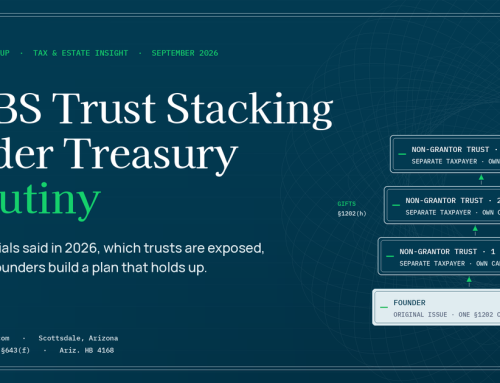
That is the foundation for QSBS stacking, an estate and trust planning technique that spreads QSBS ownership among multiple eligible taxpayers, often family members and nongrantor trusts, so that each separate taxpayer may be positioned to claim its own IRC § 1202 exclusion on a future liquidity event.[1]
Example: A founder holds QSBS worth $45 million. If the founder sells directly, the founder's exclusion is limited by the per-issuer cap rules. If the founder gifts QSBS well in advance to three properly structured nongrantor trusts, and retains some shares individually, there may be four eligible taxpayers, each potentially positioned to claim an exclusion on its own shares, if the transfers and timing withstand scrutiny and each holder satisfies the statutory and anti-abuse constraints.[1]
Stacking can produce dramatic federal tax outcomes, but it is not risk-free. The most common technical pressure points are:
- Whether the holder is truly a separate taxpayer for federal income tax purposes (grantor versus nongrantor trust analysis).[5]
- Whether multiple trusts can be aggregated under the multiple trust rule of IRC § 643(f) and its regulations.[8, 6]
- Whether transfers are vulnerable to assignment of income or step transaction challenges, particularly if made after a sale is sufficiently "locked in."[7, 9, 10]
- Whether state income tax conformity and trust taxation rules erode or eliminate the expected benefit.[11, 12]
This updated post does two things. First, it anchors the stacking concept in primary authorities and identifies where guidance is thin. Second, it updates the planning landscape to reflect the One Big Beautiful Bill Act, with a specific focus on how 2025 differs from 2026 and what new opportunities that creates.[1, 2] For the full treatment of stacking mechanics, see our companion guide, QSBS stacking with trusts under IRC 1202.
2025 versus 2026: what changed under the One Big Beautiful Bill Act
The key statutory pivot date in 2025
The One Big Beautiful Bill Act was approved July 4, 2025.[2] IRC § 1202 now uses an "applicable date" concept tied to that enactment date for several core rules, creating a split regime depending on whether QSBS was acquired on or before July 4, 2025 or acquired after that date.[1]
This means 2025 is a transition year. Two otherwise identical shareholders can face different exclusion mechanics depending on when the shares were acquired.[1]
Core QSBS changes most relevant to stacking and trust planning
For QSBS acquired after July 4, 2025, IRC § 1202 now provides a tiered exclusion schedule tied to holding period, with partial exclusion available earlier than under the historic five-year model.[1, 2]
It also increases key quantitative thresholds that drive the size and availability of the benefit, including the per-issuer dollar cap and the qualified small business gross assets ceiling, with inflation indexing that begins after 2026.[1]
Separately, for transfer planning, the One Big Beautiful Bill Act also increased the federal estate and gift planning baseline beginning in 2026, which can materially change the feasibility of completed gifts to nongrantor trusts used in stacking structures.[3, 4]
2025 and 2026 comparison chart for practitioners
| Topic | 2025 baseline for legacy QSBS (generally stock acquired on or before July 4, 2025) | 2026 baseline for post-enactment QSBS planning (stock acquired after July 4, 2025) |
|---|---|---|
| Minimum holding period to access any exclusion | Generally more than five years | Tiered schedule can begin at three years |
| Exclusion percentage schedule | Historically tied to statutory acquisition dates, with 100 percent available for many post-2010 issuances | Tiered schedule under current § 1202 for post-July 4, 2025 acquisitions, with 50 percent and 75 percent tiers before 100 percent |
| Per-issuer dollar cap concept | Generally the greater of $10 million or 10 times basis, with the classic per-taxpayer, per-issuer framing | Increased dollar cap for post-enactment acquisitions, with statutory coordination and inflation rules |
| Qualified small business gross assets ceiling | Historically $50 million at and immediately after issuance | Increased gross assets ceiling for post-enactment acquisitions, with inflation indexing beginning after 2026 |
| Inflation indexing | Not applicable to the classic $10 million and $50 million figures | Inflation adjustments apply for taxable years beginning after 2026 |
| Estate and gift tax planning backdrop | Inflation-adjusted basic exclusion amount in effect for 2025 | Statutory $15 million basic exclusion amount beginning 2026, with inflation indexing thereafter |
Authorities for the QSBS rule changes are IRC § 1202 as amended and the One Big Beautiful Bill Act enactment materials.[1, 2] Authorities for the 2026 estate and gift planning backdrop are IRC § 2010 and IRS guidance.[3, 4, 13]
IRS and Treasury framework relevant to QSBS trust stacking
Statutory core: § 1202 applies to trusts and allows tacking on qualifying transfers
IRC § 1202 applies to "a taxpayer other than a corporation," which includes individuals, trusts, and estates.[1]
IRC § 1202(h) contains the key transfer rules that make stacking feasible. For specified tax-favored transfers, including transfers by gift and transfers at death, the transferee is generally treated as having acquired the stock in the same manner as the transferor and as having held it during the transferor's holding period.[1]
This tacking rule is essential. It is what allows a founder to make a lifetime gift of QSBS to a separate taxpayer and still preserve the original issuance and holding period continuity needed for the donee to claim a later exclusion.[1]
Important 2025 and 2026 nuance: pass-through holders and holding period rules now reference the applicable date
If QSBS is held through a pass-through entity, IRC § 1202(g) imposes specific requirements, including an ownership continuity requirement tied to the date the pass-through entity acquired the stock.[1]
Notably, the statute now explicitly references a three-year minimum holding period for certain post-applicable-date stock in the pass-through entity context, while retaining the more-than-five-year concept for stock acquired on or before the applicable date.[1]
For trust stacking in fund, partnership, or S corporation contexts, this is an area where careful diligence matters, because a trust donee may not step into a partner's economics if the statutory continuity conditions are not met.[1]
Treasury anti-avoidance authority already exists inside § 1202 itself
IRC § 1202(k) directs Treasury to prescribe regulations to prevent avoidance through split-ups, shell corporations, partnerships, or otherwise.[1] For practitioners, this matters for two reasons:
- It is an express invitation for future regulations addressing perceived abuse patterns, including aggressive stacking designs.[1]
- It is a reminder that the absence of a current anti-stacking regulation is not the same as affirmative approval of every structure that multiplies exclusions.[1]
Grantor versus nongrantor trusts: the separate taxpayer question
Why grantor trusts usually do not stack for federal income tax purposes
A core requirement for stacking is that each QSBS holder must be a separate eligible taxpayer for federal income tax purposes.[1]
If a trust is a grantor trust, the grantor is treated as the owner for federal income tax purposes. Longstanding IRS guidance describes transactions between a grantor and a wholly owned grantor trust as not recognized as a sale between separate taxpayers for federal income tax purposes.[5]
As a result, placing QSBS into a grantor trust typically does not create a new taxpayer for § 1202 limitation purposes during the period the trust is treated as owned by the grantor. Put differently, a sale by the trust is generally treated as a sale by the grantor, so the structure does not multiply the exclusion by itself.[5, 1] A spousal lifetime access trust is usually a grantor trust because the grantor's spouse is a beneficiary, which is why a SLAT generally does not add a separate cap.[14, 15]
Why nongrantor trusts are used for stacking
A nongrantor trust is generally a separate taxpayer for federal income tax purposes. If QSBS is transferred to a properly structured nongrantor trust in a manner that fits within § 1202(h), the trust can potentially be positioned as its own § 1202 claimant.[1]
Private letter rulings are not precedent, but they can be useful for illustrating how the IRS has analyzed grantor trust status and transfer tax completion in modern trust designs. For example, PLR 201908006 reflects analysis of an incomplete gift trust structure designed to be a nongrantor trust for income tax purposes while producing incomplete gift treatment for transfer tax purposes.[16]
The planning takeaway is not that a ruling approves stacking, but that the technical distinction between income tax ownership and transfer tax completion is real, and it must be navigated precisely when designing stacking trusts.[16] Where an existing trust needs adjustment, trust modification or decanting may be available.
The multiple trust rule: IRC § 643(f) and the aggregation risk
Even when each trust is drafted as a separate taxpayer, multiple trusts can be aggregated for federal income tax purposes under IRC § 643(f) and the implementing regulations, if the trusts have substantially the same grantor and substantially the same primary beneficiary and a principal purpose is the avoidance of federal income tax.[8, 6]
This is the primary statutory and regulatory pressure point for a stacking plan that uses multiple trusts for the same family group.
Two additional practical constraints flow from IRS administration:
- The IRS has a formal no-ruling position for certain issues, including whether multiple trusts will be treated as a single trust under § 643(f). This materially reduces the ability to obtain advance comfort for a planned stacking structure.[17]
- Because the analysis is facts-and-circumstances-driven, practitioners typically emphasize differentiation of purpose and operation, including non-tax motivations, trustee selection, distribution standards, and beneficiary design, so the structure has real substance beyond multiplying brackets or exclusions.[6] That design work is central to planning for multi-generational families.
Judicial doctrines that matter for timing and execution
Assignment of income and substance over form risk for late-stage transfers
A stacking plan can fail even if § 1202(h) tacking is technically available, if the facts show that the donor effectively earned or fixed the right to the income before the transfer.
Two Supreme Court anchors are routinely cited in this area:
- Helvering v. Horst, which taxes the person who controls the right to income even if the income is redirected by gift.[7]
- Commissioner v. Court Holding Co., which looks to the substance of who sold the property, not merely the formal steps used to shift the sale.[9]
While those cases are not about QSBS, they represent the basic framework the IRS may invoke if QSBS is gifted after deal terms are effectively binding.
Estate of Hoensheid as a modern timing reminder
Estate of Hoensheid v. Commissioner is a modern Tax Court case in a charitable transfer setting, but it provides a useful illustration of how timing and deal maturity can drive an anticipatory assignment of income outcome.[10]
For QSBS stacking, the practical takeaway is conservative: implement transfers well before a definitive sale process reaches a point where a court could conclude the gain was already fixed to the donor.[7, 9, 10] Our pre-sale and liquidity event planning is built around that timing.
Practitioner commentary and technical analyses worth prioritizing
Because formal IRS guidance on QSBS stacking with multiple trusts remains limited, high-quality secondary sources can be useful, especially when they are grounded in the statute, regulations, and real-world diligence practices.
The following are commonly used by attorneys and advisors because they synthesize § 1202 requirements with estate and trust planning realities:
- BDO, on integrating QSBS into estate and trust planning and the practical diligence points practitioners must confirm.[18]
- FBT Gibbons (formerly Frost Brown Todd), on transfer planning with QSBS, including grantor and nongrantor trust issues and related-party strategies.[19]
- Holland & Knight, on QSBS gifting and the need to respect both § 1202 mechanics and the multiple trust rule risk.[20]
- Major firm updates explaining the One Big Beautiful Bill Act § 1202 changes and effective dates, useful as planning summaries but not a substitute for reading the amended statute itself.[21, 22]
New opportunities and planning checkpoints for 2025 and 2026
What 2025 requires practitioners to do differently
2025 is not a single-regime year. For QSBS planning, you must inventory each block of stock by acquisition date because the July 4, 2025 applicable date determines which mechanics apply.[1, 2]
Key 2025 checkpoints:
- Identify which shares are legacy shares acquired on or before July 4, 2025 and which shares are post-enactment shares.[1, 2]
- Align stack planning with trust income tax classification, because grantor trust status generally will not create a new § 1202 taxpayer.[5]
- If stacking is contemplated, build the structure early enough to reduce assignment of income exposure.[7, 9, 10]
- If multiple trusts will be used, design with § 643(f) and the regulations in mind, knowing the IRS will not rule on aggregation.[6, 17]
What 2026 changes for stacking strategy design
2026 is the first full calendar year after enactment, and it is also the year the Act's estate and gift baseline increases to $15 million, which can expand the feasibility of completed-gift stacking for clients who prefer completed gifts over incomplete gift designs.[3, 4, 13]
Key 2026 opportunities and considerations:
- More founders and early investors may be able to fund completed-gift nongrantor trusts without immediate transfer tax cost, increasing the menu of viable stacking structures.[3, 4]
- Post-enactment QSBS may have earlier partial exclusion windows under amended § 1202, which can materially affect transaction planning and liquidity modeling, especially for founders facing shorter expected holding horizons.[1, 2]
- The qualified small business gross assets ceiling is increased for post-enactment QSBS, which may allow more later-stage companies to qualify for QSBS on new issuances, expanding the universe where stacking and gifting should be analyzed early.[1, 2]
- Inflation indexing mechanics begin after 2026 for key QSBS thresholds, making 2026 a baseline year before indexed increases apply, and potentially changing how practitioners model long-term exit values and exclusion capacity.[1]
Conclusion
QSBS stacking with trusts remains a powerful planning concept because IRC § 1202 is structured around eligible taxpayers and issuer-level limitations, and because IRC § 1202(h) can allow tacking on qualifying gifts and transfers at death.[1]
At the same time, successful stacking is not achieved by forms alone. It depends on:
- Careful taxpayer identity analysis, especially grantor versus nongrantor trust status.[5]
- Respecting the multiple trust aggregation rules and operating each trust with real substance.[6, 17]
- Early implementation to reduce assignment of income and step transaction exposure.[7, 9, 10]
- Updating all modeling for the new 2025 split regime and the 2026 estate and gift planning backdrop created by the One Big Beautiful Bill Act.[1, 2, 3]
How Boland Law Group approaches QSBS planning
Both of our attorneys hold LL.M. degrees, one in taxation and one in estate planning, and both are admitted to the United States Tax Court. The same firm that designs a plan also handles tax controversy and litigation, so stacking structures are drafted with their defense in mind. We plan for business owners, senior executives with equity compensation, and family offices, often as part of a non-grantor dynasty trust plan, and we work alongside CPAs and financial advisors. Clients meet with us at our Scottsdale office, and we serve families throughout Paradise Valley and North Scottsdale.
Sources and bibliography
Numbered citations in the article link to the entries below. Statutes link to the Office of the Law Revision Counsel's U.S. Code, which is prepared by the House of Representatives; the official text controls. Private letter rulings are directed only to the taxpayers who requested them and may not be used or cited as precedent under 26 U.S.C. § 6110(k)(3). Some commentary is available only through republished copies. All links verified September 15, 2026.
- 26 U.S.C. § 1202, Partial exclusion for gain from certain small business stock. Office of the Law Revision Counsel. Back to text
- Act of July 4, 2025, Pub. L. No. 119-21, § 70431, 139 Stat. 72 (expansion of qualified small business stock gain exclusion; commonly called the One Big Beautiful Bill Act). GovInfo. Back to text
- 26 U.S.C. § 2010(c), Basic exclusion amount. Office of the Law Revision Counsel. Back to text
- Internal Revenue Service, Frequently Asked Questions on Gift Taxes (noting that Pub. L. No. 119-21 amended § 2010(c)(3) to set a $15,000,000 basic exclusion amount for 2026). irs.gov. Back to text
- Rev. Rul. 85-13, 1985-1 C.B. 184, as described in Rev. Rul. 2007-13, 2007-11 I.R.B. 684. Internal Revenue Bulletin 2007-11. Back to text
- Treas. Reg. § 1.643(f)-1, Treatment of multiple trusts, adopted by T.D. 9847, 84 Fed. Reg. 3014 (Feb. 8, 2019). eCFR; Federal Register (GovInfo). Back to text
- Helvering v. Horst, 311 U.S. 112 (1940). Cornell LII. Back to text
- 26 U.S.C. § 643(f), Treatment of multiple trusts. Office of the Law Revision Counsel. Back to text
- Commissioner v. Court Holding Co., 324 U.S. 331 (1945). Cornell LII. Back to text
- Estate of Hoensheid v. Commissioner, T.C. Memo. 2023-34 (Mar. 15, 2023). Leagle. Back to text
- California Franchise Tax Board, 2025 Instructions for California Schedule D (540), Qualified Small Business Stock (California does not conform to IRC §§ 1045 and 1202). ftb.ca.gov. Back to text
- Cal. Rev. & Tax. Code § 17742 (trust income taxable when a fiduciary or noncontingent beneficiary is a California resident). California Legislative Information. Back to text
- Internal Revenue Service, Estate Tax (basic exclusion amount table listing $15,000,000 for 2026). irs.gov. Back to text
- 26 U.S.C. § 677(a), Income for benefit of grantor. Office of the Law Revision Counsel. Back to text
- 26 U.S.C. § 672(e), Grantor treated as holding any power or interest of grantor's spouse. Office of the Law Revision Counsel. Back to text
- I.R.S. Priv. Ltr. Rul. 201908006 (Oct. 10, 2018) (released Feb. 22, 2019). irs.gov (PDF). Back to text
- Rev. Proc. 2026-3, § 3.01(93), 2026-1 I.R.B. 143 (no rulings on whether two or more trusts will be treated as one trust under § 643(f)); the same item appears in Rev. Proc. 2023-3, § 3.01(90), 2023-1 I.R.B. 144. Internal Revenue Bulletin 2026-01; Internal Revenue Bulletin 2023-01. Back to text
- BDO USA, Have Qualified Small Business Stock? Consider Section 1202 as Part of Your Estate and Trust Planning (Aug. 6, 2025). bdo.com. Back to text
- Scott W. Dolson, Transfer Planning With Qualified Small Business Stock, FBT Gibbons, formerly Frost Brown Todd (May 21, 2021). fbtgibbons.com. Back to text
- John Bunge, A Look at the Tax Implications of Gifting Qualified Small Business Stock, Holland & Knight LLP (Aug. 2025), republished by Mondaq (Aug. 29, 2025). mondaq.com. Back to text
- Perkins Coie LLP, Significant Changes by the One Big Beautiful Bill Act to the Qualified Small Business Stock Provisions of Section 1202 (July 10, 2025), republished by Mondaq (July 15, 2025); the original page is no longer available on the firm's website. mondaq.com. Back to text
- Steven Hadjilogiou, Michael J. Bruno and Alejandro Ruiz, One Big Beautiful Bill Act Brings Major Changes to Section 1202 Capital Gains Exclusion, McDermott Will & Emery (July 10, 2025). mcdermottlaw.com. Back to text
Additional authorities and further reading
- I.R.S. Priv. Ltr. Rul. 202244004 (Aug. 9, 2022) (released Nov. 4, 2022) (granting relief to make a late § 1045 rollover election for proceeds from a QSBS sale). irs.gov (PDF).
- Estelle Morris Trusts v. Commissioner, 51 T.C. 20 (1968), aff'd per curiam, 427 F.2d 1361 (9th Cir. 1970) (a decision before § 643(f) was enacted in which separately administered trusts were respected as separate taxpayers). Ninth Circuit opinion (CourtListener).
- ACTEC Foundation, Using Multiple Non-Grantor Trusts for Multiple Tax Benefits, ACTEC Trust & Estate Talk (June 15, 2021) (podcast with ACTEC Fellow Justin Miller). actecfoundation.org.
Related reading from Boland Law Group: QSBS trust stacking under Treasury scrutiny (2026), QSBS stacking with trusts, children's trusts after the 2025 tax law, dynasty trusts, SLAT planning, and all insights.
Important legal notice
Please read this notice before relying on anything in this article. By reading this article you acknowledge the following.
Information only, not advice
This article is general educational information about federal and state tax law and estate planning. It is not legal, tax, accounting, investment, or financial advice, and it is not a substitute for advice from a qualified professional who knows your facts. Do not act, or refrain from acting, based on anything in it.
No attorney-client relationship
Reading this article, using this website, calling, emailing, or submitting a form does not create an attorney-client relationship with Boland Law Group, PLLC or any of its attorneys. A relationship is formed only after a conflict check, a written engagement letter signed by the client and the firm, and payment of any required fees, as described in our Terms of Engagement. Until then, please do not send confidential information; anything you send may not be treated as privileged or confidential.
Not a tax opinion; not for penalty protection
This article is not a tax opinion or written tax advice on which any person may rely. It was not written to be used, and cannot be used, by any person to avoid penalties that may be imposed under the Internal Revenue Code or any state or local tax law, or to establish reasonable cause, good faith, or reliance on professional advice for any tax position. It is not an offer, solicitation, promotion, or recommendation of any transaction, investment, trust structure, or tax strategy.
No guarantee of any outcome
No result is promised or guaranteed. The Internal Revenue Service, the Treasury Department, state tax agencies, and courts may disagree with any view expressed here, may challenge transactions of the kind described, and may apply existing law or new guidance, including guidance with retroactive effect, in ways that increase tax, interest, or penalties. Whether any structure succeeds depends on specific facts, documentation, timing, and administration.
The law changes; no duty to update
This article reflects statutes, regulations, and guidance known to us when it was written; its sources were last checked on September 15, 2026. Tax law, agency guidance, and state conformity change frequently and sometimes without notice. We have no obligation to update this article, and information that was accurate when written may later become inaccurate.
Third-party statements and links
Statements attributed to government officials, commentators, and publications are summarized from the public sources listed above, some of which report remarks secondhand. We do not control, endorse, or guarantee the accuracy, completeness, or availability of any third-party content or link.
Examples are hypothetical
Examples, figures, and tax rates are simplified illustrations only. They are not projections, estimates, or promises of any tax savings, and your actual results will differ.
Jurisdiction
Our attorneys are admitted to practice before the Supreme Court of Arizona, the United States Tax Court, and the United States District Court for the District of Arizona. Discussion of other states' laws, including California, is general in nature; consult counsel licensed in that state. This article is not intended to solicit clients in any jurisdiction where doing so would not comply with applicable rules.
Limitation of liability
To the fullest extent permitted by law, Boland Law Group, PLLC and its attorneys and staff disclaim all liability for any loss, damage, tax, interest, penalty, or expense arising from any use of, or reliance on, this article or any linked content. Your use of this website is also subject to our Privacy Policy.
Attorney advertising
This article may be considered attorney advertising under applicable rules of professional conduct. Responsible attorney: Grant M. Boland, J.D., LL.M., Boland Law Group, PLLC, 15100 N. 78th Way, Suite 203, Scottsdale, Arizona 85260, (480) 420-8268.