For a founder holding low-basis stock, the Section 1202 exclusion can be the largest single tax number in the entire estate plan. That is why QSBS trust stacking became a standard part of high net worth estate planning for business owners in Scottsdale and Paradise Valley, and why the Treasury Department's comments this year deserve a careful reading rather than alarm. This update explains what officials actually said, what has and has not changed, which structures are most likely to be challenged, and how to build a plan that holds up. If a sale of your company is on the horizon, read it alongside our page on pre-sale and liquidity event planning.
If the technique is new to you, our two foundational guides cover the mechanics in depth: QSBS stacking with trusts under IRC 1202 and how the One Big Beautiful Bill Act changed Section 1202 for 2025 and 2026. This article focuses on the 2026 scrutiny and what to do about it.
How QSBS trust stacking works
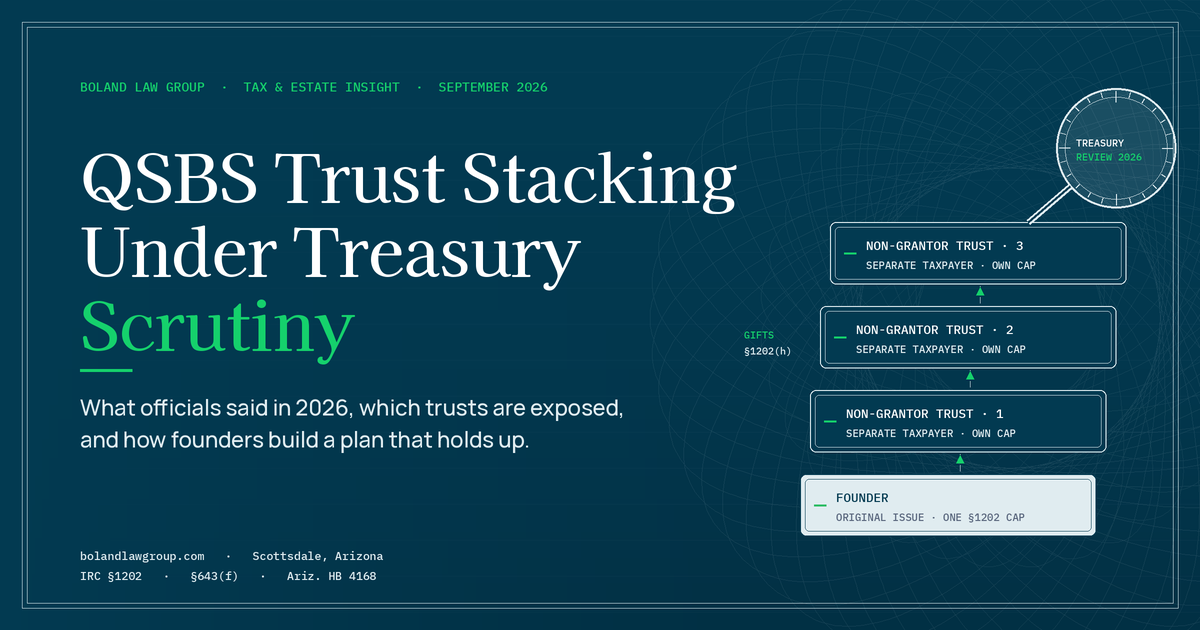
Section 1202 of the Internal Revenue Code lets a taxpayer other than a corporation exclude gain on the sale of qualified small business stock: stock originally issued by a domestic C corporation that meets the gross asset and active business tests.[1] The exclusion is capped per taxpayer and per issuer. For stock acquired after July 4, 2025, the cap is the greater of $15 million or ten times basis, and a partial exclusion becomes available sooner: 50 percent after three years, 75 percent after four, and 100 percent after five.[1, 8] For stock acquired on or before July 4, 2025, the cap is the greater of $10 million or ten times basis, with the longstanding five-year holding period.[1]
Two features of the statute make stacking possible. First, a non-grantor trust is a separate taxpayer with its own cap. Second, Section 1202(h) lets someone who receives QSBS by gift step into the donor's shoes, keeping the stock's qualified status and the donor's holding period.[1] Gift shares to three properly built non-grantor trusts, and four taxpayers may each claim a cap on the same company's stock.
| Ownership at sale | Taxpayers | Gain excluded |
|---|---|---|
| Founder holds every share | 1 | $15 million |
| Founder keeps one quarter and gifts equal shares to three non-grantor trusts, one for each child | 4 | up to $60 million |
| Additional gain excluded by stacking | $45 million | |
| Approximate federal tax avoided on that gain at a 23.8 percent combined rate | about $10.7 million |
Illustration only. Assumes stock acquired after July 4, 2025 and held more than five years, nominal basis, $15 million of gain in each holder's shares, every Section 1202 requirement met, and trusts respected as separate taxpayers. The 23.8 percent rate combines the 20 percent maximum long-term capital gains rate and the 3.8 percent net investment income tax.[9, 10] The $15 million cap is indexed for inflation beginning in 2027, and each gift uses part of the founder's lifetime gift tax exemption.[1, 11]
One trust for each child, as in the example, is the most common pattern, and reports indicate officials are focused on arrangements that go beyond it.[2] It also fits naturally with the planning in our guide to children's trusts after the 2025 tax law. When a trust is drafted as a non-grantor dynasty trust, the same gift can also keep future growth outside the taxable estate for generations.
What Treasury said in 2026, and what it has not done
Treasury attorney-adviser Evan Adams publicly raises concerns about QSBS stacking.[2]
At a tax seminar in Washington, Kenneth Kies, Treasury's assistant secretary for tax policy and acting IRS chief counsel, warns practitioners, "we don't like stacking," and indicates that guidance is being developed. Reports describe his focus as arrangements that go beyond one trust per family member.[2, 3]
- Late June 2026
The Wall Street Journal reports on the spread of trust stacking and the government's objections, describing a proposal in which two co-founders would gift stock to 18 trusts. Subsequent commentary reports that Treasury and IRS officials are preparing guidance.[12, 13, 14]
Foley & Lardner advises founders and venture investors that deal diligence will increasingly probe when gifts were made and how independent the trusts are.[5]
In Tax Notes Federal, professors Gregg Polsky and Ethan Yale urge Treasury to use its Section 1202(k) authority against abusive trust structures, while acknowledging that well-structured stacking appears safe under current law.[13]
No notice, proposed regulation, or revenue ruling on QSBS stacking has been released.
Three points keep this in perspective. Conference remarks and press reports are signals, not law. Congress expanded Section 1202 in 2025 and left the gift rule untouched.[8, 2] And whether Treasury can restrict by regulation a result the statute expressly allows is genuinely contested, particularly after the Supreme Court's 2024 Loper Bright decision ended judicial deference to agency interpretations of ambiguous statutes.[15, 2] Most practitioners expect any new rule to begin as proposed regulations open for public comment and to apply going forward, though some caution that the government may argue the most aggressive structures already fail under existing doctrines.[4, 14]
The structures most likely to draw a challenge
Officials have not published a list, but their comments and the existing law point to the same pressure points:[4, 5]
- More trusts than beneficiaries. A founder with two children who creates five trusts invites the question of what the extra trusts do besides claim extra exclusions.
- Overlapping beneficiaries. Trusts that benefit the same people in the same way look like one trust divided for tax purposes.[16]
- Friendly or shared trustees. Separation that exists on paper but not in how the trusts are actually run.[5]
- Gifts made after a sale is in motion. Once a letter of intent is signed, the gain may be treated as the founder's own under the assignment of income doctrine.[2]
- Trusts that change status near a sale. Converting a grantor trust to a non-grantor trust shortly before closing raises the same timing question.
- Rollovers into companies without real operations. Commentators have flagged Section 1045 reinvestments into shell companies as another likely target.[17, 18]
The rules the IRS can already use
The multiple trust rule
Section 643(f) allows the IRS to treat two or more trusts as one when they have substantially the same grantor and substantially the same primary beneficiaries, and a principal purpose is avoiding federal income tax.[16] The implementing regulation, Treasury Regulation 1.643(f)-1, was finalized in February 2019 and treats spouses as one person, so trusts created separately by each spouse for the same children can be aggregated.[19, 20] Aggregated trusts share one cap, and the stacking benefit disappears.
Grantor trust status
A grantor trust is not a separate taxpayer for income tax purposes, so it does not add an exclusion.[21] This surprises many families. A spousal lifetime access trust is usually a grantor trust because the grantor's spouse is a beneficiary, so a SLAT holding QSBS generally shares the grantor's cap rather than adding one.[22, 23] The same is true of many irrevocable trusts that are intentionally drafted as grantor trusts. Our SLAT planning guide explains why that design is often the right choice for other reasons.
Judicial doctrines and Section 1202(k)
Assignment of income, step transaction, and substance over form let a court look past the paperwork. A gift made days before a signed deal closes is the classic losing case.[2] Separately, Section 1202(k) directs Treasury to issue regulations preventing avoidance of the statute's purposes, and it is the authority commentators point to for any new guidance.[1, 13]
An existing trust is not necessarily a problem. Where a trust's terms or administration weaken its independence, trust modification or decanting may be available to strengthen it, provided the changes serve sound purposes and are made well before any sale.
What defensible planning looks like
| Draws scrutiny | Built to hold up |
|---|---|
| More trusts than family members | One trust for each real beneficiary, each with its own purpose |
| Identical terms and overlapping beneficiaries | Distinct beneficiaries, distribution standards, and remainder plans |
| Relatives or advisers acting as one unit across every trust | Independent trustees who administer each trust separately |
| Gifts after a letter of intent or during a sale process | Gifts completed years before any exit discussion |
| Values borrowed from the deal price | A qualified appraisal as of the gift date and a gift tax return that adequately discloses the transfer |
| Stacking as the only reason the trusts exist | Documented family, asset protection, and estate goals that stand on their own |
Sources for this comparison: commentary on the 2026 Treasury remarks and the federal gift reporting rules.[4, 5, 24]
The common thread is substance. A trust that would make sense for your family even if Section 1202 did not exist is far more likely to be respected than one that exists only to claim an exclusion. That is where QSBS planning meets the rest of the plan: estate planning for business owners, succession, and the long-range goals of multi-generational families. Early employees and senior executives with equity compensation should run the same analysis on their own shares, and families with a family office should make sure trustee roles are genuinely separated across trusts.
The Arizona angle
Arizona conforms to the Internal Revenue Code as of a fixed date that the Legislature updates. On June 13, 2026, Governor Hobbs signed HB 4168, which moved that date to January 1, 2026 and generally adopted the One Big Beautiful Bill Act changes, including those with retroactive effective dates.[6, 7] For most Arizona residents, that means gain excluded under Section 1202 on the federal return is also excluded on the Arizona return, though your CPA should confirm the result for your specific year of sale. Arizona also repealed its estate tax and imposes no inheritance or gift tax,[25] which is part of why Scottsdale estate planning for founders can be unusually efficient.
Where Arizona families get caught is across the state line. California does not follow Section 1202,[26] and it can tax the entire income of a non-grantor trust when a trustee or a noncontingent beneficiary is a California resident.[27] Families who moved to Paradise Valley or North Scottsdale from California, who name a California trustee, or whose children live there should review trust situs before relying on a stacked exclusion. We review these questions with clients at our Scottsdale office and by secure video.
Should you act now or wait for guidance?
Waiting has a cost. The best QSBS gifts are made early, when the stock's value is low, the gift uses little of your $15 million lifetime exemption,[11] and no sale is in view. Rushing has a cost too, because a hurried structure with thin substance is exactly what officials described. For most founders the right answer is to build a plan now that would make sense even if guidance arrived next quarter, and to avoid the aggressive variations until the rules are clear. Our QSBS planning for founders is built on that principle.
If your family already holds stacked trusts, this is a good time for a review. Confirm each trust's non-grantor status, trustee independence, and records, and assemble the documentation you would want if the IRS asked why each trust exists.
A founder's sequence before any gift
- Confirm the stock qualifies. Check original issuance, C corporation status, the gross asset test at issuance, and the active business test throughout the holding period.[1]
- Model the cap. Compare the dollar cap with ten times basis for each holder, and decide how many separate taxpayers the expected gain actually supports.
- Define the family goals first. Decide who should benefit and why, then design one trust for each real purpose.
- Draft true non-grantor trusts. Appoint independent trustees and confirm that no provision makes a trust a grantor trust.[22, 23]
- Value and transfer early. Obtain a qualified appraisal and complete the gifts well before any letter of intent.
- Report the gifts. File gift tax returns on Form 709 that adequately disclose each transfer.[28, 24]
- Keep the file current. Coordinate with your CPA, wealth adviser, and corporate counsel, and keep records of the company's QSBS status for every year you hold the stock. We regularly work alongside CPAs and financial advisors on exactly this.
How Boland Law Group approaches QSBS planning
Both of our attorneys hold LL.M. degrees, one in taxation and one in estate planning, and both are admitted to the United States Tax Court. The same firm that designs a plan also handles tax controversy and litigation. That matters here. A stacking plan should be drafted by lawyers who think about how it would be defended, because that is exactly the question Treasury is now asking.
Frequently asked questions
Is QSBS trust stacking still legal in 2026?
Yes. As of September 15, 2026, stacking is permitted under current law. Section 1202 applies its cap per taxpayer, a non-grantor trust is a separate taxpayer, and Section 1202(h) preserves qualified status for gifted shares. Treasury officials have criticized aggressive stacking, but no notice, proposed regulation, or ruling restricting it has been issued.
What did Treasury say about QSBS stacking?
In May 2026, Treasury attorney-adviser Evan Adams and then Kenneth Kies, Treasury's assistant secretary for tax policy and acting IRS chief counsel, publicly criticized stacking. Kies reportedly focused on arrangements that go beyond one trust per family member and said guidance is being developed. Later reporting indicated that work on that guidance is under way.
Will new rules apply to trusts I have already created?
No one knows yet. Most practitioners expect Treasury to start with proposed regulations and to apply new rules going forward. Some caution that the IRS may argue the most aggressive existing structures already fail under Section 643(f) or the assignment of income doctrine. A well-documented trust with a genuine family purpose is in the strongest position either way.
How many trusts is too many for QSBS stacking?
There is no bright-line number. Reports indicate officials are focused on arrangements that go beyond one trust for each family member who is a real beneficiary. Risk rises when trusts outnumber beneficiaries, share the same beneficiaries on the same terms, or are run by the same people as a single unit, because Section 643(f) lets the IRS treat such trusts as one.
Does a SLAT or other grantor trust get its own QSBS exclusion?
Generally no. A grantor trust is treated as owned by the grantor for income tax purposes, so it shares the grantor's cap. A spousal lifetime access trust is usually a grantor trust because the grantor's spouse is a beneficiary. Only a trust that is a non-grantor trust for income tax purposes adds a separate Section 1202 cap.
Does Arizona follow the federal QSBS exclusion?
Generally yes. Arizona conforms to the Internal Revenue Code as of a fixed date, and HB 4168, signed June 13, 2026, updated that date to January 1, 2026, bringing in the 2025 federal changes. Gain excluded under Section 1202 federally is generally excluded for Arizona as well. Confirm the result for your year of sale with your CPA.
When is it too late to gift QSBS before a sale?
There is no fixed deadline, but risk climbs sharply once a sale is in motion. A gift made after a letter of intent is signed invites an assignment of income challenge, and a known deal price complicates valuation. The most defensible gifts are completed years before any exit discussion begins.
Should founders still consider QSBS stacking?
For many founders, yes. The scrutiny is aimed at duplicative, tax-driven structures, not at ordinary gifts to trusts for children and grandchildren. A plan built early, with independent trustees, distinct beneficiaries, qualified appraisals, and a purpose that stands without the tax result, remains one of the most valuable tools available to a founder's family.
Sources and bibliography
Numbered citations in the article link to the entries below. Statutes and regulations are linked to the Legal Information Institute at Cornell Law School for convenience; the official text controls. Some news and journal sources require a subscription.
- 26 U.S.C. § 1202, Partial exclusion for gain from certain small business stock. Cornell LII. Back to text
- Paul B. Myers, Samuel Olchyk and Moshe Golombeck, QSBS Stacking in the Crosshairs?, Venable LLP (May 28, 2026). venable.com. Back to text
- IRS to Target Stacking Under Qualified Small Business Stock Rules, CBIZ (May 26, 2026). cbiz.com. Back to text
- Treasury Signals Increased Scrutiny on QSBS Trust "Stacking" Strategies, Withum (June 2, 2026). withum.com. Back to text
- Louis Lehot, Brian L. Lucareli and Jason J. Kohout, QSBS Trust Stacking Comes Under the Microscope, Foley & Lardner LLP (July 6, 2026). foley.com. Back to text
- Ariz. H.B. 4168, 57th Leg., 2d Reg. Sess. (2026), Taxation; omnibus; 2026-2027, signed June 13, 2026 (Laws 2026, ch. 140). House bill summary (azleg.gov). Back to text
- Arizona Updates IRC Conformity Date to January 1, 2026, Forvis Mazars (July 10, 2026). forvismazars.us. Back to text
- One Big Beautiful Bill Act, Pub. L. No. 119-21 (July 4, 2025) (H.R. 1, 119th Cong.). Congress.gov. Back to text
- 26 U.S.C. § 1(h), Maximum capital gains rate. Cornell LII. Back to text
- 26 U.S.C. § 1411, Net investment income tax. Cornell LII. Back to text
- 26 U.S.C. § 2010(c), Basic exclusion amount. Cornell LII. Back to text
- The Wall Street Journal, reporting on QSBS trust stacking and the government's objections (late June 2026) (subscription required). wsj.com. Back to text
- Gregg D. Polsky and Ethan Yale, Fixing the QSBS Stacking Problem, 192 Tax Notes Fed. 1769 (Sept. 7, 2026). Tax Notes (subscription required); excerpt at TaxProf Blog. Back to text
- Treasury Eyes QSBS Trust Stacking: What Founders Should Do, The Startup Law Blog (updated July 4, 2026). thestartuplawblog.com. Back to text
- Loper Bright Enterprises v. Raimondo, 603 U.S. 369 (2024). Opinion (supremecourt.gov). Back to text
- 26 U.S.C. § 643(f), Treatment of multiple trusts. Cornell LII. Back to text
- 26 U.S.C. § 1045, Rollover of gain from qualified small business stock to another qualified small business stock. Cornell LII. Back to text
- Eleanor Dulam, Treasury's Coming QSBS Crackdown Puts Trust Stacking in the Spotlight, QSBS Expert (June 3, 2026). qsbsexpert.com. Back to text
- Treas. Reg. § 1.643(f)-1, Treatment of multiple trusts (26 C.F.R. § 1.643(f)-1). Cornell LII. Back to text
- T.D. 9847, Qualified Business Income Deduction, 84 Fed. Reg. 3014 (Feb. 8, 2019). GovInfo. Back to text
- Rev. Rul. 85-13, 1985-1 C.B. 184 (transactions between a grantor and a wholly owned grantor trust are disregarded for federal income tax purposes). Back to text
- 26 U.S.C. § 677(a), Income for benefit of grantor or grantor's spouse. Cornell LII. Back to text
- 26 U.S.C. § 672(e), Grantor treated as holding any power or interest of grantor's spouse. Cornell LII. Back to text
- Treas. Reg. § 301.6501(c)-1(f), Adequate disclosure of gifts. Cornell LII. Back to text
- Arizona Department of Revenue, Publication 900, Estate Tax (rev. Sept. 2006). azdor.gov. Back to text
- California Franchise Tax Board, 2024 Instructions for California Schedule D (540), Qualified Small Business Stock. ftb.ca.gov. Back to text
- Cal. Rev. & Tax. Code § 17742. California Legislative Information. Back to text
- Internal Revenue Service, About Form 709, United States Gift (and Generation-Skipping Transfer) Tax Return. irs.gov. Back to text
Related reading from Boland Law Group: QSBS stacking with trusts, QSBS after the OBBBA, dynasty trusts, high net worth estate planning, and all insights.
Important legal notice
Please read this notice before relying on anything in this article. By reading this article you acknowledge the following.
Information only, not advice
This article is general educational information about federal and state tax law and estate planning. It is not legal, tax, accounting, investment, or financial advice, and it is not a substitute for advice from a qualified professional who knows your facts. Do not act, or refrain from acting, based on anything in it.
No attorney-client relationship
Reading this article, using this website, calling, emailing, or submitting a form does not create an attorney-client relationship with Boland Law Group, PLLC or any of its attorneys. A relationship is formed only after a conflict check, a written engagement letter signed by the client and the firm, and payment of any required fees, as described in our Terms of Engagement. Until then, please do not send confidential information; anything you send may not be treated as privileged or confidential.
Not a tax opinion; not for penalty protection
This article is not a tax opinion or written tax advice on which any person may rely. It was not written to be used, and cannot be used, by any person to avoid penalties that may be imposed under the Internal Revenue Code or any state or local tax law, or to establish reasonable cause, good faith, or reliance on professional advice for any tax position. It is not an offer, solicitation, promotion, or recommendation of any transaction, investment, trust structure, or tax strategy.
No guarantee of any outcome
No result is promised or guaranteed. The Internal Revenue Service, the Treasury Department, state tax agencies, and courts may disagree with any view expressed here, may challenge transactions of the kind described, and may apply existing law or new guidance, including guidance with retroactive effect, in ways that increase tax, interest, or penalties. Whether any structure succeeds depends on specific facts, documentation, timing, and administration.
The law changes; no duty to update
This article reflects statutes, regulations, public statements, and reporting known to us as of September 15, 2026. Tax law, agency guidance, and state conformity change frequently and sometimes without notice. We have no obligation to update this article, and information that was accurate when written may later become inaccurate.
Third-party statements and links
Statements attributed to government officials, commentators, and publications are summarized from the public sources listed above, some of which report remarks secondhand. We do not control, endorse, or guarantee the accuracy, completeness, or availability of any third-party content or link.
Examples are hypothetical
Examples, figures, and tax rates are simplified illustrations only. They are not projections, estimates, or promises of any tax savings, and your actual results will differ.
Jurisdiction
Our attorneys are admitted to practice before the Supreme Court of Arizona, the United States Tax Court, and the United States District Court for the District of Arizona. Discussion of other states' laws, including California, is general in nature; consult counsel licensed in that state. This article is not intended to solicit clients in any jurisdiction where doing so would not comply with applicable rules.
Limitation of liability
To the fullest extent permitted by law, Boland Law Group, PLLC and its attorneys and staff disclaim all liability for any loss, damage, tax, interest, penalty, or expense arising from any use of, or reliance on, this article or any linked content. Your use of this website is also subject to our Privacy Policy.
Attorney advertising
This article may be considered attorney advertising under applicable rules of professional conduct. Responsible attorney: Grant M. Boland, J.D., LL.M., Boland Law Group, PLLC, 15100 N. 78th Way, Suite 203, Scottsdale, Arizona 85260, (480) 420-8268.