The short answer
What is a dynasty trust, and what changed for 2026?
A dynasty trust is an irrevocable trust built to hold family wealth for children, grandchildren and later generations instead of ending when the children inherit. When generation-skipping transfer (GST) tax exemption is allocated to it at funding, the trust and all of its growth can pass down free of federal estate and GST tax at each death. The trade is income tax basis: assets kept outside the estate receive no step-up at death, so a modern dynasty trust is drafted to manage basis as carefully as it manages transfer tax.
- The 2026 federal estate, gift and GST exemption is $15 million per person, and the top rate above it is 40 percent.[1, 2]
- The GST exemption is not portable between spouses. Each spouse allocates it, in life or at death, or it is lost.[3, 4]
- Under Rev. Rul. 2023-2, assets in an irrevocable grantor trust that are outside the grantor's estate receive no basis step-up at the grantor's death.[5]
- Arizona lets a trust interest wait up to 500 years to vest and imposes no estate, inheritance or gift tax.[6, 7]
Dynasty trusts remain the most durable way to separate control from beneficial enjoyment, to hard-wire creditor and divorce protection, and to compound capital outside the transfer tax system for several generations. This guide is the technical companion to our overview for families, dynasty trust attorneys in Arizona. It is written for the attorneys, CPAs and financial advisors who draft, fund and administer long-duration trusts, and for families across Scottsdale, Paradise Valley, North Scottsdale and Carefree who want to understand the engineering behind an Arizona estate plan.
Executive summary
The federal landscape shifted in 2025. For calendar year 2025 the basic exclusion amount for estate and gift tax was $13.99 million per individual and the annual gift tax exclusion was $19,000 per donee.[14] Congress then enacted the One Big Beautiful Bill Act in July 2025, which set the basic exclusion at $15 million beginning in 2026 with inflation indexing for later years.[8, 1] That removed the uncertainty that the exemption would fall by roughly half at the end of 2025. The rate remains 40 percent.[2] Practitioners should recalibrate designs for both lifetime and testamentary transfers, with special attention to basis management after the Service's 2023 ruling on step-up for grantor trusts. For families near or above those figures, this is the core of high net worth estate planning.
On the income tax side the step-up in basis rule under section 1014 is intact.[15] The Service confirmed in Rev. Rul. 2023-2 that assets in an irrevocable grantor trust that are not includible in the grantor's gross estate do not receive a basis adjustment at the grantor's death.[5] Basis consistency and reporting rules under section 1014(f) and section 6035 continue to constrain mismatches between estate tax value and income tax basis for property reported on an estate tax return that is required to be filed.[16, 13] These points together make basis engineering essential in dynasty trust drafting and administration.
What follows is a deep dive into wealth propagation with an eye on estate tax, generation-skipping transfer tax, income tax basis, and the practical levers that allow a family to retain optionality as laws and facts change.
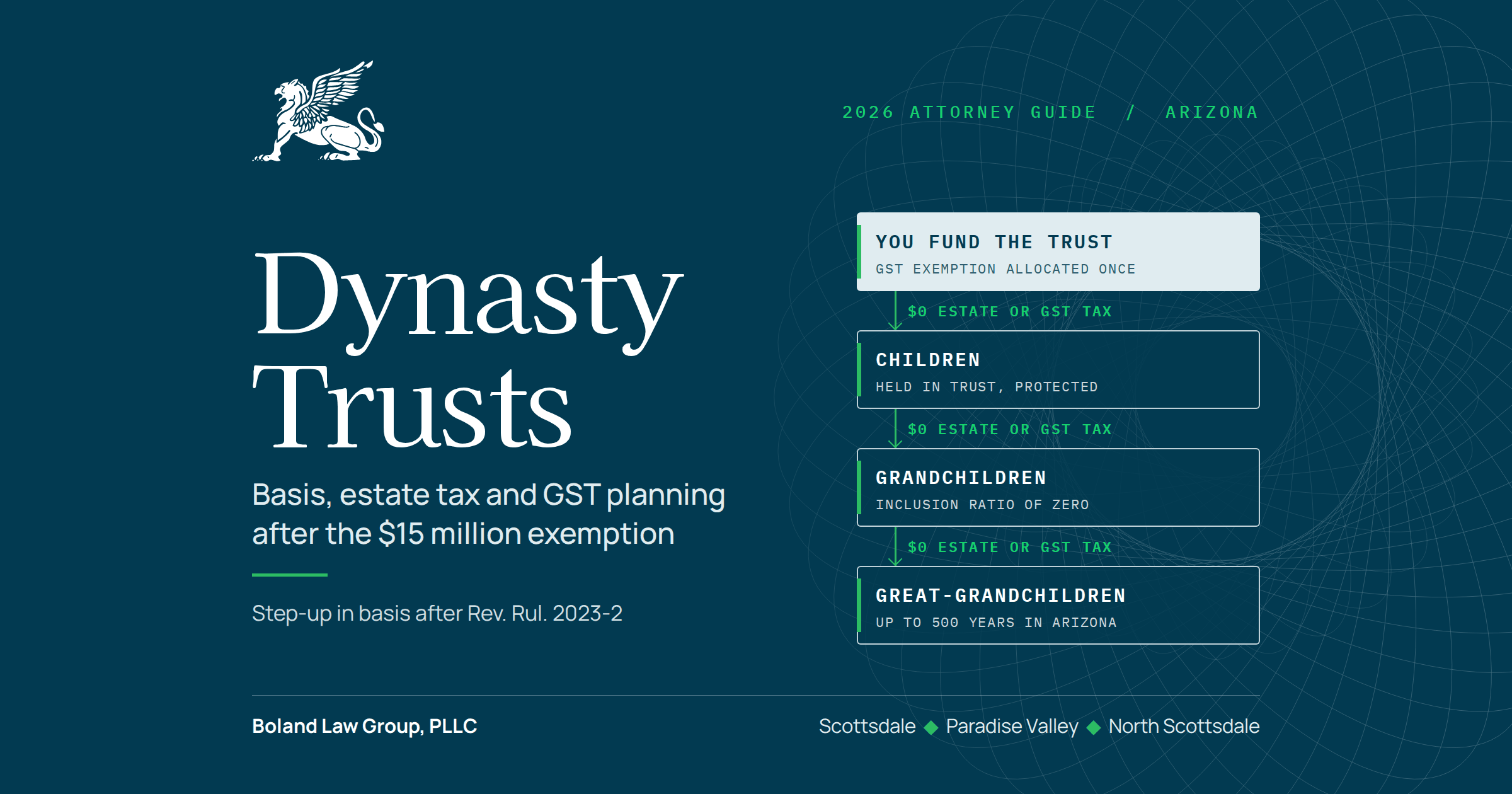
You fund the trust
A gift or bequest uses your exemption once, and GST exemption is allocated so the inclusion ratio is zero.
Your children benefit
Trustees distribute under your standards. Nothing is included in a child's taxable estate.
Your grandchildren benefit
No estate tax and no GST tax at the children's deaths, however much the trust has grown.
Later generations
The same protection repeats for as long as state law lets the trust last.
Federal transfer taxes in 2025 and what changed in 2026
Current thresholds. For 2026 the basic exclusion is $15 million per person, or $30 million for a married couple, and the annual gift tax exclusion is $19,000 per donee.[1] For 2025 the figures were $13.99 million and $19,000.[14] Spouses can continue to elect portability of a deceased spouse's unused exclusion.[4] The top federal rate is 40 percent.[2]
From 2026 forward. The One Big Beautiful Bill Act fixes the basic exclusion at $15 million starting January 1, 2026 and indexes it for later years. Because the GST exemption is defined by reference to the basic exclusion amount, that figure applies for estate, gift and GST purposes.[8, 3] The Act did not repeal portability or the 40 percent rate, and it schedules no sunset, although a future Congress can always change the figure. Plan designs that assumed a hard drop at the end of 2025 should be revisited. Our earlier notes cover the gift and estate tax exemption changes in the Act, the Act's key takeaways at a glance and why planning is still crucial at $15 million.
No clawback of prior gifts. The anti-clawback regulations remain in effect.[17] A decedent who used a higher exclusion during life is not penalized if the exclusion is lower at death. With the exclusion now rising and not falling, the rule matters less in 2026 than it did in 2025, but it remains the assurance behind any advice to use exemption during life.
The GST tax in one paragraph. The generation-skipping transfer tax is a separate flat tax, at the top estate tax rate, on transfers that skip a generation, whether made outright or from a trust.[18, 19] A trust's exposure is measured by its inclusion ratio. Allocate enough GST exemption when the trust is funded and the inclusion ratio is zero, which means no GST tax on any later distribution or termination, however much the trust grows.[20, 21] That single election is the engine of every dynasty trust, and because a surviving spouse cannot inherit a deceased spouse's unused GST exemption, couples well below $30 million still have a reason to use it.[3]
Why dynasty trusts still dominate
A dynasty trust locks in creditor protection, family governance and multigenerational GST shelter. Modern trust jurisdictions permit very long or perpetual duration and often offer directed trustee statutes, decanting flexibility, trust protector roles and favorable income tax treatment. Where a family wants lifetime protection for one generation only, the simpler structures in our guide to children's trusts for lifetime planning may be enough. A dynasty trust is what carries the same protection past that generation.
Duration. How long a trust may last is a question of state law, and the answers differ widely.
| State | Duration rule | Authority |
|---|---|---|
| Arizona | An interest must vest or terminate within 500 years. A separate provision covers trusts whose trustee holds a power of sale when its conditions are met. | A.R.S. § 14-2901(A)(2), (A)(3)[6] |
| South Dakota | The common law rule against perpetuities is not in force. | S.D. Codified Laws § 43-5-8[22] |
| Delaware | No perpetuities limit for personal property held in trust. Real property held in trust is limited to 110 years. | Del. Code Ann. tit. 25, § 503[23] |
| Nevada | An interest must vest or terminate within 365 years. | Nev. Rev. Stat. § 111.1031[24] |
| Alaska | The common law rule does not apply. Certain powers of appointment must be exercised within 1,000 years, and a separate rule limits suspension of the power of alienation. | Alaska Stat. §§ 34.27.051, .075, .100[25] |
Statutes as published by each legislature when this guide was reviewed. State trust law changes often. Confirm current text before choosing a situs.
Situs selection. Selecting situs in a jurisdiction that does not tax trust income can reduce drag on compounding when the trust will accumulate income for decades. This interacts with state source rules and fiduciary residency, so documents should empower trustees to change situs and governing law if family circumstances or statutes change. For an Arizona family the income tax case for leaving is modest. Arizona taxes a resident trust's income at a flat 2.5 percent, and a trust is an Arizona resident trust only when a fiduciary is an Arizona resident or, for a corporate trustee acting alone or with a nonresident, when the trust is administered here.[26, 27, 28]
Dynasty trusts under Arizona law
Federal tax law decides what a dynasty trust saves. State trust law decides how long it lasts, who can change it and whom it protects. Most of our clients live in Arizona, and most of their dynasty trusts are governed by Arizona law, so the Arizona rules deserve their own summary. Our page on how dynasty trusts work in Arizona gives the overview for families.
- Duration
Arizona's statute allows an interest to wait 500 years to vest.[6] In 2018 the Arizona Attorney General concluded that the 500 year period, and the companion provision for trusts with a power of sale, likely conflict with the Arizona Constitution's prohibition on perpetuities.[29, 30] An Attorney General opinion is advisory and does not bind a court, and we are aware of no Arizona appellate decision striking either provision. We draft for the question anyway, with a savings clause that ends each share within the traditional perpetuities period if the longer periods are ever lost.
- Adaptability
The instrument may appoint a trust protector with power to remove and replace trustees, amend the trust for changes in law and change the governing law, and it may give an advisor power to direct investments.[31, 32] Unless the instrument specifically says otherwise, a protector's amendment may not give a beneficial interest to someone the instrument does not already provide for. The terms of the trust designate the law that governs it, and a trustee may move the principal place of administration.[33, 34]
- Modification
A trustee with discretion over distributions may decant to a new trust without court approval, and interested persons may resolve many matters by nonjudicial settlement agreement.[35, 36] See trust modification and decanting.
- Creditor protection
A spendthrift clause keeps a beneficiary's interest from most creditors, with narrow exceptions such as a child's support order, and a creditor cannot compel a discretionary distribution.[37, 38, 39] Arizona does not extend that protection to the person who funds the trust: a settlor's creditors can reach the maximum amount that could be distributed to the settlor. The statute carves out trusts for a spouse, property that was subject to another person's general power of appointment, and distributions that depend on a third party's power of appointment.[40]
- Community property
Property acquired during marriage is community property, property received by gift or inheritance is separate, and both halves of community property receive a basis adjustment at the first death.[41, 42, 15] Which kind of property funds a trust decides who the transferor is for gift and GST purposes.
- State taxes
Arizona imposes no estate, inheritance or gift tax, and it taxes a resident trust's income at 2.5 percent.[7, 27]
What it costs. We publish our fees. On the firm's 2026 schedule a standalone GST or dynasty trust starts at $40,000, which includes the first $7.5 million funded, plus $1,500 for each additional $1 million or part, fixed in a written engagement letter before work begins. The detail is in what a dynasty trust costs in Arizona, the advanced planning fee schedule and our 2026 guide to estate planning costs in Arizona. Hourly matters are billed at our published rates.
Step-up in basis after 2023 and why it drives design
What still steps up. Section 1014 continues to adjust the basis of property acquired from a decedent to fair market value at death. When an estate tax return is required and the property increased the estate tax, the recipient's basis may not exceed the value finally determined for estate tax purposes.[15, 13]
What does not step up. Rev. Rul. 2023-2 states that assets held in an irrevocable grantor trust that are not includible in the grantor's gross estate do not receive a basis adjustment at the grantor's death.[5] This confirms that completed gift grantor trusts that are excluded from the estate will carry the donor's basis forward under the gift rules.[43]
The one year rule. Do not try to pass appreciated property through a terminal person only to have it return to the original donor. Section 1014(e) denies a basis increase if the appreciated property was given to the decedent within one year of death and comes back to the donor or the donor's spouse.[15] Planners can sometimes route assets to a different beneficiary to avoid the bar, but the facts must be examined with care.
Practical drafting responses.
- Include a power of substitution under section 675(4)(C) so the grantor can swap low basis trust assets for high basis assets or cash before death.[44] Rev. Rul. 2008-22 explains how to keep this swap power without estate inclusion, and Rev. Rul. 2011-28 extends the analysis to life insurance.[45, 46] Document fiduciary safeguards and valuation procedures so the power is respected.
- Use formula or toggled general powers of appointment. An independent person can be granted authority to confer a general power of appointment over selected assets to absorb the powerholder's remaining exclusion amount.[47] That brings only the targeted assets into the estate to secure a basis increase while keeping the overall estate tax neutral.
- Consider upstream planning. A child can contribute assets to a trust designed to cause inclusion in a parent's estate if the parent has a modest taxable estate. This can capture a basis increase without transfer tax cost. The one year rule and local creditor rules must be respected.
- In community property states, Arizona among them, spouses receive a basis adjustment on both halves of community assets at the first death.[15, 41] In separate property states a joint exempt step-up trust is sometimes used to approximate the result. Drafting and state law risk vary, and section 1014(e) is the usual objection, so treat this as a situational tool.
One GST caution. Drawing trust assets into a beneficiary's estate makes that beneficiary the new transferor of those assets for GST purposes.[48] If the assets will stay in trust for the next generation, the beneficiary's own GST exemption has to cover them, so a formula power should measure unused GST exemption as well as unused estate tax exclusion.
Administrative responses.
- Keep robust records for basis consistency reporting under section 6035 and Form 8971 when an estate tax return is required. Beneficiaries cannot claim basis above the reported value.[16, 49]
- Build a valuation and swap calendar for aging clients with grantor trusts. The goal is to substitute low basis trust assets out of completed gift grantor trusts well before death.
What the step-up is worth, and what it costs. The decision to pull an asset back into an estate is arithmetic. Take one trust asset worth $10 million with a $1 million basis at the relevant death.
| Line | Left outside the estate | Drawn into a taxable estate | Drawn into an estate with unused exclusion |
|---|---|---|---|
| Federal estate tax at 40 percent | $0 | $4,000,000 | $0 |
| Basis after death | $1,000,000 | $10,000,000 | $10,000,000 |
| Federal tax on a later sale, 23.8 percent of gain | $2,142,000 | $0 | $0 |
| Arizona tax on the gain at 2.5 percent | $225,000 | $0 | $0 |
| Total tax | $2,367,000 | $4,000,000 | $0 |
Illustration only. Assumes a sale at $10 million soon after death by an Arizona resident non-grantor trust, a 20 percent federal capital gain rate plus the 3.8 percent net investment income tax, Arizona's 2.5 percent rate on trust income, no deduction for state tax, and no change in law.[50, 51, 26] If the asset is never sold, the income tax cost in the first column is never paid.
The table explains the whole playbook. For a family already above its exclusion, staying outside the estate wins, and the swap power is how basis is recovered without inclusion. For a beneficiary with exclusion to spare, inclusion is free and the step-up is worth more than $2.3 million, which is the case for formula powers of appointment and upstream planning.
Lifetime dynasty trusts for married clients and for single wealth creators
A dynasty trust is a set of terms, not a single product. The same perpetual, GST-exempt, spendthrift design can sit inside most of the irrevocable trusts used in lifetime planning.
Spousal lifetime access trusts. A spousal lifetime access trust allows one spouse to fund an irrevocable, typically grantor, trust for the other spouse and descendants. This uses exclusion, removes appreciation from the taxable estate and keeps indirect access through the beneficiary spouse. Avoid reciprocal trust issues by separating timing, trustees, beneficial terms and funding sources.[52] In Arizona, fund a SLAT from the donor spouse's separate property, partitioning community property in writing first where needed, because a beneficiary spouse who is also a donor risks estate inclusion.[41, 53] The basis lesson from 2023 is that low basis assets left in a completed gift grantor SLAT will not receive a basis increase at the grantor's death, so add swap powers and consider later inclusion techniques when exclusion is available. Arizona adds comfort on the creditor side, which matters for estate inclusion: a trust for a spouse is not treated as self-settled because the donor spouse becomes a beneficiary after the other spouse's death, or because each spouse created a trust for the other.[40] Our article on SLATs, estate tax and step-up in basis planning covers the design in depth.
Sales to intentionally defective grantor trusts. The classical sale to an IDGT exchanges appreciating assets for a note, supported by a seed gift. Income tax is ignored between the grantor and the trust.[54, 55] The sale freezes value and shifts future appreciation out of the estate. After 2023 this technique requires a basis plan because trust assets excluded from the estate will not step up at death. Swap powers, upstream options and late stage toggles are essential.[5]
GRATs. A GRAT transfers only the remainder interest as a gift, valued using the section 7520 rate.[56, 57] Zeroed out, short term rolling GRATs remain workhorses when a family wants to move upside with minimal exclusion use, including concentrated positions held by senior executives. Mortality and reinvestment risk remain the tradeoffs. GRATs are authorized under section 2702, and Walton allows a near zero gift when the annuity is structured carefully.[58] A higher section 7520 rate raises the hurdle a GRAT must clear and shrinks the deduction for a charitable lead annuity trust, while it improves the math for QPRTs and charitable remainder annuity trusts. The rate was 4.6 percent for October 2025 and is 5.4 percent for September 2026.[9, 10] GST exemption cannot be allocated effectively during the GRAT term because of the estate tax inclusion period. It can be allocated only when the term ends, at the value the remainder then has, which makes a GRAT an inefficient way to fund a GST exempt trust. Many GRAT remainders therefore pass to non-exempt trusts for children, and the family's GST exemption is used on gifts and sales instead.[20]
Preferred partnership freezes and FLPs. Section 2701 governs preferred partnership freezes and section 2704 polices lapsing rights and certain restrictions.[59, 60] Freezes can deliver powerful valuation outcomes for business owners but are technically demanding, and recent cases continue to pull assets back into estates under section 2036 when formalities and nontax purposes are weak.[53, 61, 11] Careful drafting, real business purposes and clean administration matter more than ever.
QPRTs for residences. With the section 7520 rate above 5 percent, QPRTs are again attractive for primary and vacation homes, especially for clients with long life expectancy and a strong desire to keep the property in the family.[62, 10] Remember that if the grantor dies during the term the property is pulled back into the estate, which restores a basis increase but sacrifices the transfer tax benefit.[53]
Domestic asset protection trust structures. In appropriate jurisdictions a self-settled spendthrift trust can be combined with dynasty features for future gift funding, or built as a hybrid that initially benefits only a spouse and descendants with a protector power to add the settlor later. Creditor law and public policy limits vary by state and by timing of transfers. Arizona does not recognize a fully self-settled asset protection trust: a settlor's creditors can reach the maximum amount that could be distributed to the settlor. The same statute does not apply that rule where the settlor can receive distributions only through a power of appointment held by a third party, which supports the hybrid design, and it protects the spousal trusts described above.[40] An Arizona resident who wants more than that must use another state's law and accept the conflict of laws risk. Situs, solvency and clear nonfraudulent purposes are essential.
State income tax reduction with ING trusts. Incomplete gift non-grantor trusts established in favorable jurisdictions have been used to shift investment income and capital gain away from a high tax home state. They are complex. They require a precise balance between avoiding grantor trust status and retaining enough power to keep the funding transfer incomplete. State conformity and sourcing rules differ widely, and some states have legislated against them. California, for example, has taxed its residents on ING trust income since 2023.[63] With Arizona's rate at 2.5 percent, the technique rarely earns its cost for an Arizona resident.[27]
Beneficiary-side grantor trusts. A dynasty trust can also be built so that a beneficiary, not the settlor, is treated as its owner for income tax purposes under section 678.[64] We compare the two leading designs in BDITs and BDOTs in estate planning.
Testamentary structures that seed or continue dynasty trusts
Many dynasty trusts are never funded during life. They are created at death under the revocable living trust that anchors the plan, which is why the dispositive terms of that document deserve as much engineering as any lifetime gift. Our guide to revocable trusts after the 2025 law covers the foundation.
Marital and bypass design. Many families still benefit from a marital trust plus a family bypass trust, each drafted with dynasty provisions and GST allocation. The surviving spouse can receive income and principal under a HEMS standard in the bypass trust and can enjoy all income and discretionary principal from a QTIP, with the QTIP remainder made GST exempt through the reverse QTIP election where appropriate.[47, 65, 48]
Portability remains helpful but is no substitute for a trust. Portability preserves unused exclusion for the survivor, but it does not shelter growth outside the survivor's estate, does not carry over GST exemption and can be lost on remarriage, because only the last deceased spouse's unused amount counts.[4, 3] The Service allows a simplified late portability election up to the fifth anniversary of death in many cases, which is a useful backstop, yet practitioners should not rely on portability alone when creditor protection and GST shelter are core goals.[66]
Formula powers for basis. Consider adding an independent person who can grant a general power of appointment over selected assets near death to soak up the decedent's remaining exclusion and capture a basis increase while avoiding estate tax.[47, 15]
Charitable overlays. Testamentary CLATs can reduce or eliminate estate tax while ultimately delivering a remainder to trusts for descendants.[67] The inclusion ratio of a charitable lead annuity trust is fixed only when the lead interest ends, under a special rule that makes GST exemption hard to use efficiently, so the remainder usually passes to trusts for children and the exemption is saved for assets that can use it.[20] In a high section 7520 rate environment CRTs can be paired with concentrated low basis assets to diversify inside a tax exempt wrapper and then direct the remainder to family foundations or donor advised funds.[68]
Step-up optimization playbook
Core rules to respect.
- Assets included in the decedent's gross estate under the usual inclusion sections are eligible for a basis increase. Basis must match the reported estate tax value when a return is required.[15, 13]
- Assets in a completed gift grantor trust that are not includible in the estate do not step up at the grantor's death.[5]
- Gifts within one year that return to the donor or the donor's spouse do not step up.[15]
Tools.
- Swap power under section 675(4)(C). Use written procedures requiring independent valuation, trustee fiduciary review and same day settlement to minimize challenge. A well drafted swap power allows the grantor to pull low basis assets from a grantor trust before death and replace them with cash or high basis assets.[44, 45]
- Upstream basis trusts. Give a senior family member with unused exclusion a limited testamentary power of appointment over assets placed in trust for the senior's benefit. Add a formula mechanism to expand that power to a general power of appointment to the extent of unused exclusion at the senior's death.[47] In Arizona, trust property that was subject to another person's general power of appointment is not treated as contributed by the original settlor for creditor purposes, which helps when the assets return to a trust that benefits the child who funded it.[40]
- Marital basis strategies. In community property states both halves of community property receive a basis adjustment at the first death. Outside those states a joint exempt step-up trust is sometimes used to approximate the outcome where permitted.
- QTIP basis toggles. Because QTIP assets are includible in the surviving spouse's estate, placing appreciated assets inside a QTIP for the survivor can produce a second basis adjustment at the survivor's death.[69]
- Valuation discipline. Basis consistency under section 6035 and section 1014(f) punishes casual reporting. Line up appraisal teams early, especially if fractional interests or hard to value assets are involved.[16, 13]
Retirement accounts and dynasty trusts after the final RMD regulations
Stretch planning changed. Final regulations issued in July 2024 implement the SECURE Acts.[70, 71] For most designated beneficiaries who are not eligible designated beneficiaries and are subject to the ten year rule, annual required minimum distributions are required during the ten year window if the account owner died on or after the required beginning date. The Service waived penalties for missed 2021 through 2024 distributions and stated that the final rules apply for 2025 and later years.[72] Conduit and accumulation trust design for retirement benefits must be harmonized with these rules and with dynasty trust objectives.
Two practical points follow. An accumulation trust that holds distributions pays income tax at compressed brackets, reaching the 37 percent rate above $16,000 of taxable income in 2026, so a traditional IRA is usually the least efficient asset to leave to a dynasty trust, and a Roth account suits one far better.[1] And beneficiary designations, not the trust instrument, control where the account goes. This is a central topic for clients planning in retirement.
QSBS and dynasty trusts after the 2025 law change
The Act significantly expands the QSBS regime for stock acquired after July 4, 2025. A partial exclusion is available after three years (50 percent) and four years (75 percent), the full exclusion after five, and the per issuer cap rises to the greater of $15 million or ten times basis.[8, 73] Non-corporate taxpayers include trusts, so carefully structured non-grantor dynasty trusts can hold QSBS, and stock received by gift keeps the donor's holding period. Families continue to explore stacking strategies by spreading stock across multiple non-grantor trusts. This is an aggressive area that must account for the multiple trust rule under section 643(f) and related doctrines, and in May 2026 Treasury officials said publicly that guidance on stacking is being developed.[74, 75, 12] Tie every trust to distinct beneficiaries, purposes and governance to reduce aggregation risk. Blend QSBS planning with GST shelter and situs choices, and remember that the old rules remain for stock issued on or before July 4, 2025. Arizona has conformed its income tax to the Internal Revenue Code as of January 1, 2026, which generally carries the federal exclusion onto the Arizona return.[76]
We cover this ground in three companion articles: QSBS stacking with trusts under section 1202, how the 2025 Act changed section 1202 for 2025 and 2026, and QSBS trust stacking under Treasury scrutiny in 2026. Founders with a sale on the horizon should also read planning before a business exit or liquidity event.
Life insurance inside dynasty structures
ILITs. An irrevocable life insurance trust remains the standard for removing policy proceeds from the taxable estate, provided the insured retains no incidents of ownership.[77] Avoid the three year rule for policies transferred to an ILIT by having the trust purchase new coverage, or by structuring a sale to the trust with valuation and proper funding.[78] A sale must also clear the transfer for value rule, which is why the buyer is a trust treated as wholly owned by the insured for income tax purposes.[79, 80] Coordinate Crummey administration and, for large programs, consider a corporate trustee with specialty administration.[81, 82] Annual exclusion gifts to a multigenerational trust do not carry a zero inclusion ratio on their own, so GST exemption is allocated to them as well.[20]
Split dollar and private placement. Advanced families sometimes pair dynasty trusts with economic benefit or loan regime split dollar to finance large coverage or to move value through collateral arrangements. The Tax Court's intergenerational split dollar cases illustrate inclusion and valuation risk when the terms give the senior generation a way to unwind the arrangement, so practitioners should document arm's length terms and observe the regulations.[83, 84] Private placement life insurance funded by trusts can wrap investments to defer income tax and reduce future estate tax if ownership and funding are properly structured.[85] Expect heightened scrutiny.
Grantor trust tax reimbursement and cash flow
Grantor trust status is often desirable because the grantor's payment of the trust's income tax allows additional tax free compounding inside the trust. Rev. Rul. 2004-64 explains that the grantor's tax payments are not gifts.[86] If the governing instrument or local law allows discretionary reimbursement, use an independent trustee and avoid any arrangement that suggests an enforceable right to reimbursement by the grantor. The ruling also warns that inclusion can follow if local law lets the grantor's creditors reach the trust because of the reimbursement power. Arizona closes that door by statute: a settlor's creditor cannot reach trust property on account of a power to reimburse the settlor's income tax.[40]
Draft the clause at the outset. In a 2023 Chief Counsel Advice the Service concluded that adding a discretionary reimbursement clause later, by modification with the beneficiaries' consent, is a taxable gift by the beneficiaries.[87] Proceed carefully with post funding changes.
Governance, controls and flexibility
Directed and divided trusteeship. Separate investment and distribution functions. Use letters of wishes that can be refreshed over time. Provide for a trust protector with narrowly drawn powers such as adding or removing beneficiaries, moving situs, appointing successor trustees, granting or withholding powers of appointment, and toggling grantor trust powers on or off.[31, 32] In Arizona a protector can add a beneficiary only if the instrument specifically permits it. Bar any protector power that would cause estate inclusion for the person who holds it.
Decanting and modification. In long horizon plans, decanting and nonjudicial modification statutes will eventually be needed.[35, 36] Draft to permit use of those statutes, but limit beneficiary driven changes that could trigger estate inclusion, a gift or creditor exposure, and confirm the trust's GST status before any change. Our trust planning and modification practice handles these projects.
Spendthrift and beneficiary stewardship. Use spendthrift clauses across the dynasty system.[37] Integrate education on trust purpose and distribution standards for future trustees and beneficiaries. For multi-generational families and family offices, the governance often matters more than the tax result: who sits on the distribution committee, how successors are chosen and how the family is told what the trust is for.
Putting it together by client fact pattern
Two parent family with a net worth of $60 million, concentrated in a private business and real estate.
- During life, create two independent SLATs with dynasty terms. Seed each with diversified separate property and a swap power.
- For the business, consider a preferred partnership freeze paired with a sale to an IDGT for growth units, with the GRAT reserved for a particularly volatile sleeve.
- Fund an ILIT for liquidity sized to the estate tax that would be due if basis toggles fail. Arizona has no state death tax, but real property in another state may.
- Add an upstream basis trust for a parent with modest wealth to harvest basis on a concentrated low basis block.
- At death, build a bypass trust with a formula general power that can be granted by an independent person to the extent of unused exclusion. Place highly appreciated assets in the marital QTIP for a possible second basis increase at the survivor's death.
- Allocate GST exemption to each long duration trust to keep growth GST free.
- For retirement assets, route to see-through accumulation trusts tailored for the ten year regime and liquidity needs.[70]
Founder expecting a QSBS exit in seven years.
- For new issuances after July 4, 2025, spread stock across truly independent non-grantor dynasty trusts with distinct primary beneficiaries and trustees, one trust for each child being the pattern least likely to draw attention.
- Document business purpose and respect trust separateness to reduce section 643(f) aggregation risk.[75]
- After the exclusion period, consider moving non-QSBS assets into completed gift grantor trusts and use swap powers to manage basis before later deaths.
Couple with valuable residences and marketable securities, strong charitable intent and adult children.
- Use a QPRT for the vacation home.
- Layer a testamentary CLAT to reduce estate tax and deliver the remainder to lifetime trusts for the children, saving GST exemption for the dynasty trusts funded with other assets.
- For concentrated low basis stock, pair a CRT with tax aware reallocation, then coordinate the remainder with the family foundation.
Professional athlete or public figure with a short, high earning career.
- Fund a dynasty trust early, while values are low and earning years remain, and let the trust own growth assets and endorsement or business entities.
- Use trust and entity ownership for privacy, and spendthrift terms for protection from claims that follow public life.
- Pair the trust with an ILIT and disability coverage sized to a career that can end in a day. See our work with athletes and public figures.
Common drafting elements for dynasty trust instruments
- Spendthrift protection and a broad discretionary distribution standard.
- Directed trust architecture with investment advisers for complex assets.
- Trust protector with powers to change situs, amend administrative provisions and grant formula general powers of appointment to harvest basis.
- Power of substitution for the settlor with fiduciary guardrails and valuation requirements.[45]
- Tax reimbursement clause that is discretionary only and administered by an independent trustee, mindful of Rev. Rul. 2004-64 and the 2023 Chief Counsel Advice.[86, 87]
- Express decanting permission and nonjudicial settlement language subject to state law.
- A perpetuities savings clause that does not depend on any one state's extended period.
- Clear accounting, loan and related party transaction provisions for family entities.
Funding and administration checklists
Before funding.
- Confirm situs and governing law.
- Align appraisers, especially for FLPs and closely held companies.
- Map basis by lot for swap planning and future consistency reporting.
- In Arizona, confirm whether the funding assets are community or separate property and partition in writing where a spouse will be a beneficiary.
At funding.
- Observe formalities for transfers into FLPs and LLCs.
- For GRATs and freezes, lock in section 7520 and AFR numbers and calendar annuity or preferred returns.[9]
Annual.
- Review swap opportunities for basis.
- Reevaluate trustee and protector composition.
- Confirm GST allocations and file Form 709 where needed, with adequate disclosure, in light of the $19,000 annual exclusion for annual gifts and Crummey programs.[88, 89, 1]
Near a death.
- Inventory low basis assets inside completed gift grantor trusts and execute swaps.
- Consider granting a formula general power of appointment to soak up remaining exclusion.
- For retirement accounts, verify that trust design and beneficiary designations meet the current ten year and annual RMD framework.[70]
Trustees do not have to run these lists alone. Our trust administration practice supports trustees with notices, accountings and tax coordination, and we work alongside the family's CPA and wealth manager throughout.
Cautions and ethics
- Dynasty trusts must be anchored in legitimate nontax purposes. Family governance, creditor protection and stewardship are real purposes that justify long duration planning.
- Avoid last minute FLPs. Courts continue to collapse deathbed partnerships and to include the underlying assets in the estate. In June 2026 the Fifth Circuit affirmed Estate of Fields, where an agent moved about $17 million into a partnership roughly a month before death. The discounts were lost and a 20 percent penalty was sustained.[11]
- Family entities need real operations: separate accounts, minutes, pro rata distributions and arm's length terms. Our outside general counsel service keeps those formalities current between planning events.
- When exploring QSBS stacking with multiple trusts, weigh reputational and audit risk and rely on formal independence and real economic separateness. The multiple trust regulation can aggregate similar trusts if a principal purpose is income tax avoidance.[75]
- Draft as though the plan will be examined. The lawyer who designs a dynasty trust should be able to defend it, which is why the firm keeps an active tax controversy and litigation practice.
Rates and numbers to remember for the current season
| Figure | 2025 | 2026 |
|---|---|---|
| Estate and gift basic exclusion, per person | $13,990,000 | $15,000,000[1] |
| GST exemption, per person | $13,990,000 | $15,000,000 |
| Annual gift exclusion, per donee | $19,000 | $19,000 |
| Annual exclusion for gifts to a noncitizen spouse | $190,000 | $194,000[14] |
| Top estate, gift and GST rate | 40 percent | 40 percent[2] |
| Section 7520 rate | 4.6 percent (October 2025) | 5.4 percent (September 2026)[10] |
| Arizona estate, inheritance and gift tax | None | None[7] |
| Arizona income tax on a resident trust | 2.5 percent | 2.5 percent[27] |
The basic exclusion is indexed for inflation for years after 2026. The 2027 figure had not been published when this guide was reviewed. Final RMD regulations apply beginning in 2025 and confirm annual distributions for many designated beneficiaries under the ten year rule when the account owner died on or after the required beginning date.[70]
Dynasty trust terms, defined
- Dynasty trust
- An irrevocable trust designed to last for several generations, with GST exemption allocated so that no estate or GST tax is due as each generation of beneficiaries dies.
- GST exemption
- The amount each person may transfer free of generation-skipping transfer tax, equal to the basic exclusion amount: $15 million in 2026. It is not portable between spouses.
- Inclusion ratio
- The fraction of a trust exposed to GST tax. A ratio of zero means fully exempt. A ratio of one means fully taxable at 40 percent.
- Skip person
- A beneficiary two or more generations below the transferor, such as a grandchild, or a trust held only for such people.
- Grantor trust
- A trust whose income is taxed to the person who funded it under sections 671 through 679, so the trust grows without paying its own income tax.
- Swap power
- A grantor's power under section 675(4)(C) to take back trust assets by substituting assets of equal value, used to bring low basis assets home before death.
- Step-up in basis
- The adjustment of an asset's income tax basis to fair market value at death under section 1014, available only for property treated as acquired from the decedent.
- Formula general power of appointment
- A power, sized by formula to a beneficiary's unused exclusion, that draws selected assets into the beneficiary's estate for a step-up without creating estate tax.
- Decanting
- A trustee's distribution of trust assets to a new trust with updated terms, authorized in Arizona by A.R.S. § 14-10819.
- Situs
- The state whose law governs a trust and where it is administered, which controls duration, creditor protection and state income tax.
- Trust protector
- A person named in the instrument who is not the trustee and who holds limited powers over the trust, such as replacing trustees or changing its governing law.
- ETIP
- The estate tax inclusion period, during which GST exemption cannot be effectively allocated because the assets could still return to the transferor's estate.
Where we meet clients
Our office is in the Scottsdale Airpark at 15100 N. 78th Way, Suite 203, Scottsdale, Arizona 85260. It is open Monday through Thursday from 9 a.m. to 5 p.m. Arizona time and on Saturdays by appointment, and every visit is by appointment. See all locations and appointment options.
- Scottsdale
Within about 25 minutes of most of the city.
- North Scottsdale
About 12 minutes to DC Ranch and Silverleaf, about 32 minutes to Desert Mountain.
- Paradise Valley
About 17 minutes, off-peak, from the center of town.
- Carefree
About 29 minutes from the Carefree Sundial, and serving Cave Creek.
- In your home
Across the East Valley, and in Prescott, Prescott Valley, Sedona, Clarkdale and Jerome.
- Anywhere in Arizona
Secure video and telephone consultations.
Closing thoughts
The 2025 legislative reset and the Service's pronouncements on basis sharpen the difference between transfer tax minimization and income tax efficiency. Dynasty trusts continue to excel at the former. With thoughtful toggles, flexible powers and careful administration they can serve the latter as well. For families with the will to steward capital across generations, the attorney's task is to engineer a blueprint that defends against creditors and chaos, uses the exemptions the law provides and preserves optionality as people and laws change.
Frequently asked questions about dynasty trusts
Do assets in a dynasty trust get a step-up in basis at death?
Generally no. A step-up under section 1014 applies to property included in a decedent's gross estate, and the point of a dynasty trust is to keep assets out of every beneficiary's estate. Rev. Rul. 2023-2 confirmed the same result at the grantor's death for an irrevocable grantor trust. Basis is recovered by design instead: a swap power lets the grantor exchange low basis trust assets for cash or high basis assets during life, and a formula general power of appointment can draw selected assets into the estate of a beneficiary who has unused exclusion.
What did Rev. Rul. 2023-2 change for irrevocable grantor trusts?
It ended an argument more than it changed the law. Some planners had claimed that because a grantor is treated as owning a grantor trust's assets for income tax purposes, those assets should receive a basis step-up at the grantor's death even though they are outside the taxable estate. In Rev. Rul. 2023-2 the IRS ruled that they do not, because the assets are not acquired from a decedent within the meaning of section 1014(b). Every completed gift grantor trust, including most SLATs and IDGTs, now needs a written plan for basis.
Is a dynasty trust still worth it now that the exemption is $15 million per person?
Often yes, for three reasons. First, the GST exemption is not portable, so a married couple who relies on portability alone shelters up to $30 million from estate tax but wastes the first spouse's GST exemption. Second, the test is not whether your estate is taxable today but whether your children's estates will be once your wealth is added to theirs and grows for decades. Third, the creditor, divorce and governance protections of a dynasty trust have nothing to do with tax. For a high net worth family, those protections are frequently the main reason to build one.
Did the 2025 tax law make the $15 million exemption permanent?
The One Big Beautiful Bill Act, signed July 4, 2025, set the basic exclusion amount at $15 million per person for 2026 and indexes it for inflation in later years, with no scheduled sunset. The GST exemption follows the same figure. Permanent means only that current law contains no expiration date. A future Congress can lower the exemption, which is one reason families who can afford to use it during life often do, protected by the anti-clawback regulations if the figure later falls.
Is the GST exemption portable between spouses?
No. Portability lets a surviving spouse inherit a deceased spouse's unused estate and gift tax exclusion when a timely estate tax return makes the election. There is no equivalent for the generation-skipping transfer tax. Each spouse's GST exemption must be allocated to a trust, during life or at death, or it disappears. In a married couple's plan that usually means a GST-exempt bypass trust or a reverse QTIP election at the first death, both of which are built into the revocable living trust.
What is an inclusion ratio, and why should it be zero?
The inclusion ratio measures how much of a trust is exposed to GST tax. It is one minus the fraction of the trust covered by GST exemption when the exemption is allocated. A trust funded with $10 million and allocated $10 million of exemption has an inclusion ratio of zero, and no distribution or termination is ever taxed, even if the trust grows to $100 million. A ratio between zero and one taxes part of every generation-skipping distribution at 40 percent and complicates administration permanently, so trusts are usually severed into fully exempt and fully nonexempt shares.
What happens if we forget to allocate GST exemption on Form 709?
It depends on the trust. The automatic allocation rules of section 2632 will cover many trusts that fit the statutory definition of a GST trust, but they can also miss a trust you wanted covered, or cover one you did not. A late allocation is allowed, but it is measured at the trust's value when the allocation is made, so the growth you meant to shelter uses up exemption. Relief for a missed allocation is available by private letter ruling under section 2642(g), at real cost. The safe practice is an affirmative election on a timely return.
Should an Arizona family set up its dynasty trust in South Dakota, Nevada or Delaware?
Usually not for tax reasons. Arizona has no estate or inheritance tax, taxes trust income at only 2.5 percent, permits a 500 year vesting period, and has modern trust protector, directed trust and decanting statutes. The cases for another state are narrower: a family that wants a fully self-settled asset protection trust, which Arizona does not recognize, or that wants to avoid any reliance on Arizona's extended perpetuities period, which a 2018 Attorney General opinion questioned. A well drafted Arizona trust keeps the option open by letting a protector change governing law later. Our Arizona dynasty trust page explains how we draft for it.
Does Arizona tax the income of a dynasty trust?
While the trust is a grantor trust, its income is reported on the grantor's own return and the trust pays nothing. Once it becomes a non-grantor trust, Arizona taxes a resident trust on all of its taxable income at a flat 2.5 percent and taxes a nonresident trust only on Arizona source income. A trust is an Arizona resident trust if at least one fiduciary is an Arizona resident, with a special rule for corporate trustees. Federal tax is the larger concern, because a trust reaches the top 37 percent bracket above $16,000 of taxable income in 2026.
What is a swap power, and how does it recover basis?
A swap power is the grantor's right, held in a nonfiduciary capacity under section 675(4)(C), to reacquire trust assets by substituting other assets of equal value. It makes the trust a grantor trust, and under Rev. Rul. 2008-22 it does not cause estate inclusion when the trustee must confirm equivalent value. Late in life the grantor buys low basis assets out of the trust with cash or high basis assets. The low basis assets are then in the taxable estate and receive a step-up at death, while the trust holds the same value with nothing lost.
What is upstream basis planning, and what is the one year rule?
Upstream planning gives an older family member with unused exclusion, often a parent of the wealth creator, a general power of appointment over low basis assets held in trust. The assets are included in the parent's estate, sheltered by the parent's own exclusion, and receive a step-up at the parent's death. Section 1014(e) denies the step-up if appreciated property was given to the decedent within one year of death and returns to the donor or the donor's spouse, so the structure is drafted to pass the assets to a trust for descendants, and it is put in place well before anyone is ill.
Can a dynasty trust be the beneficiary of an IRA or 401(k)?
Yes, but the stretch is gone for most beneficiaries. Under the SECURE Act and the final regulations effective in 2025, a see-through trust for beneficiaries who are not eligible designated beneficiaries must empty the account within ten years, with annual distributions along the way if the owner died on or after the required beginning date. An accumulation trust can hold those distributions for protection, at compressed trust income tax rates. Roth accounts suit a dynasty trust far better than traditional accounts. See planning in retirement.
Can a dynasty trust hold QSBS and claim its own section 1202 exclusion?
A non-grantor trust is a separate taxpayer with its own per issuer cap, and stock received by gift keeps the donor's holding period and qualified status, so a non-grantor dynasty trust can hold qualified small business stock and claim the exclusion on a sale. Multiplying caps across several trusts is known as stacking. In May 2026 Treasury officials said they dislike aggressive stacking and that guidance is being developed, and section 643(f) already lets the IRS combine trusts that have substantially the same grantors and primary beneficiaries when a principal purpose is tax avoidance. Read our 2026 update on QSBS trust stacking before acting.
Can the grantor be reimbursed for income tax paid on a grantor dynasty trust?
Yes, if the clause is drafted correctly at the start. Rev. Rul. 2004-64 holds that a mandatory right to reimbursement causes estate inclusion, while a purely discretionary power held by an independent trustee generally does not. Arizona helps by statute: a settlor's creditors cannot reach trust property because of a tax reimbursement power. Adding the clause later is risky. In Chief Counsel Advice 202352018 the IRS concluded that a modification adding the power with the beneficiaries' consent is a taxable gift by the beneficiaries.
Can my spouse benefit from a dynasty trust I create?
Yes. That design is a spousal lifetime access trust with dynasty terms: your spouse is a discretionary beneficiary for life, and the trust continues for descendants afterward, GST exempt throughout. In a community property state the trust must be funded with the donor spouse's separate property, after a written partition if needed, because a beneficiary spouse who contributes to the trust risks estate inclusion. If each spouse creates a trust for the other, the two trusts must differ enough to avoid the reciprocal trust doctrine. See SLATs in Arizona.
Who should serve as trustee of a dynasty trust, and what does a trust protector do?
Most families divide the work. A family trustee makes distribution decisions under an ascertainable standard, a corporate or professional trustee handles administration, and under A.R.S. § 14-10808 an advisor can direct investments. Because the trust will outlive everyone who signs it, the succession rules matter more than the first names. A trust protector under A.R.S. § 14-10818 holds whatever powers the instrument grants, which can include removing and replacing trustees, amending the trust for changes in tax or state law and changing the governing law, all without going to court. We name someone independent of the family.
Can a dynasty trust be changed after it is signed?
The grantor cannot amend an irrevocable trust, but the trust is not frozen. In Arizona a trustee with discretion over distributions can decant to a new trust under A.R.S. § 14-10819, interested persons can sign a nonjudicial settlement agreement under § 14-10111, a protector can exercise the powers the instrument grants, and a court can modify. Each route has tax limits. A change that shifts beneficial interests or extends vesting can cost a GST-exempt or grandfathered trust its status, so the trust's GST history is confirmed first. See trust modification and decanting.
What assets are best to put into a dynasty trust?
Assets you expect to grow, moved before the growth happens: interests in a closely held business ahead of a sale or recapitalization, a family LLC or partnership, concentrated or pre-IPO stock, and life insurance. High basis assets and cash are ideal because no built-in gain comes with them. Very low basis assets that you expect to hold until death are usually better kept in your estate for the step-up, and retirement accounts cannot be moved into a trust during life without being distributed and taxed. For entity interests, adequate disclosure on the gift tax return, usually with a qualified appraisal, starts the statute of limitations on the reported value.
When is a dynasty trust the wrong tool?
When the wealth will be spent within a generation, when the family's combined estates will stay well below the exemption and creditor protection is not a concern, when the assets are mostly low basis and the step-up is worth more than the transfer tax saved, or when the client cannot afford to give up access to what is transferred. Many families in that position are better served by lifetime trusts for children inside a revocable trust, which we describe in our guide to children's trusts, or by a SLAT that preserves indirect access.
How is a dynasty trust different from a SLAT, an ILIT or an IDGT?
Those names describe how a trust is funded or who benefits first. Dynasty describes how long it lasts and how it is taxed at each generation. A SLAT is funded by one spouse for the other. An ILIT is funded with life insurance. An IDGT buys assets from the grantor for a note. Any of them can carry dynasty terms: GST exemption allocated to a zero inclusion ratio, no beneficiary interest that causes estate inclusion, spendthrift protection and a duration as long as state law allows.
What does a dynasty trust cost, and how do we start?
On our published 2026 schedule a standalone dynasty trust starts at $40,000, including the first $7.5 million funded, plus $1,500 for each additional $1 million or part, fixed in writing before work begins. We start with a meeting with a partner to review your balance sheet, existing trusts, prior gift tax returns and advisors, and we tell you whether the trust belongs in your plan before you commit to anything. See dynasty trust fees or schedule a consultation.
Do you work with families outside Scottsdale?
Yes. Our office is in the Scottsdale Airpark at 15100 N. 78th Way, Suite 203, about 12 minutes from DC Ranch and Silverleaf, about 17 minutes from central Paradise Valley and about 29 minutes from the Carefree Sundial. We hold in-home appointments across the East Valley and in Prescott, Prescott Valley, Sedona, Clarkdale and Jerome, and meet by secure video or telephone anywhere in Arizona. We also work directly with a family's CPA, wealth manager and financial advisors. Every visit is by appointment.
Related reading
- Dynasty trust attorneys in Arizona: the overview for families, with a worked example and published fees.
- Spousal lifetime access trusts: estate tax and step-up in basis planning
- Revocable trusts after the 2025 law: estate tax, basis step-up and wealth transfer
- Children's trusts for lifetime planning after the recent federal changes
- BDITs and BDOTs in estate planning
- QSBS trust stacking under Treasury scrutiny (2026)
- Estate tax update: relief for many, but planning is still crucial
- Estate planning costs in Arizona, 2026
- The purpose of estate planning in Arizona: nine goals for 2026
Browse all estate planning articles, our estate tax articles, every insight or all six practice areas.
Sources
Numbered citations in the article link to the entries below. Federal statutes and regulations are linked to the Legal Information Institute at Cornell Law School for convenience, state statutes to the legislature that publishes them, and other sources to their publishers; the official text controls. Every source was opened and checked against the statement it supports on September 17, 2026.
- Internal Revenue Service, Rev. Proc. 2025-32 (released Oct. 9, 2025), § 2.14 (basic exclusion amount and GST exemption of $15,000,000 for 2026, adjusted for inflation for years after 2026), § 4.42 (annual exclusion of $19,000; $194,000 for gifts to a noncitizen spouse) and Table 5 (2026 income tax brackets for estates and trusts). irs.gov. Back to text
- 26 U.S.C. § 2001, Imposition and rate of tax; § 2001(c) sets the top rate at 40 percent. Cornell LII. Back to text
- 26 U.S.C. § 2631, GST exemption; § 2631(c) sets the exemption equal to the basic exclusion amount under § 2010(c). Nothing in chapter 13 carries a deceased spouse's unused GST exemption to the survivor. Cornell LII. Back to text
- 26 U.S.C. § 2010, Unified credit against estate tax; § 2010(c)(2), (4) and (5) define the applicable exclusion amount, the deceased spousal unused exclusion amount (limited to the last deceased spouse) and the portability election. Cornell LII. Back to text
- Internal Revenue Service, Rev. Rul. 2023-2, 2023-16 I.R.B. 658 (no § 1014 basis adjustment at the grantor's death for an asset held in an irrevocable grantor trust that is not included in the grantor's gross estate). irs.gov. Back to text
- A.R.S. § 14-2901, Nonvested property interest; general power of appointment; validity; exception (the 500 year period is in subsection A, paragraph 2; the alternative for trusts with a power of sale is in paragraph 3). azleg.gov. Back to text
- Arizona Department of Revenue, Publication 900, Estate Tax (rev. Sept. 2006), stating that Arizona imposes no estate tax for decedents dying after 2004 and does not impose an inheritance or gift tax. azdor.gov. Back to text
- Pub. L. No. 119-21, 139 Stat. 72 (July 4, 2025) (H.R. 1, 119th Cong.), § 70106 (amending 26 U.S.C. § 2010(c)(3) to set the basic exclusion amount at $15,000,000, indexed for years after 2026) and § 70431 (amending 26 U.S.C. § 1202 for stock acquired after July 4, 2025). congress.gov. Back to text
- Internal Revenue Service, Section 7520 interest rates (2026 monthly table) and Section 7520 interest rates for prior years (4.6 percent for October 2025 under Rev. Rul. 2025-19). irs.gov. Back to text
- Internal Revenue Service, Rev. Rul. 2026-17, Table 5 (§ 7520 rate of 5.40 percent for September 2026). irs.gov. Back to text
- Estate of Fields v. Commissioner, T.C. Memo. 2024-90 (Sept. 26, 2024), aff'd, No. 25-60403 (5th Cir. June 8, 2026) (about $17 million moved to a limited partnership under a power of attorney roughly a month before death was included under § 2036(a); discounts lost; 20 percent accuracy-related penalty sustained). Fifth Circuit opinion (FindLaw). Back to text
- Paul B. Myers, Samuel Olchyk and Moshe Golombeck, QSBS Stacking in the Crosshairs?, Venable LLP (May 28, 2026) (reporting Treasury officials' May 2026 remarks on trust stacking). venable.com. Back to text
- T.D. 9991, Consistent Basis Reporting Between Estate and Person Acquiring Property From Decedent, 89 Fed. Reg. 76356 (Sept. 17, 2024) (final regulations under §§ 1014(f) and 6035, including Treas. Reg. §§ 1.1014-10 and 1.6035-1), corrected at 91 Fed. Reg. 13220 (Mar. 19, 2026). Federal Register. Back to text
- Internal Revenue Service, IRS releases tax inflation adjustments for tax year 2026, including amendments from the One, Big, Beautiful Bill, IR-2025-103 (Oct. 9, 2025) (basic exclusion of $15,000,000 for 2026, up from $13,990,000 for 2025; annual exclusion remains $19,000). irs.gov. Back to text
- 26 U.S.C. § 1014, Basis of property acquired from a decedent; see § 1014(b)(6) (community property), § 1014(b)(9) (property included in the gross estate), § 1014(e) (appreciated property reacquired within one year) and § 1014(f) (basis consistent with the estate tax value). Cornell LII. Back to text
- 26 U.S.C. § 6035, Basis information to persons acquiring property from decedent. Cornell LII. Back to text
- T.D. 9884, Estate and Gift Taxes; Difference in the Basic Exclusion Amount, 84 Fed. Reg. 64995 (Nov. 26, 2019), adopting Treas. Reg. § 20.2010-1(c) (the anti-clawback rule). Federal Register. Back to text
- 26 U.S.C. § 2641, Applicable rate (the maximum federal estate tax rate multiplied by the trust's inclusion ratio). Cornell LII. Back to text
- 26 U.S.C. § 2612, Taxable termination; taxable distribution; direct skip. Cornell LII. Back to text
- 26 U.S.C. § 2642, Inclusion ratio; see § 2642(b)(3) (late allocations valued when filed), § 2642(c) (annual exclusion gifts to trusts), § 2642(e) (charitable lead annuity trusts), § 2642(f) (estate tax inclusion period) and § 2642(g) (relief for late allocations). Cornell LII. Back to text
- 26 U.S.C. § 2632, Special rules for allocation of GST exemption, including the deemed allocation rules of § 2632(b) and (c). Cornell LII. Back to text
- S.D. Codified Laws § 43-5-8, Rule against perpetuities not in force. sdlegislature.gov. Back to text
- Del. Code Ann. tit. 25, § 503, Rule against perpetuities (no perpetuities limit for personal property held in trust; 110 years for real property held in trust). delcode.delaware.gov. Back to text
- Nev. Rev. Stat. § 111.1031, Statutory rule against perpetuities (365 years). leg.state.nv.us. Back to text
- Alaska Stat. §§ 34.27.051 (1,000 year period for certain powers of appointment), 34.27.075 (the common law rule against perpetuities does not apply) and 34.27.100 (suspension of the power of alienation). akleg.gov. Back to text
- A.R.S. § 43-1311, Tax imposed on estates and trusts; rates; annual adjustment. azleg.gov. Back to text
- Arizona Department of Revenue, Fiduciary Income Tax Highlights (the rate for estates and trusts is 2.5 percent of taxable income beginning with tax year 2023). azdor.gov. Back to text
- A.R.S. § 43-1301, Definitions; estates and trusts (paragraph 5 defines a resident trust by the residence of a fiduciary). azleg.gov. Back to text
- Ariz. Att'y Gen. Op. I18-006 (R17-010) (July 2, 2018), Arizona's Rule Against Perpetuities (concluding that A.R.S. § 14-2901(A)(2) and (A)(3) are likely unconstitutional under Ariz. Const. art. 2, § 29). azag.gov. Back to text
- Ariz. Const. art. 2, § 29, Hereditary emoluments, privileges or powers; perpetuities or entailments. azleg.gov. Back to text
- A.R.S. § 14-10818, Trust protector. azleg.gov. Back to text
- A.R.S. § 14-10808, Powers to direct. azleg.gov. Back to text
- A.R.S. § 14-10107, Governing law. azleg.gov. Back to text
- A.R.S. § 14-10108, Principal place of administration. azleg.gov. Back to text
- A.R.S. § 14-10819, Trustee's special power to appoint to other trust (decanting). azleg.gov. Back to text
- A.R.S. § 14-10111, Nonjudicial settlement agreements; definition. azleg.gov. Back to text
- A.R.S. § 14-10502, Spendthrift provision. azleg.gov. Back to text
- A.R.S. § 14-10503, Exceptions to spendthrift provision; definition (including a beneficiary's child with a support order). azleg.gov. Back to text
- A.R.S. § 14-10504, Discretionary trusts; effect of standard; definition. azleg.gov. Back to text
- A.R.S. § 14-10505, Creditor's claim against settlor; subsection A, paragraph 2 lets a settlor's creditors reach the maximum amount distributable to the settlor from an irrevocable trust, except where a distribution depends on a third party's power of appointment; paragraph 2(a) protects a power to reimburse the settlor's income tax; subsection E excludes certain spousal trusts and property that was subject to another person's general power of appointment. azleg.gov. Back to text
- A.R.S. § 25-211, Property acquired during marriage as community property; exceptions; effect of service of a petition. azleg.gov. Back to text
- A.R.S. § 25-213, Separate property. azleg.gov. Back to text
- 26 U.S.C. § 1015, Basis of property acquired by gifts and transfers in trust (carryover basis). Cornell LII. Back to text
- 26 U.S.C. § 675, Administrative powers; § 675(4)(C) (a power, held in a nonfiduciary capacity, to reacquire trust corpus by substituting property of equivalent value). Cornell LII. Back to text
- Internal Revenue Service, Rev. Rul. 2008-22, 2008-16 I.R.B. 796 (a grantor's nonfiduciary power of substitution does not, by itself, cause inclusion under §§ 2036 or 2038 when the trustee has a fiduciary duty to confirm equivalent value and the power cannot shift benefits among beneficiaries). irs.gov. Back to text
- Internal Revenue Service, Rev. Rul. 2011-28, 2011-49 I.R.B. 830 (extending the substitution power analysis to life insurance under § 2042). irs.gov. Back to text
- 26 U.S.C. § 2041, Powers of appointment; § 2041(b)(1)(A) excepts a power limited by an ascertainable standard relating to health, education, support or maintenance. Cornell LII. Back to text
- 26 U.S.C. § 2652, Other definitions; § 2652(a)(1) (transferor) and § 2652(a)(3) (the reverse QTIP election). Cornell LII. Back to text
- Internal Revenue Service, About Form 8971, Information Regarding Beneficiaries Acquiring Property From a Decedent. irs.gov. Back to text
- 26 U.S.C. § 1, Tax imposed; § 1(h) sets the maximum rate on net capital gain at 20 percent. Cornell LII. Back to text
- 26 U.S.C. § 1411, Imposition of tax (the 3.8 percent net investment income tax, which applies to trusts at a low income threshold). Cornell LII. Back to text
- United States v. Estate of Grace, 395 U.S. 316 (1969) (the reciprocal trust doctrine). Cornell LII. Back to text
- 26 U.S.C. § 2036, Transfers with retained life estate. Cornell LII. Back to text
- Rev. Rul. 85-13, 1985-1 C.B. 184 (transactions between a grantor and a wholly owned grantor trust are disregarded for federal income tax purposes). Back to text
- 26 U.S.C. § 671, Trust income, deductions, and credits attributable to grantors and others as substantial owners (the grantor trust rules, §§ 671 through 679). Cornell LII. Back to text
- 26 U.S.C. § 2702, Special valuation rules in case of transfers of interests in trusts (GRATs and personal residence trusts). Cornell LII. Back to text
- 26 U.S.C. § 7520, Valuation tables (the rate is 120 percent of the federal midterm rate, rounded to the nearest two-tenths of one percent). Cornell LII. Back to text
- Walton v. Commissioner, 115 T.C. 589 (2000) (an annuity payable to the grantor or the grantor's estate for a fixed term is a qualified interest, which permits a near zero gift on a GRAT). Back to text
- 26 U.S.C. § 2701, Special valuation rules in case of transfers of certain interests in corporations or partnerships. Cornell LII. Back to text
- 26 U.S.C. § 2704, Treatment of certain lapsing rights and restrictions. Cornell LII. Back to text
- Estate of Powell v. Commissioner, 148 T.C. 392 (2017) (a limited partner's ability to join with others to dissolve the partnership triggered § 2036(a)(2)). Back to text
- Treas. Reg. § 25.2702-5, Personal residence trusts (26 C.F.R. § 25.2702-5). Cornell LII. Back to text
- Cal. Rev. & Tax. Code § 17082 (for taxable years beginning on or after January 1, 2023, a California resident grantor includes the income of an incomplete gift nongrantor trust). California Legislative Information. Back to text
- 26 U.S.C. § 678, Person other than grantor treated as substantial owner. Cornell LII. Back to text
- 26 U.S.C. § 2056, Bequests, etc., to surviving spouse; § 2056(b)(7) (qualified terminable interest property). Cornell LII. Back to text
- Internal Revenue Service, Rev. Proc. 2022-32 (July 8, 2022), simplified method for a late portability election on or before the fifth anniversary of the decedent's death, for estates not otherwise required to file. irs.gov. Back to text
- 26 U.S.C. § 2055, Transfers for public, charitable, and religious uses; § 2055(e)(2)(B) (charitable lead interests in the form of a guaranteed annuity or unitrust amount). Cornell LII. Back to text
- 26 U.S.C. § 664, Charitable remainder trusts. Cornell LII. Back to text
- 26 U.S.C. § 2044, Certain property for which marital deduction was previously allowed (QTIP property is included in the surviving spouse's gross estate). Cornell LII. Back to text
- T.D. 10001, Required Minimum Distributions, 89 Fed. Reg. 58886 (July 19, 2024) (final regulations under § 401(a)(9), applicable to distribution calendar years beginning on or after January 1, 2025), including Treas. Reg. § 1.401(a)(9)-4 (designated beneficiaries and see-through trusts) and § 1.401(a)(9)-5 (required minimum distributions from defined contribution plans, including after an employee's death on or after the required beginning date). Federal Register. Back to text
- 26 U.S.C. § 401, Qualified pension, profit-sharing, and stock bonus plans; § 401(a)(9)(E) and (H) (eligible designated beneficiaries and the ten year rule). Cornell LII. Back to text
- Internal Revenue Service, Notice 2024-35, Certain Required Minimum Distributions for 2024 (relief for certain 2024 distributions under the ten year rule, following the relief announced for 2021 through 2023 in Notices 2022-53 and 2023-54, and announcing that the final regulations will apply for calendar years beginning on or after January 1, 2025). irs.gov. Back to text
- 26 U.S.C. § 1202, Partial exclusion for gain from certain small business stock; § 1202(h) (stock received by gift keeps the donor's holding period and qualified status). Cornell LII. Back to text
- 26 U.S.C. § 643, Definitions applicable to subparts A, B, C, and D; § 643(f) (treatment of multiple trusts). Cornell LII. Back to text
- Treas. Reg. § 1.643(f)-1, Treatment of multiple trusts (26 C.F.R. § 1.643(f)-1). Cornell LII. Back to text
- Ariz. H.B. 4168, 57th Leg., 2d Reg. Sess. (2026), signed June 13, 2026 (Laws 2026, ch. 140) (conforming Arizona income tax to the Internal Revenue Code as of January 1, 2026); House summary. azleg.gov. Back to text
- 26 U.S.C. § 2042, Proceeds of life insurance (incidents of ownership). Cornell LII. Back to text
- 26 U.S.C. § 2035, Adjustments for certain gifts made within 3 years of decedent's death. Cornell LII. Back to text
- 26 U.S.C. § 101, Certain death benefits; § 101(a)(2) (the transfer for value rule and its exceptions, including a transfer to the insured). Cornell LII. Back to text
- Internal Revenue Service, Rev. Rul. 2007-13, 2007-11 I.R.B. 684 (a transfer of a life insurance contract to a grantor trust treated as wholly owned by the insured is a transfer to the insured for purposes of § 101(a)(2)). irs.gov. Back to text
- 26 U.S.C. § 2503, Taxable gifts; § 2503(b) (annual exclusion for gifts of present interests). Cornell LII. Back to text
- Crummey v. Commissioner, 397 F.2d 82 (9th Cir. 1968) (a beneficiary's withdrawal right makes a gift in trust a present interest). Back to text
- Treas. Reg. § 1.61-22, Taxation of split-dollar life insurance arrangements (26 C.F.R. § 1.61-22); see also Treas. Reg. § 1.7872-15 (split-dollar loans). Cornell LII. Back to text
- Estate of Cahill v. Commissioner, T.C. Memo. 2018-84 (June 18, 2018); Estate of Morrissette v. Commissioner, T.C. Memo. 2021-60 (May 13, 2021); Estate of Levine v. Commissioner, 158 T.C. No. 2 (Feb. 28, 2022) (intergenerational split-dollar arrangements tested under §§ 2036, 2038 and 2703). Back to text
- 26 U.S.C. § 7702, Life insurance contract defined. Cornell LII. Back to text
- Internal Revenue Service, Rev. Rul. 2004-64, 2004-27 I.R.B. 7 (a grantor's payment of income tax on grantor trust income is not a gift; a mandatory reimbursement right causes estate inclusion; a discretionary power alone generally does not). irs.gov. Back to text
- Internal Revenue Service, Chief Counsel Advice 202352018 (Nov. 28, 2023; released Dec. 29, 2023) (modifying an irrevocable grantor trust with beneficiary consent to add a discretionary tax reimbursement clause is a taxable gift by the beneficiaries). Chief Counsel Advice may not be used or cited as precedent. irs.gov. Back to text
- Internal Revenue Service, About Form 709, United States Gift (and Generation-Skipping Transfer) Tax Return. irs.gov. Back to text
- Treas. Reg. § 301.6501(c)-1(f), Adequate disclosure of gifts (26 C.F.R. § 301.6501(c)-1). Cornell LII. Back to text
Important legal notice
Please read this notice before relying on anything in this article. By reading this article you acknowledge the following.
Information only, not advice
This article is general educational information about federal and state tax and trust law and estate planning. It is not legal, tax, accounting, investment, or financial advice, and it is not a substitute for advice from a qualified professional who knows your facts. Do not act, or refrain from acting, based on anything in it.
No attorney-client relationship
Reading this article, using this website, calling, emailing, or submitting a form does not create an attorney-client relationship with Boland Law Group, PLLC or any of its attorneys. A relationship is formed only after a conflict check, a written engagement letter signed by the client and the firm, and payment of any required fees, as described in our Terms of Engagement. Until then, please do not send confidential information; anything you send may not be treated as privileged or confidential.
Not a tax opinion; not for penalty protection
This article is not a tax opinion or written tax advice on which any person may rely. It was not written to be used, and cannot be used, by any person to avoid penalties that may be imposed under the Internal Revenue Code or any state or local tax law. It is not an offer, solicitation, promotion, or recommendation of any transaction, investment, trust structure, or tax strategy.
No guarantee of any outcome
No result is promised or guaranteed. Courts, the Internal Revenue Service and state agencies may disagree with any view expressed here. Whether any plan achieves its purpose depends on specific facts, drafting, funding, timing, and administration.
The law changes; no duty to update
This article reflects statutes, regulations, and published sources known to us as of September 17, 2026. Tax and estate law change frequently. We have no obligation to update this article, and information that was accurate when written may later become inaccurate.
Third-party sources and links
Court decisions, agency guidance and other third-party information are summarized from the public sources listed above. We do not control, endorse, or guarantee the accuracy, completeness, or availability of any third-party content or link.
Examples are simplified
Examples, tables, and figures are simplified illustrations only. They are not projections or promises of any tax savings or result, and your circumstances will differ.
Jurisdiction
Our attorneys are admitted to practice before the Supreme Court of Arizona, the United States Tax Court, and the United States District Court for the District of Arizona. Discussion of other states' laws is general in nature; consult counsel licensed in that state. This article is not intended to solicit clients in any jurisdiction where doing so would not comply with applicable rules.
Limitation of liability
To the fullest extent permitted by law, Boland Law Group, PLLC and its attorneys and staff disclaim all liability for any loss, damage, tax, interest, penalty, or expense arising from any use of, or reliance on, this article or any linked content. Your use of this website is also subject to our Privacy Policy.
Attorney advertising
This article may be considered attorney advertising under applicable rules of professional conduct. Responsible attorney: Grant M. Boland, J.D., LL.M., Boland Law Group, PLLC, 15100 N. 78th Way, Suite 203, Scottsdale, Arizona 85260, (480) 420-8268.
Passionately Preserving Wealth™
Two generations of LL.M. counsel. Founder licensed in 1974.