The complete guide to multiplying the Section 1202 exclusion with trusts, updated for the 2025 tax act, Arizona's 2026 conformity law, and Treasury's 2026 comments on stacking.
Introduction to IRC § 1202 and the "stacking" strategy
IRC § 1202 provides a qualified small business stock (QSBS) gain exclusion that allows an individual, trust, or estate (any "taxpayer other than a corporation") to exclude a significant amount of capital gain on the sale of QSBS.[1] For founders and early investors, it is often the largest single number in a high net worth estate plan.
For stock acquired after September 27, 2010 and held more than five years, 100 percent of the gain can be excluded, up to the greater of $10 million or ten times basis, per issuer and per taxpayer. For stock acquired after July 4, 2025, the dollar cap is $15 million and a partial exclusion begins at three years.[1, 2] The cap applies to each taxpayer separately. Multiple taxpayers who hold QSBS in the same company can each claim their own exclusion on that company's stock, and nothing in Section 1202 combines or prorates the cap among a donor and the people or trusts that receive shares by gift.[1, 11]
That gives rise to QSBS stacking: an estate planning technique that spreads stock ownership among several taxpayers, usually family members and non-grantor trusts, so that each owner is entitled to a separate exclusion when the company is sold.[3] It belongs in any conversation about pre-sale and liquidity event planning, and it works best when that conversation happens years before a buyer appears.
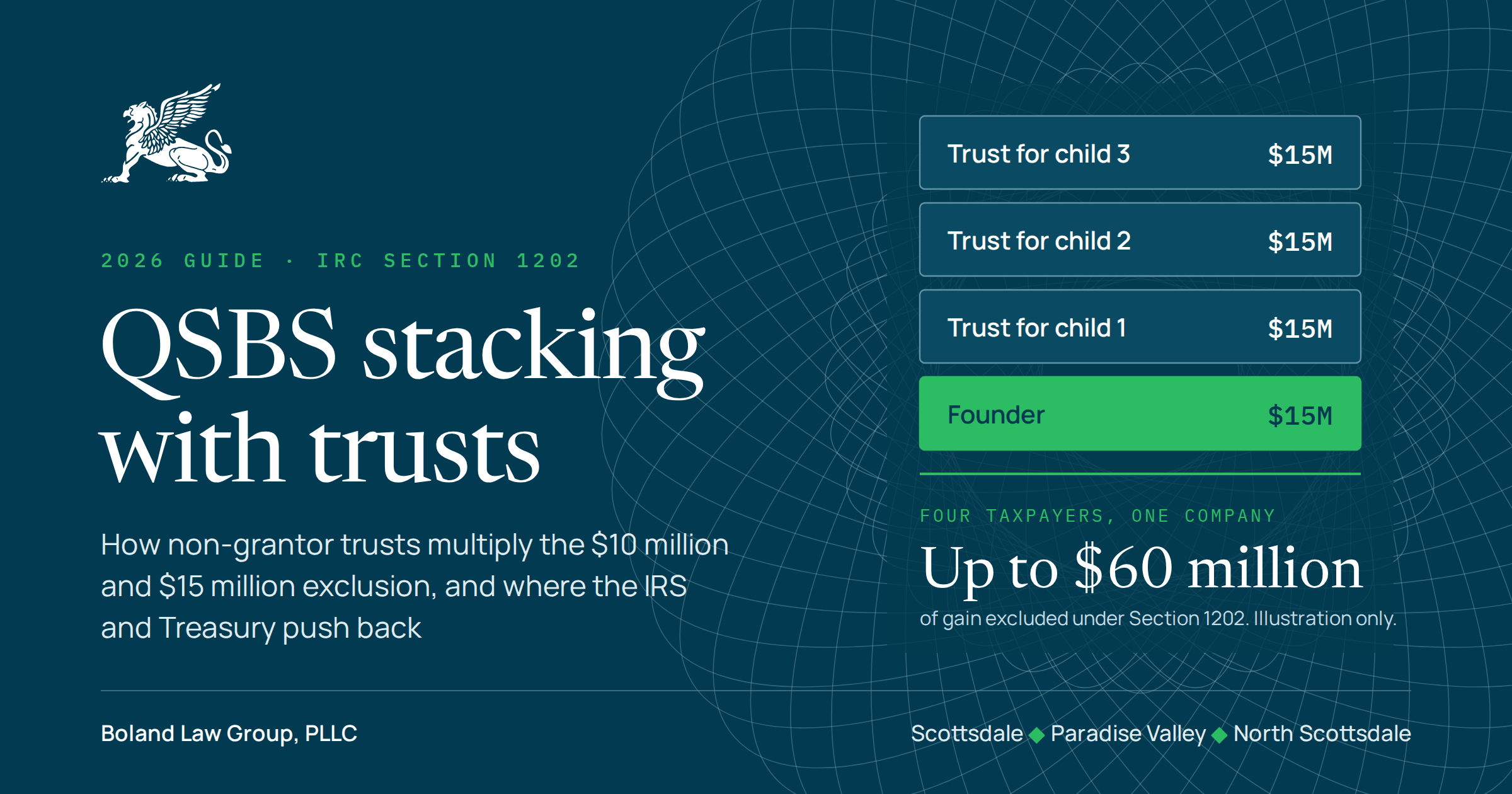
Example: A founder holds QSBS worth $30 million, acquired in 2019. Selling alone, the founder can exclude $10 million. If the founder had earlier gifted shares to three non-grantor trusts, one for each child, and kept the rest, up to four separate $10 million exclusions may be available, enough to cover the entire $30 million.[12] Each trust and the founder is a separate taxpayer, and each qualifies only if every Section 1202 requirement is met: original issuance, a domestic C corporation, the gross assets ceiling, an active qualified business, and the holding period.[1]
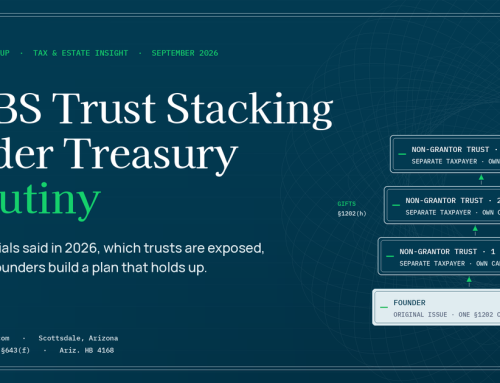
Stacking can multiply tax-free gain dramatically, but it is not without risk. Too many similar trusts, or transfers made on the eve of a sale, invite challenge under the multiple trust rule of Section 643(f) and the assignment of income doctrine.[6, 13] This guide surveys the authorities on QSBS trust planning: IRS guidance, case law, tax literature, CLE materials, and practitioner commentary, with a focus on grantor versus non-grantor trusts and the use of multiple trusts to maximize the exclusion. It is organized by source type, then brought home to Arizona.
| Term | What it means |
|---|---|
| QSBS | Qualified small business stock: stock acquired at original issuance from a domestic C corporation that meets the gross assets and active business tests of Section 1202.[1] |
| Stacking | Spreading QSBS among several separate taxpayers, typically by gift to family members and non-grantor trusts, so each claims its own per-issuer cap. |
| Packing | Making the most of the ten-times-basis cap, for example by choosing which higher-basis shares to sell in which year, or by acquiring newly issued stock in exchange for appreciated property, which Section 1202(i) values at fair market value for this purpose. Basis added after the stock was issued does not count. Some writers also use the term for spreading investments or Section 1045 rollovers across several issuers.[1, 14] |
| Non-grantor trust | An irrevocable trust that is its own taxpayer, files Form 1041, and pays its own income tax. It can have its own Section 1202 cap. |
| Grantor trust | A trust whose income is taxed to the person who created it under Sections 671 through 679. It shares the grantor's cap.[15, 4] |
| Section 1202(h) | The rule that lets stock transferred by gift, at death, or from a partnership to a partner keep its QSBS status and the transferor's holding period.[1] |
| Section 643(f) | The multiple trust rule: trusts with substantially the same grantor and primary beneficiaries, created with a principal purpose of avoiding income tax, are treated as one trust.[6] |
Which rules apply to your shares: the July 4, 2025 dividing line
The One Big Beautiful Bill Act was signed on July 4, 2025, and Section 1202 now runs on two tracks. The date you acquired the stock decides which one you are on, and a gift does not move stock from one track to the other, because the donee is treated as having acquired the stock the same way and at the same time as the donor.[1, 2] Our summaries of the Act's key takeaways and of the $15 million estate tax exemption cover the rest of the law.
| Rule | Stock acquired on or before July 4, 2025 | Stock acquired after July 4, 2025 |
|---|---|---|
| Per-issuer dollar cap | $10 million per taxpayer | $15 million per taxpayer, indexed for inflation after 2026 |
| Alternative cap | Ten times the basis of the shares sold that year | Same |
| Holding period | More than five years for any exclusion | 50 percent at three years, 75 percent at four, 100 percent at five |
| Gross assets ceiling at issuance | $50 million | $75 million, indexed for inflation after 2026 |
| Married filing separately | $5 million each | One half of the dollar cap each |
| Gift and estate tax backdrop | Exemption of $13.99 million per person in 2025 | Exemption of $15 million per person in 2026, indexed thereafter |
Sources: 26 U.S.C. § 1202 as amended; Pub. L. No. 119-21; 26 U.S.C. § 2010(c); Rev. Proc. 2024-40; Rev. Proc. 2025-32.[1, 2, 16, 17, 18] The gross assets ceiling is tested as of the date the stock was issued. The taxable part of a partially excluded gain is generally taxed at a maximum 28 percent rate rather than 20 percent.[19]
Two practical consequences follow. First, the larger gift and estate tax exemption makes completed gifts of founder stock to non-grantor trusts easier to fit within a family's lifetime exemption. Second, a family may hold both legacy and post-enactment shares of the same company, and the statute coordinates the two caps so they cannot simply be added together.[1]
Worked example: what QSBS stacking is worth
| Ownership at sale | Taxpayers | Gain excluded | Federal tax on the rest |
|---|---|---|---|
| Founder holds every share | 1 | $10 million | about $7.14 million |
| Founder keeps one quarter and, years earlier, gifted equal blocks to three non-grantor trusts, one for each child | 4 | up to $40 million | $0 |
| Additional gain excluded by stacking | $30 million | ||
| Approximate federal tax avoided at a 23.8 percent combined rate | about $7.14 million |
Illustration only. Assumes nominal basis, $10 million of gain in each holder's shares, stock held more than five years, every Section 1202 requirement met, and each trust respected as a separate taxpayer. The 23.8 percent rate combines the 20 percent maximum long-term capital gains rate and the 3.8 percent net investment income tax.[19, 20] Each gift uses lifetime gift tax exemption measured by the stock's value on the gift date, not by the gain at sale, which is why early gifts are so efficient.[16, 3] For post-enactment stock the same structure could protect up to $60 million.
The ten-times-basis cap changes the math for investors who paid real money for their shares. Because a donee takes the donor's basis, a founder who owns both low-basis common stock and high-basis preferred stock can often protect more gain by gifting low-basis shares to a trust, which will rely on the dollar cap, and keeping high-basis shares, which can use the ten-times cap. For that cap, basis is measured as of original issuance, without later additions.[1, 21, 14]
IRS guidance and commentary on QSBS trust planning
Statutory framework
Section 1202 allows the exclusion to "a taxpayer other than a corporation," which includes trusts.[1] Section 1202(h) then provides that certain transfers (by gift, at death, and from a partnership to a partner) are carryover transfers that do not disqualify QSBS. The transferee steps into the transferor's shoes for both original issuance and holding period.[1] Section 1202(h) does not require the donor and donee to share a cap. If a shareholder gifts QSBS to a family member or to a trust that is a separate taxpayer, both the donor and the donee can claim a full exclusion on their respective shares.[1, 11]
Grantor versus non-grantor trusts
The critical ruling is Rev. Rul. 85-13, which holds that when a trust is a grantor trust, the grantor is treated as the owner of its assets for income tax purposes and transactions between the grantor and the trust are ignored.[4] It follows that moving QSBS into a grantor trust is not a transfer to a new taxpayer. A sale by the grantor trust is a sale by the grantor, and no additional cap is gained.[4, 11] That covers every revocable living trust, most spousal lifetime access trusts (because the grantor's spouse is a beneficiary), and the many irrevocable trusts that are intentionally drafted as grantor trusts for estate tax reasons.[5, 22]
Planners who want to stack therefore use non-grantor trusts. Private letter rulings are not precedent, but they illustrate the distinction. In PLR 201908006 the IRS analyzed an incomplete gift non-grantor ("ING") trust: a transfer that was incomplete for gift tax purposes, to a trust that no one was treated as owning for income tax purposes.[23] The ruling does not address Section 1202, and it does not approve stacking. It shows that income tax ownership and gift tax completion are separate questions, and a stacking trust has to get the income tax answer right.
The multiple trust rule, and why you cannot get a ruling
The IRS has offered little formal guidance on how many trusts are too many.[3] Section 643(f), enacted in 1984, treats two or more trusts as one if they have substantially the same grantor and substantially the same primary beneficiaries, and a principal purpose of the trusts is avoiding federal income tax. Spouses are treated as one person.[6] For decades the statute had no regulations. In August 2018, proposed regulations issued with the Section 199A guidance would have presumed a tax avoidance purpose whenever separate trusts produced a significant income tax benefit. The final regulation, Treas. Reg. § 1.643(f)-1, was published in February 2019 without that presumption. It essentially restates the statute and applies to taxable years ending after August 16, 2018.[24, 25, 3]
The IRS treats the area as sensitive. Since 2021 its annual no-ruling revenue procedure has listed whether two or more trusts will be treated as one under Section 643(f) as a question on which it will not issue a letter ruling.[26, 8] The current list, Rev. Proc. 2026-3, goes further: it places ING trusts, and the question whether a corporation meets the Section 1202(e) active business requirement, among the areas under study on which rulings will not be issued.[8] A family cannot obtain an advance ruling that the trusts in a multi-trust QSBS plan will be respected as separate. The plan has to stand on its design: distinct trusts, distinct beneficiaries, and real purposes beyond tax.[3]
IRS administrative guidance
- Private letter rulings. Beyond the ING rulings, PLRs such as 201436001 and 201717010 address which businesses are "qualified trades or businesses," a corporate-level question rather than a trust question.[27] In PLR 202244004 (released November 4, 2022), the IRS granted an extension of time to make a late Section 1045 rollover election. Section 1045 lets a taxpayer who sells QSBS held more than six months defer gain by reinvesting in other QSBS within 60 days, and because the cap is per issuer, reinvesting in more than one company can lead to more than one cap.[28, 29, 30]
- Chief Counsel advice. In AM 2023-006, the Office of Chief Counsel rejected a marketed non-grantor trust arrangement that claimed to avoid tax by allocating gains to corpus. The memorandum does not involve Section 1202, but it shows the attention the IRS is paying to promoted trust structures.[31] Commentators warn that an expanded QSBS benefit may attract the same kind of overpromotion the employee retention credit did.[32]
- Section 1202(k). The statute directs Treasury to issue regulations to prevent avoidance of its purposes "through split-ups, shell corporations, partnerships, or otherwise." It is the authority most often cited for any future anti-stacking rule.[1, 33]
What Treasury said in 2026
On May 20, 2026, Kenneth Kies, Treasury's assistant secretary for tax policy and acting IRS chief counsel, told a tax seminar in Washington, "Let me just warn you: We don't like stacking," echoing remarks by Treasury attorney-adviser Evan Adams on May 9. Reports describe the concern as arrangements that go beyond one trust per family member.[34, 35] As of September 17, 2026, no notice, proposed regulation, or ruling has been released. Our companion article, QSBS trust stacking under Treasury scrutiny, tracks the developments and what they mean for existing trusts.
In summary, the law permits stacking: each individual donee or non-grantor trust has its own cap. But the IRS will not bless a plan in advance, and it has the tools to challenge trusts that are artificial, duplicative, or late.[6, 3]
Judicial cases on QSBS and trust planning
Few cases interpret Section 1202, and none to date squarely addresses a contested multi-trust stacking arrangement. Several decisions guide the related issues: what qualifies, who bears the burden of proof, when a gift comes too late, and how states treat the gain.
- Owen v. Commissioner, T.C. Memo. 2012-21. An early Tax Court decision on the "qualified trade or business" definition, decided under the companion rollover provision, Section 1045. The IRS argued that an insurance-marketing company was a business whose principal asset was its owners' skill. The court disagreed, even while acknowledging that the owners' talent drove the company's success.[36, 37] The taxpayer still lost the deferral, because the replacement company he funded held its assets almost entirely in cash and failed the active business requirement.[38] Owen shows both that courts will read the qualification rules fairly in close cases and that every requirement must actually be met. It did not involve a gift or a trust.
- Estate of Hoensheid v. Commissioner, T.C. Memo. 2023-34. Not a QSBS case, but the most important recent authority on timing. A shareholder gave stock to a donor-advised fund two days before the company's sale closed. The Tax Court declined to apply a bright-line "binding obligation" test. It looked at the realities of the deal, found the sale practically certain by the date of the gift, and taxed the gain to the donor under the anticipatory assignment of income doctrine.[7, 39] The lesson for founders hoping to stack is direct: a gift made once the sale is effectively locked in may simply be ignored, even though Section 1202(h) would otherwise let the donee tack the holding period.[13]
- Ju v. United States, 170 Fed. Cl. 266 (2024). Described by commentators as the first reported decision squarely applying Section 1202.[40] Dr. Ju claimed the exclusion in a refund suit and lost on part of his shares. The Court of Federal Claims held that the taxpayer bears the burden of proving the gross assets test was met through the date the stock was issued, found financial records from later years insufficient for that purpose, and rejected his argument that he had effectively held certain shares before the date his settlement agreement transferred them to him.[41] For trust planning, the point is documentation. A trustee who sells gifted QSBS years later must be able to prove facts that date from the original issuance.
- Leto v. United States (D. Ariz. 2022). An Arizona case. The business began as an Arizona limited liability company that had elected S corporation status, and it was later reincorporated as a C corporation. The court agreed with the government that the owner received his C corporation shares in exchange for stock, which fails the original issuance requirement, because what counts as "stock" is a question of federal tax law and not Arizona law.[42] Many Arizona business owners operate through LLCs. How and when a company converts to a C corporation decides whether there is any exclusion to stack.
- Aciu v. Director, Division of Taxation (N.J. Tax Ct. 2012). A New Jersey resident excluded half of her QSBS gain on her federal return and sought the same treatment on her state return. The Tax Court of New Jersey ruled for the Director of the Division of Taxation: New Jersey's gross income tax did not incorporate the Section 1202 exclusion.[43, 10] New Jersey has since changed course and allows the exclusion for tax years beginning on or after January 1, 2026.[10]
State conformity in 2026
Aciu still teaches the right lesson: the federal exclusion does not bind the states. As of September 2026, Alabama, California, Mississippi, and Pennsylvania tax QSBS gain in full. Illinois and Oregon require a full addback beginning in 2026, Maine denies the exclusion for stock acquired after July 4, 2025, and Hawaii allows only part of it.[10] California's history is often misdescribed. In Cutler v. Franchise Tax Board, the Court of Appeal struck down California's own QSBS incentive because it favored companies with California property and payroll. California does not allow a QSBS exclusion today.[44, 45] New York (since 2014) and California (since 2023) also tax the income of an ING trust to its grantor, which removes the state income tax benefit of that structure for their residents.[46, 47, 3]
The cases reinforce four principles. (1) Plan early: a transfer made when a sale is practically certain invites assignment of income.[7] (2) Prove everything: taxpayers and trusts carry the burden on every QSBS requirement.[41] (3) Check the entity history: a flawed conversion can defeat original issuance.[42] (4) Mind state law: a trust may save federal tax and still owe state tax.[10] To these, add the unresolved one: if multiple trusts look like clones created only to multiply exclusions, the IRS could seek to combine them under Section 643(f), although no reported case has yet applied that section to a QSBS stack.
Commentary in legal journals and tax publications
Tax practitioners and academics have analyzed QSBS trust strategies closely, especially as the exclusion grew in value after the 100 percent exclusion arrived in 2010 and the corporate rate fell in 2017.[3] The most useful pieces agree on the technique and differ mainly on how far it can be pushed.
- The Tax Adviser, "Qualified small business stock: Gray areas in estate planning" (Lederman and Casteel, April 2024). The article confirms that stacking is accomplished by gifting QSBS to family members and to irrevocable non-grantor trusts, each eligible for its own exclusion, and it urges early gifts, when values are low and little gift tax exemption is used. On "how many trusts are too many," it finds no bright line and treats Section 643(f) as the key constraint. Its practical advice: one trust per beneficiary, perhaps one additional pot trust for the group, documented non-tax purposes, different trustees, and distribution patterns that actually differ. It also reviews ING trusts and charitable remainder trusts as stacking vehicles, notes that New York and California tax ING income to the grantor, and flags that the treatment of excluded gain inside a charitable remainder trust's tier system is unclear.[3]
- Tax Stringer (NYSSCPA), "Estate Planning for Founders and Investors in Venture-backed Companies: Transfers of Qualified Small Business Stock by Gift" (Arlein, May 2020). A detailed treatment of Section 1202(h). It explains why a gift to a grantor trust is not a transfer for Section 1202 purposes under Rev. Rul. 85-13, why "gift" for income tax purposes is not the same as a completed gift for gift tax purposes, and how outright gifts, completed gifts to non-grantor trusts, ING trusts, GRAT remainders, and charitable remainder trusts each fit the statute.[11]
- Tax Notes Federal, "Stacking Qualified Small Business Stock: New Guidance on Anticipatory Assignment" (Karachale and Osheroff, July 24, 2023). The authors use Estate of Hoensheid to analyze when a pre-sale gift of QSBS will be recharacterized. Their recommendation is that founders not wait until the eleventh hour. Shares should move to trusts or family members well before term sheets harden into purchase agreements.[13]
- Tax Notes Federal, "Fixing the QSBS Stacking Problem" (Polsky and Yale, September 7, 2026). Two tax professors who are critics of Section 1202 urge Treasury to respond to stacking short of new legislation. The article is a useful map of where regulators may aim.[33]
- Packing and Section 1045. Discussions of stacking often travel with "packing." Because the dollar cap is per issuer, an entrepreneur with three $10 million companies has three caps, and a Section 1045 rollover into more than one replacement company can have a similar effect.[28, 30] Because the alternative cap is ten times basis, measured when the stock was issued and ignoring later additions, holders of high-basis shares plan carefully which shares to sell in which year.[1, 14]
The bottom line from the literature is that QSBS offers powerful opportunities and carries traps for the unwary. Publications stress coordination among advisers and careful compliance, and they warn that QSBS could become "a minefield if misused or overpromoted."[32]
CLE materials and conference insights (ABA, ALI-CLE, estate planning conferences)
QSBS planning has been a regular topic at continuing legal education programs, including the Heckerling Institute on Estate Planning. These forums share cutting-edge strategies and are candid about risk.
- Heckerling Institute 2019, "Qualified Small Business Stock: The Quest for Quantum Exclusions" (Lee, Comeau, Kwon, and Long). The materials catalogue the potential holders of a separate per-issuer cap (an individual, a non-grantor trust, an ING trust, a pot trust that later divides into separate trusts) and chart how QSBS status carries over on different transfers. They also discuss what happens when a grantor trust stops being one. At the grantor's death, a formerly revocable trust becomes a separate taxpayer, and a transfer at death keeps QSBS status under Section 1202(h), which raises real planning questions in trust administration.[48, 1]
- ACTEC Trust and Estate Talk, "Don't Guess and Make a Mess with QSBS" (Miller, October 2021). ACTEC Fellow Justin Miller explains the fundamentals in plain language and strongly favors non-grantor trusts for QSBS. His example is a founder who creates three non-grantor trusts for three children, giving the family four exclusions, with the trusts sited in a state that does not tax them. He also warns about the multiple trust rule: if the trusts "start to look too similar," Section 643(f) may treat them as one.[12]
- The recurring CLE advice. Divide family holdings among trusts early, and avoid cookie-cutter trusts. Five identical trusts created the same day for the same beneficiary, each funded with QSBS, is the fact pattern Section 643(f) describes. Speakers recommend different beneficiaries, different terms, staggered funding, and stated non-tax purposes for each trust.[3, 26]
These programs also discuss audit risk. Section 1202 claims were once rare. After years of large technology exits, they are not, and practitioners expect more questions about the gross assets test, the active business requirement, and returns on which several related trusts all exclude gain from the same sale.[3, 41]
Practitioner white papers and planning guides
Law firms, accounting firms, and wealth advisers have published many client guides on using trusts with Section 1202. The better ones combine the rules with field experience.
- Firm memos on stacking. A widely read series from FBT Gibbons explains that a gift of QSBS to a non-grantor trust is a transfer to a separate taxpayer, that a transfer to a disregarded entity or a grantor trust is not, and that the donee tacks the donor's holding period. It recommends gifting when value is low and well before a sale.[14]
- Risk mitigation under Section 643(f). Practitioner guides recommend separate beneficiaries for each trust, sometimes one discretionary "spray" or pot trust for a class of beneficiaries, and care not to have each spouse create a mirror-image trust for the same child, since spouses count as one grantor.[6, 3]
- State tax and residency planning. Trust situs can decide whether a trust's gain is taxed by a state. California, for example, taxes a non-grantor trust based on the residence of its trustees and its noncontingent beneficiaries, and a separate rule can tax a resident beneficiary on accumulated income when it is later distributed.[49, 50] A founder with California ties needs that analysis before relying on a stacked exclusion. See the Arizona angle below.
- Combining trust and non-trust strategies. A BDO analysis notes that non-grantor trusts can add exclusion limits while grantor trusts have their own benefits, and it recommends a break-even analysis of the two.[51] The main grantor trust benefit is that the grantor's payment of the trust's income tax is not treated as a further gift.[52] Some planners use a grantor trust first and end grantor status before a sale, which is sophisticated, unblessed by the IRS, and sensitive to timing.[48]
- Audit and compliance. Guides recommend an audit file: the corporate charter, stock purchase or subscription documents proving original issuance, financial statements or a gross assets calculation as of issuance, records of the company's activities, any company QSBS representation letter, and the gift documents, appraisals, and trust instruments. Each trust should keep its own accounts and records so that its independence is visible.[41, 40]
Common trust-based QSBS strategies
| Strategy | How it works and the Section 1202 result | Key considerations and risks |
|---|---|---|
| Outright gift to a family member | The donor gives shares directly to a child or other individual. The donee takes the donor's basis, holding period, and QSBS status, and has a separate cap.[1, 21] | Simple, but the donee owns the shares outright with no creditor or divorce protection. Must be completed well before a sale. Uses annual exclusion or lifetime exemption. |
| Completed gift to a non-grantor trust | The donor transfers shares to an irrevocable trust drafted so that no one is treated as its owner for income tax purposes. The trust is a separate taxpayer with its own cap.[1, 11] | Uses gift tax exemption. The grantor's spouse generally cannot be a beneficiary, and the grantor cannot keep powers that trigger Sections 671 through 679.[5, 22] The trust pays its own tax at compressed brackets: 37 percent above $16,000 of taxable income in 2026.[18] |
| Multiple non-grantor trusts (stacking) | One trust for each child or grandchild, funded early when values are low. Each trust has its own cap, so three trusts plus the donor can mean four caps.[12, 3] | Everything above, plus Section 643(f): differentiate beneficiaries, terms, trustees, and purposes. Spouses count as one grantor.[6, 24] This is the structure Treasury officials criticized in 2026 when it goes beyond one trust per family member.[34] |
| Incomplete gift non-grantor (ING) trust | The donor keeps enough control that the gift is incomplete for gift tax, while a distribution committee design keeps the trust a non-grantor trust. A separate cap without using exemption.[23, 3] | The IRS will not currently rule on ING trusts.[8] New York and California tax ING income to the grantor.[46, 47] The assets stay in the donor's taxable estate. Requires a state that permits self-settled trusts, which Arizona does not.[53] |
| Grantor trust now, non-grantor later (toggle) | The donor funds a grantor trust for estate freeze benefits and ends grantor status before a liquidity event, hoping the trust then has its own cap.[48] | Not addressed by the IRS. A conversion close to a sale raises the same timing concerns as a late gift.[7] |
| GRAT with remainder to a non-grantor trust | A grantor retained annuity trust shifts appreciation above the Section 7520 rate. It is a grantor trust during its term, so it has no separate cap until the remainder passes to a child or a non-grantor trust.[11, 54] | A sale during the GRAT term uses only the grantor's cap. Annuity payments may return shares to the grantor. Whether the remainder beneficiary tacks the holding period depends on the transfer qualifying under Section 1202(h), so the design needs care. |
| Charitable remainder trust | A charitable remainder trust is exempt from income tax, pays the donor or family an annual amount, and leaves the remainder to charity. Commentators treat it as another potential holder of QSBS.[55, 3] | How excluded Section 1202 gain is characterized when distributed under the four-tier rules is unsettled.[3] The remainder goes to charity, and a gift after the sale is practically certain fails for the reason Hoensheid did.[7] |
| Section 1045 rollover into several issuers | A holder who sells QSBS held more than six months reinvests within 60 days in replacement QSBS of more than one company. Each issuer carries its own cap.[28, 30] | Replacement companies must be real operating businesses that meet every QSBS test. Commentators expect rollovers into thinly capitalized shells to draw scrutiny.[1] |
Each technique has advantages and costs, and practitioners often layer them. A founder might gift some shares outright, some to a non-grantor dynasty trust, and some to a charitable vehicle. The consistent thread is that non-grantor trusts are the linchpin of stacking for family members.[12]
How QSBS stacking fits the rest of your estate plan
Stacking is an income tax technique carried out with estate planning tools, and it has to work with everything else in the plan. These are the intersections we see most often among the clients we serve.
- Your revocable living trust. Shares held in a revocable trust are treated as yours, so the trust adds no cap. At death the shares keep their QSBS status under Section 1202(h), but they also generally receive a basis step-up, so the built-in gain largely disappears either way.[1, 56] Our guide to revocable trusts, estate tax, and basis explains the step-up.
- SLATs. A SLAT is usually a grantor trust and generally shares your cap. It may still be the right home for some founder stock for estate tax reasons. See our SLAT planning guide.
- Dynasty trusts. A non-grantor dynasty trust can do two jobs with one gift: claim its own exclusion at sale and keep the proceeds outside the transfer tax system for generations. See dynasty trusts and generational planning.
- Children's trusts. One trust per child is both the most common stacking pattern and the pattern officials have signaled is least concerning.[34] Our article on children's trusts for lifetime planning covers the design choices.
- BDITs and BDOTs. A trust taxed to its beneficiary under Section 678 is, for income tax purposes, the beneficiary's own, so it generally shares the beneficiary's cap and does not add one.[57] Compare the structures in BDITs versus BDOTs.
- Family limited partnerships and LLCs. This is a trap. A contribution of QSBS to a partnership or multi-member LLC in exchange for an interest is not among the transfers Section 1202(h) protects, and leading commentary warns that it destroys the stock's qualified status.[1, 14] Founder stock usually should stay out of the family partnership.
- Life insurance. Pre-exit founder wealth is illiquid. An irrevocable life insurance trust can supply cash for estate tax or buy-sell obligations without forcing a sale of shares.
- Existing trusts that need work. Where an older trust's terms undermine non-grantor status or independence, trust modification or decanting may help, if done for sound reasons and well before any sale.
- The people around the plan. Executives with equity compensation, family offices, multi-generational families, athletes and public figures who invest in early-stage companies, and founders now planning in retirement all face versions of the same question: who should own the shares on the day of sale.
If you are starting from the beginning, the purpose of estate planning in Arizona explains what a complete plan is for, and our guide to estate planning costs in Arizona and our published rates explain what it costs.
The Arizona angle: Scottsdale and Paradise Valley founders
Arizona is a favorable place to hold QSBS. Arizona conforms to the Internal Revenue Code as of a fixed date, and H.B. 4168, signed June 13, 2026, moved that date to January 1, 2026 and adopted the 2025 federal changes, including those with retroactive effective dates.[9, 58] For most Arizona residents, gain excluded under Section 1202 on the federal return is excluded on the Arizona return as well. Confirm the result for your year of sale with your CPA. Arizona also has no estate, inheritance, or gift tax.[59]
Three Arizona points matter in trust design:
- When Arizona taxes a trust. A trust is an Arizona resident trust if at least one fiduciary is an Arizona resident. Where a corporate fiduciary engaged in interstate trust administration is the sole fiduciary, or serves with a nonresident, the trust is a resident trust only if the corporate fiduciary administers it in Arizona.[60] Because Arizona follows Section 1202, residency matters less for the excluded gain than for everything the trust earns afterward.
- No self-settled asset protection trusts. Under Arizona law a settlor's creditors can reach the maximum amount a trustee could distribute to the settlor.[53] ING trusts depend on the opposite rule, so Arizona residents who use them form them in states such as Nevada, Delaware, or South Dakota.
- Community property. Arizona is a community property state. How founder shares are titled and characterized between spouses affects who the donor is, how the gift is reported, and how the one-grantor rule for spouses applies under Section 643(f).[6]
Where Arizona families get caught is across the state line. California does not follow Section 1202 and can tax a non-grantor trust through a California trustee or a California beneficiary.[45, 49] Families who moved to Paradise Valley or North Scottsdale from California, who name a sibling in California as trustee, or whose adult children live there should review trust situs before relying on a stacked exclusion. And as Leto shows, Arizona companies that began as LLCs need a careful look at how they became C corporations.[42]
We meet founders and their advisers at our Scottsdale office in the Airpark, serve families in Carefree and across the north Valley, and work by secure video with clients elsewhere in Arizona. All of our locations and meeting options are listed on one page.
A founder's QSBS stacking checklist
- Confirm the stock qualifies. Original issuance, C corporation status, the gross assets ceiling at issuance, and the active business test throughout the holding period. If the company was ever an LLC or S corporation, review the conversion.[1, 42]
- Identify which track each block is on. Shares acquired on or before July 4, 2025 and shares acquired after it carry different caps and holding periods.[1]
- Model both caps for each holder. Compare the dollar cap with ten times basis, and decide how many separate taxpayers the expected gain actually supports.
- Start with the family, not the tax. Decide who should benefit and why. Design one trust for each real purpose.
- Draft true non-grantor trusts. Independent trustees, no spouse as beneficiary unless carefully limited, and no retained powers that create grantor trust status.[5, 22]
- Appraise and transfer early. Obtain a qualified appraisal as of the gift date and complete gifts long before any letter of intent.[7]
- Report the gifts. File Form 709 with adequate disclosure so the statute of limitations on the gift's value begins to run.[61, 62]
- Run each trust as its own trust. Separate accounts, separate records, separate trustee decisions, and a Form 1041 for each.
- Build the audit file now. Collect the issuance documents, gross assets support, and company QSBS representations while the people who can provide them are still at the company.[41]
- Coordinate the team. Your corporate counsel, CPA, and wealth adviser each hold a piece of this. We work alongside CPAs and financial advisors on exactly this kind of plan.
Conclusion
Planning with qualified small business stock can reduce or eliminate capital gains tax for entrepreneurs and investors, and trusts can multiply the savings. Grantor and non-grantor trusts play very different roles. A grantor trust keeps the stock's tax attributes with the grantor: no new Section 1202 cap, but real estate tax benefits. A non-grantor trust is a separate taxpayer eligible for its own exclusion.[4, 1] Stacking exclusions through gifts to multiple non-grantor trusts is well established in practice and rests on the statute's text: a per-taxpayer cap, an express rule preserving QSBS status for gifts, and no rule combining donor and donee.[1]
The area sits where tax policy and anti-abuse enforcement meet. Avoid carbon-copy trusts with no purpose other than tax, or Section 643(f) may be invoked.[6] Respect the assignment of income doctrine, which means transfers cannot wait for the eve of a sale.[7] The safest path is early, proactive planning: well-differentiated trusts created years before an exit, with every QSBS requirement documented.[41] Done that way, a family can legitimately turn one $10 million or $15 million exclusion into several.
Finally, stay current. Treasury has said guidance is coming, Congress changed the statute in 2025, and states keep moving.[34, 10] With careful structuring and attention to the economic reality of each trust, QSBS stacking with non-grantor trusts remains one of the most valuable tools available to a successful founder's family.
How Boland Law Group approaches QSBS planning
Boland Law Group is a Scottsdale estate planning and tax firm with a deliberately narrow practice. Both of our attorneys, Grant M. Boland and Robert W. Boland, Jr., hold LL.M. degrees, one in taxation and one in estate planning, and both are admitted to the United States Tax Court. The firm that designs the plan also handles tax controversy and litigation, and has served Arizona families for more than fifty years. That matters for stacking, because the question Treasury is now asking is the one a tax litigator asks first: how would this be defended?
Our QSBS planning for founders starts with whether the stock qualifies, then the family's goals, then the trusts. Companies that want the same judgment applied to the business itself use our outside general counsel service. You can read more about the firm or browse all of our insights.
Frequently asked questions
Short answers to the questions founders, investors, and their advisers ask us most about QSBS stacking with trusts. Each answer is general information as of September 17, 2026.
The basics
What is QSBS stacking?
QSBS stacking is the practice of spreading qualified small business stock among several separate taxpayers, usually children and non-grantor trusts, before a sale. Section 1202 caps the gain exclusion per taxpayer and per company, and Section 1202(h) lets gifted shares keep their qualified status and holding period. Each separate taxpayer can therefore claim its own $10 million or $15 million cap on the same company's stock.
How much gain can one taxpayer exclude under Section 1202 in 2026?
For stock acquired on or before July 4, 2025 and held more than five years, the greater of $10 million or ten times basis, per company. For stock acquired after July 4, 2025, the greater of $15 million or ten times basis, with 50 percent of the gain excludable at three years, 75 percent at four, and 100 percent at five. The $15 million figure is indexed for inflation beginning in 2027.
Is QSBS stacking legal?
Yes. As of September 17, 2026, stacking is permitted under current law. The statute applies its cap per taxpayer, a non-grantor trust is a separate taxpayer, and Section 1202(h) expressly protects gifted shares. Treasury officials criticized aggressive stacking in May 2026 and said guidance is being developed, but nothing has been issued. We track developments in QSBS trust stacking under Treasury scrutiny.
What is the difference between stacking and packing?
Stacking adds taxpayers, so there are more caps. Packing makes one taxpayer's cap larger, usually by increasing the ten-times-basis alternative, for example by selling higher-basis shares in the same year. Some writers also call it packing when an investor spreads money, or a Section 1045 rollover, across several companies, because the cap is per company. The two techniques are often used together.
Does a gift of QSBS restart the five-year holding period?
No. Under Section 1202(h), a person or trust that receives QSBS by gift is treated as having acquired it the same way the donor did and as having held it for the donor's holding period. The donee also takes the donor's basis. A gift likewise does not move stock from the pre-July 5, 2025 rules to the newer $15 million rules.
Choosing and designing the trusts
Does a revocable living trust get its own QSBS exclusion?
No. A revocable living trust is a grantor trust, so for income tax purposes you still own the shares and the trust shares your cap. A revocable trust remains essential for probate avoidance and incapacity planning. It simply is not a stacking vehicle.
Does a SLAT get its own $10 million or $15 million exclusion?
Generally no. A spousal lifetime access trust is almost always a grantor trust because the grantor's spouse is a beneficiary, and a grantor trust shares the grantor's Section 1202 cap. A SLAT can still be an excellent estate tax tool for founder stock. It just should not be counted as an extra exclusion.
What makes a trust a non-grantor trust?
A trust is a non-grantor trust when no one is treated as its owner under Sections 671 through 679 of the Internal Revenue Code. In practice that means it is irrevocable, the grantor and the grantor's spouse are not beneficiaries, the grantor keeps no power to swap assets, borrow without security, or control beneficial enjoyment, and distributions are controlled by an independent or adverse trustee. The trust files its own Form 1041 and pays its own tax.
How many trusts can I create for QSBS stacking?
There is no statutory number. The practical limit is Section 643(f), which treats trusts with substantially the same grantor and primary beneficiaries as one trust when a principal purpose is avoiding income tax. One trust for each child or grandchild who is a real beneficiary is the common, defensible pattern. Risk rises quickly when trusts outnumber beneficiaries or share the same beneficiaries on the same terms.
Do my spouse and I each get a separate QSBS cap?
The statute does not answer this cleanly. It cuts the dollar cap in half for a married person who files separately, and it says that on a joint return excluded gain is allocated equally between the spouses for later years. Some advisers read that as one cap per couple and others as one cap per spouse who owns shares. Until there is guidance, a careful plan does not depend on two.
Can my spouse and I each create a trust for the same child to double the exclusion?
That is unlikely to work. Section 643(f) and its regulation treat spouses as one person when asking whether trusts have substantially the same grantor. Two trusts for the same child, one created by each spouse, can be combined into a single trust with a single cap if tax avoidance is a principal purpose.
What is an ING trust, and can an Arizona resident use one?
An incomplete gift non-grantor (ING) trust is designed so the transfer is not a completed gift, which saves gift tax exemption, while the trust is still a separate income taxpayer. In practice it is formed in a state that allows self-settled trusts, such as Nevada, Delaware, or South Dakota. Arizona does not, so an Arizona resident would use an out-of-state trustee. The IRS currently will not issue rulings on ING trusts, and the assets remain in the grantor's taxable estate.
Can I put QSBS in a family limited partnership or LLC?
Be very careful. Section 1202(h) protects gifts, transfers at death, and certain distributions from a partnership to its partners. A contribution of QSBS into a partnership or multi-member LLC is not on that list, and leading commentary warns that it destroys the stock's qualified status. Founder stock should usually stay out of the family partnership.
What are the downsides of a non-grantor trust?
It pays its own income tax at compressed brackets, reaching the 37 percent rate above $16,000 of taxable income in 2026. If you pay that tax for it, the payment is an additional gift, while paying a grantor trust's tax is not. Your spouse generally cannot be a beneficiary. It typically needs an independent or adverse trustee, along with its own records and its own return every year. For expected gains far above the caps, a grantor trust can sometimes produce the better overall result.
Timing, gifts, and risk
When is it too late to gift QSBS before a sale?
There is no fixed deadline, but the Tax Court's 2023 decision in Estate of Hoensheid shows the test: if the sale is practically certain to close when the gift is made, the gain can be taxed to the donor anyway. In that case the gift was completed two days before closing. A signed letter of intent is already a warning sign. The most defensible gifts are finished years before any sale process begins.
How much gift tax exemption does a QSBS gift use?
The gift is measured by the fair market value of the shares on the date of the gift, not by the gain you expect at sale. In 2026 each person can give $19,000 per recipient under the annual exclusion (a gift in trust qualifies only if the beneficiary has a present interest) and has a $15 million lifetime exemption. Shares given when the company is young may use very little exemption and still carry a full $10 million or $15 million exclusion later. A qualified appraisal and a Form 709 are essential.
Can the IRS combine my trusts into one?
Yes, if Section 643(f) applies. It applies when trusts have substantially the same grantor and substantially the same primary beneficiaries and a principal purpose of the trusts is avoiding federal income tax. In a dispute, the taxpayer generally carries the burden of proof. Combined trusts share one cap. Different beneficiaries, different terms, independent trustees, separate administration, and documented family reasons for each trust are the defenses.
Can I get an IRS ruling approving my stacking plan?
No. The IRS lists the multiple trust question under Section 643(f) among the areas where it will not issue letter rulings, currently in Rev. Proc. 2026-3, and it has declined to rule on ING trusts and on the Section 1202 active business test while those areas are under study. A stacking plan has to rest on sound design and documentation.
What records do I need to prove QSBS status?
Keep the documents showing you acquired the shares from the company at original issuance, the company's C corporation status, a gross assets calculation as of the issuance date, evidence of the company's business activities during your holding period, any QSBS representation letter from the company, and for gifted shares the gift documents, appraisal, and Form 709. In Ju v. United States (2024), the court found the taxpayer's gross assets evidence insufficient because it covered later years and not the period through issuance, and it denied the exclusion on other shares for failing the holding period.
What happens to QSBS when the owner dies?
The shares keep their qualified status and the decedent's holding period in the hands of the estate, trust, or heir, because a transfer at death is protected by Section 1202(h). The shares also generally receive a new basis equal to their value at death, so the gain built up during life usually disappears without any need for the exclusion. Section 1202 then matters for growth after death. Trust administration should document both facts.
Arizona and state taxes
Does Arizona tax QSBS gain?
Generally no. Arizona starts with federal income and conforms to the Internal Revenue Code as of a fixed date. H.B. 4168, signed June 13, 2026, updated that date to January 1, 2026 and brought in the 2025 federal changes. Gain excluded under Section 1202 on your federal return is generally excluded on your Arizona return. Arizona also has no estate, inheritance, or gift tax.
I moved from California to Scottsdale. Will California still tax my QSBS gain?
Gain on the sale of stock is generally taxed by the state where you reside when you sell, so an established Arizona resident is generally taxed by Arizona, which follows the exclusion. The risks are a move made close to the sale, which invites a California residency audit, and a non-grantor trust with a California trustee or a California beneficiary, which California can tax. California allows no QSBS exclusion at all. Get advice from California counsel before relying on the move.
My company started as an Arizona LLC. Can my stock still qualify as QSBS?
Possibly, but the conversion is critical. In Leto v. United States (D. Ariz. 2022), an Arizona LLC that had elected S corporation status was reincorporated as a C corporation, and the owner lost the exclusion because he was treated as exchanging stock for stock, which fails the original issuance requirement. An LLC taxed as a partnership that converts properly can produce QSBS, with the holding period starting at conversion. Review the history before planning any gifts.
Working with Boland Law Group
When should a founder start QSBS trust planning?
As early as the company's value allows, and ideally years before any sale. Early gifts use less gift tax exemption, are far safer under the assignment of income doctrine, and give each trust time to operate as a real trust. If a sale is already being discussed, call before you sign a letter of intent. Our page on pre-sale and liquidity event planning explains the sequence.
Who should be on the planning team?
An estate planning and tax attorney to design and draft the trusts, your CPA to model the caps and prepare the gift tax and trust returns, a qualified appraiser, the company's corporate counsel to confirm QSBS status and handle transfer restrictions, and your wealth adviser. We regularly serve as the estate and tax bench for CPAs and financial advisors whose clients hold founder stock.
What does QSBS trust planning cost?
It depends on how many trusts are needed and how much corporate and tax diligence the stock requires. We publish our attorney fees and billable rates, and we discuss the expected cost with you before any work begins. Measured against a federal tax of roughly $2.4 million on each additional $10 million of gain, careful legal work is a small part of the result.
Related reading
- QSBS trust stacking under Treasury scrutiny (2026): what officials said and how to respond.
- QSBS under IRC 1202: 2025 versus 2026 planning after the OBBBA: the new caps, tiers, and thresholds.
- Dynasty trusts: basis, estate tax, and GST planning: the long-term home for stacked shares.
- Spousal lifetime access trusts: why a SLAT usually shares your cap.
- Children's trusts for lifetime planning: designing one trust per child.
- BDITs versus BDOTs: beneficiary-taxed trusts compared.
- Revocable trusts, estate tax, and the basis step-up: what happens to founder stock at death.
- The $15 million estate tax exemption: what it means for gifts of founder stock.
- More in QSBS and estate planning insights.
Sources and bibliography
Numbered citations in the article link to the entries below. Statutes and regulations are linked to the Legal Information Institute at Cornell Law School for convenience; the official text controls. Some journal sources require a subscription. This September 2026 revision corrects several citations that appeared in the original July 2025 version of this article.
- 26 U.S.C. § 1202, Partial exclusion for gain from certain small business stock (including § 1202(b) per-issuer limitation, § 1202(h) transfers by gift and at death, and § 1202(k) anti-avoidance regulations). Cornell LII. Back to text
- One Big Beautiful Bill Act, Pub. L. No. 119-21 (July 4, 2025) (H.R. 1, 119th Cong.). Congress.gov. Back to text
- Arielle Lederman and Heather D. Casteel, Qualified small business stock: Gray areas in estate planning, The Tax Adviser (Apr. 1, 2024). thetaxadviser.com. Back to text
- Rev. Rul. 85-13, 1985-1 C.B. 184 (transactions between a grantor and a wholly owned grantor trust are disregarded for federal income tax purposes). Back to text
- 26 U.S.C. § 677(a), Income for benefit of grantor or grantor's spouse. Cornell LII. Back to text
- 26 U.S.C. § 643(f), Treatment of multiple trusts. Cornell LII. Back to text
- Estate of Hoensheid v. Commissioner, T.C. Memo. 2023-34 (Mar. 15, 2023), discussed in The Hoensheid Case and the Assignment of Business Income for a Sale, ACTEC Trust and Estate Talk (Nov. 14, 2023). actecfoundation.org. Back to text
- Rev. Proc. 2026-3, 2026-1 I.R.B. 143, §§ 3.01(93) (Section 643(f)), 5.01(5) and 5.01(13) (incomplete gift non-grantor trusts), and 5.01(8) (Section 1202(e) active business requirement). Internal Revenue Bulletin 2026-1. Back to text
- Ariz. H.B. 4168, 57th Leg., 2d Reg. Sess. (2026), signed June 13, 2026. House bill summary (azleg.gov). Back to text
- Benjamin Aspir, Nicholas Montorio and Camille Adams, The Federal QSBS Benefit Stops at Some State Lines, EisnerAmper (Sept. 8, 2026). eisneramper.com. Back to text
- Michael S. Arlein (co-author), Estate Planning for Founders and Investors in Venture-backed Companies: Transfers of Qualified Small Business Stock by Gift, Tax Stringer (N.Y. State Society of CPAs) (May 2020). Publication page (Patterson Belknap). Back to text
- Justin Miller, Don't Guess and Make a Mess with QSBS, ACTEC Trust and Estate Talk (Oct. 19, 2021). actecfoundation.org. Back to text
- Christopher A. Karachale and Ethan Osheroff, Stacking Qualified Small Business Stock: New Guidance on Anticipatory Assignment, 180 Tax Notes Fed. 523 (July 24, 2023). Reprint (PDF). Back to text
- Scott W. Dolson, Maximizing Section 1202's Gain Exclusion, FBT Gibbons LLP (July 25, 2025; updated May 8, 2026). fbtgibbons.com. Back to text
- 26 U.S.C. §§ 671-679, Grantors and others treated as substantial owners. Cornell LII. Back to text
- 26 U.S.C. § 2010(c), Basic exclusion amount. Cornell LII. Back to text
- Rev. Proc. 2024-40 (inflation adjustments for 2025, including the $13,990,000 basic exclusion amount). irs.gov (PDF). Back to text
- Rev. Proc. 2025-32 (inflation adjustments for 2026: $15,000,000 basic exclusion amount, $19,000 gift tax annual exclusion, and the income tax brackets for estates and trusts). irs.gov (PDF). Back to text
- 26 U.S.C. § 1(h), Maximum capital gains rate (including the 28 percent rate on Section 1202 gain). Cornell LII. Back to text
- 26 U.S.C. § 1411, Net investment income tax. Cornell LII. Back to text
- 26 U.S.C. § 1015, Basis of property acquired by gifts and transfers in trust. Cornell LII. Back to text
- 26 U.S.C. § 672(e), Grantor treated as holding any power or interest of grantor's spouse. Cornell LII. Back to text
- I.R.S. Priv. Ltr. Rul. 201908006 (Feb. 22, 2019) (incomplete gift non-grantor trust). Private letter rulings may not be used or cited as precedent. irs.gov (PDF). Back to text
- Treas. Reg. § 1.643(f)-1, Treatment of multiple trusts (26 C.F.R. § 1.643(f)-1). Cornell LII. Back to text
- T.D. 9847, Qualified Business Income Deduction, 84 Fed. Reg. 2952, 3014 (Feb. 8, 2019). GovInfo (PDF). Back to text
- Using Multiple Non-Grantor Trusts for Multiple Tax Benefits, ACTEC Trust and Estate Talk (June 15, 2021) (discussing the addition of Section 643(f) to the no-ruling list in Rev. Proc. 2021-3). actecfoundation.org. Back to text
- I.R.S. Priv. Ltr. Rul. 201436001 (Sept. 5, 2014) and I.R.S. Priv. Ltr. Rul. 201717010 (Apr. 28, 2017) (qualified trade or business under § 1202(e)(3)). Private letter rulings may not be used or cited as precedent. PLR 201436001 (PDF); PLR 201717010 (PDF). Back to text
- 26 U.S.C. § 1045, Rollover of gain from qualified small business stock to another qualified small business stock. Cornell LII. Back to text
- I.R.S. Priv. Ltr. Rul. 202244004 (Nov. 4, 2022) (extension of time to make a Section 1045 election). Private letter rulings may not be used or cited as precedent. irs.gov (PDF). Back to text
- George F. Bearup, Qualified Small Business Stock Update, Greenleaf Trust (Apr. 26, 2023). greenleaftrust.com. Back to text
- Office of Chief Counsel, I.R.S., Generic Legal Advice Memorandum AM 2023-006 (Aug. 18, 2023), summarized in Chief Counsel Discusses Trust Structure Marketed as a Tax Shelter, Thomson Reuters Tax & Accounting (Nov. 16, 2023). tax.thomsonreuters.com. Back to text
- The OBBBA and QSBS: Opportunities and risks involving 1202, RSM US LLP (July 25, 2025). rsmus.com. Back to text
- Gregg D. Polsky and Ethan Yale, Fixing the QSBS Stacking Problem, 192 Tax Notes Fed. 1769 (Sept. 7, 2026) (subscription required); excerpt at TaxProf Blog. Back to text
- Paul B. Myers, Samuel Olchyk and Moshe Golombeck, QSBS Stacking in the Crosshairs?, Venable LLP (May 28, 2026). venable.com. Back to text
- IRS to Target Stacking Under Qualified Small Business Stock Rules, CBIZ (May 26, 2026). cbiz.com. Back to text
- Owen v. Commissioner, T.C. Memo. 2012-21. Back to text
- Section 1202: A Big Deal for Small Business, ABA Tax Times, American Bar Association Section of Taxation. americanbar.org. Back to text
- The §1045 Cash Box Trap: QSBS Working Capital Rules (discussing the failed rollover in Owen), The Startup Law Blog (2026). thestartuplawblog.com. Back to text
- Helvering v. Horst, 311 U.S. 112 (1940). Justia. Back to text
- Documentation is Key When Claiming QSBS Benefits, Keating Muething & Klekamp PLL (Apr. 25, 2025). kmklaw.com. Back to text
- Ju v. United States, 170 Fed. Cl. 266 (2024), discussed in QSBS Holding Period and $50 Million Test in Ju vs. United States: A Patent Oversight, Hanson Bridgett LLP (Apr. 8, 2024). hansonbridgett.com. Back to text
- Leto v. United States, No. CV-20-02180-PHX-DWL (D. Ariz. 2022), discussed in T.W. Langevin, Leto v. United States: How a Taxpayer's Section 1202 Exclusion Could Have Been Saved, Keating Muething & Klekamp PLL (May 15, 2024). kmklaw.com. Back to text
- Aciu v. Director, Division of Taxation (N.J. Tax Ct. 2012). FindLaw. Back to text
- Cutler v. Franchise Tax Board, 208 Cal. App. 4th 1247 (2012). Back to text
- California Franchise Tax Board, 2024 Instructions for California Schedule D (540), Qualified Small Business Stock. ftb.ca.gov. Back to text
- N.Y. Tax Law § 612(b)(41) (income of an incomplete gift non-grantor trust included in the grantor's New York income). nysenate.gov. Back to text
- Cal. Rev. & Tax. Code § 17082 (incomplete gift non-grantor trusts). California Legislative Information. Back to text
- Paul S. Lee, L. Joseph Comeau, Julie Miraglia Kwon and Syida C. Long, Qualified Small Business Stock: The Quest for Quantum Exclusions (Queries, Qualms, and Qualifications), 53rd Annual Heckerling Institute on Estate Planning (2019). Back to text
- Cal. Rev. & Tax. Code § 17742 (taxation of trusts based on residence of fiduciaries and noncontingent beneficiaries). California Legislative Information. Back to text
- Cal. Rev. & Tax. Code § 17745 (taxation of a resident beneficiary on distributed trust income on which California tax was not paid). California Legislative Information. Back to text
- Abbie M.B. Everist, Blake Head and Justin Tu, ESOPs Offer Tax-Efficient Business Succession in an Estate Plan, BDO USA (Aug. 26, 2024) (originally published by Bloomberg Tax). bdo.com. Back to text
- Rev. Rul. 2004-64, 2004-2 C.B. 7 (a grantor's payment of income tax attributable to a grantor trust is not a gift to the trust beneficiaries). Back to text
- A.R.S. § 14-10505, Creditor's claim against settlor. azleg.gov. Back to text
- 26 U.S.C. § 2702, Special valuation rules in case of transfers of interests in trusts (grantor retained annuity trusts). Cornell LII. Back to text
- 26 U.S.C. § 664, Charitable remainder trusts. Cornell LII. Back to text
- 26 U.S.C. § 1014, Basis of property acquired from a decedent. Cornell LII. Back to text
- 26 U.S.C. § 678, Person other than grantor treated as substantial owner. Cornell LII. Back to text
- Arizona Updates IRC Conformity Date to January 1, 2026, Forvis Mazars (July 10, 2026). forvismazars.us. Back to text
- Arizona Department of Revenue, Publication 900, Estate Tax (rev. Sept. 2006). azdor.gov. Back to text
- A.R.S. § 43-1301, Definitions; estates and trusts (resident trust). azleg.gov. Back to text
- Internal Revenue Service, About Form 709, United States Gift (and Generation-Skipping Transfer) Tax Return. irs.gov. Back to text
- Treas. Reg. § 301.6501(c)-1(f), Adequate disclosure of gifts. Cornell LII. Back to text
Related reading from Boland Law Group: QSBS stacking under Treasury scrutiny, QSBS after the OBBBA, dynasty trusts, high net worth estate planning, and all insights.
Important legal notice
Please read this notice before relying on anything in this article. By reading this article you acknowledge the following.
Information only, not advice
This article is general educational information about federal and state tax law and estate planning. It is not legal, tax, accounting, investment, or financial advice, and it is not a substitute for advice from a qualified professional who knows your facts. Do not act, or refrain from acting, based on anything in it.
No attorney-client relationship
Reading this article, using this website, calling, emailing, or submitting a form does not create an attorney-client relationship with Boland Law Group, PLLC or any of its attorneys. A relationship is formed only after a conflict check, a written engagement letter signed by the client and the firm, and payment of any required fees, as described in our Terms of Engagement. Until then, please do not send confidential information; anything you send may not be treated as privileged or confidential.
Not a tax opinion; not for penalty protection
This article is not a tax opinion or written tax advice on which any person may rely. It was not written to be used, and cannot be used, by any person to avoid penalties that may be imposed under the Internal Revenue Code or any state or local tax law, or to establish reasonable cause, good faith, or reliance on professional advice for any tax position. It is not an offer, solicitation, promotion, or recommendation of any transaction, investment, trust structure, or tax strategy.
No guarantee of any outcome
No result is promised or guaranteed. The Internal Revenue Service, the Treasury Department, state tax agencies, and courts may disagree with any view expressed here, may challenge transactions of the kind described, and may apply existing law or new guidance, including guidance with retroactive effect, in ways that increase tax, interest, or penalties. Whether any structure succeeds depends on specific facts, documentation, timing, and administration.
The law changes; no duty to update
This article was first published July 31, 2025 and was substantially revised to reflect statutes, regulations, public statements, and reporting known to us as of September 17, 2026. Tax law, agency guidance, and state conformity change frequently and sometimes without notice. We have no obligation to update this article, and information that was accurate when written may later become inaccurate.
Third-party statements and links
Statements attributed to government officials, courts, commentators, and publications are summarized from the public sources listed above, some of which report remarks secondhand. Summaries of cases, rulings, and articles are ours and are necessarily incomplete; read the original before relying on it. We do not control, endorse, or guarantee the accuracy, completeness, or availability of any third-party content or link.
Examples are hypothetical
Examples, tables, figures, and tax rates are simplified illustrations only. They are not projections, estimates, or promises of any tax savings, and your actual results will differ.
Jurisdiction
Our attorneys are admitted to practice before the Supreme Court of Arizona, the United States Tax Court, and the United States District Court for the District of Arizona. Discussion of other states' laws, including California, New York, and New Jersey, is general in nature; consult counsel licensed in that state. This article is not intended to solicit clients in any jurisdiction where doing so would not comply with applicable rules.
Limitation of liability
To the fullest extent permitted by law, Boland Law Group, PLLC and its attorneys and staff disclaim all liability for any loss, damage, tax, interest, penalty, or expense arising from any use of, or reliance on, this article or any linked content. Your use of this website is also subject to our Privacy Policy.
Attorney advertising
This article may be considered attorney advertising under applicable rules of professional conduct. Responsible attorney: Grant M. Boland, J.D., LL.M., Boland Law Group, PLLC, 15100 N. 78th Way, Suite 203, Scottsdale, Arizona 85260, (480) 420-8268.